





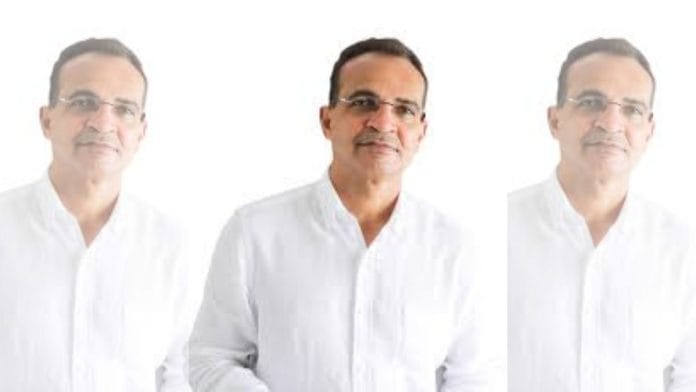



New Delhi: Bringing to a close a high-profile POCSO case involving a sitting minister, a special court in Goa acquitted state cabinet minister Atanasio ‘Babush’ Monserrate and co-accused Rosaria alias Rosy Ferros of all charges, including rape, saying the prosecution failed to prove the victim’s minor status at the time of the alleged offence.
The case, stemming from a 2016 FIR, involved allegations of drugging and sexually assaulting a minor, but the court Wednesday concluded that the prosecution failed to establish the “foundational facts” of the crime. The chargesheet was filed in 2018.
Monserrate, now 64, was arrested on 5 May 2016 and granted bail days later on 18 May, while Rosy Ferros spent 11 days in jail at the same time. Monserrate was one of 10 members of the Congress party who joined the BJP in July 2019.
“The most vital fact which was required to be proved by the prosecution is the age of the victim at the time when offence was committed,” Merces sessions judge Irshad Agha said in a 200-page judgement.
“The prosecution in the present case has failed to prove that accused no.1 had sexual intercourse with the victim girl and that the age of the victim girl was below 16 years. Prosecution has failed to prove the age of the victim,” he concluded.
The police’s case was built on the allegation that the two accused acted with common intention to exploit the minor victim.
The specific charges included rape and penetrative sexual assault under the erstwhile Indian Penal Code (IPC) and POCSO Act sections.
The accused were also charged with wrongful confinement, criminal intimidation under the IPC and child pornography under Section 67B of the Information and Technology Act, 2000, for the alleged transmission of nude photographs.
Rosy Ferros was accused of enticing the victim with gifts and inducing her to send “dirty pictures” to Monserrate by threatening her family.
It was further alleged that the victim was taken to a farmhouse, given a “stupefying” drink, and sexually assaulted while unconscious.
Also Read: Why Punjab & Haryana High Court suspended a convict’s 20-year sentence in POCSO case
Victim’s retraction: A ‘figment of imagination’
The case, according to the judge, largely collapsed due to the testimony of the victim, who turned hostile during the trial. The court noted that “she has taken a summersault” in one of her statements.
In a 180-degree-turn in cross-examination, she said that the complaints she had filed were a “figment of imagination” and there was “no truth in the same”.
She testified that her initial statements were made out of “frustration and depression” while she was being kept at the state-run shelter, Apna Ghar, where she felt “mentally tortured”.
She further stated that the allegations were a “false story” and that “nothing untoward” had happened at the farmhouse.
The court also noted that the victim was “told by the NGO that all that had happened, had appeared in the newspaper and if she backs out, everybody will think that she is a liar”.
Failure to prove her minor age
A critical requirement under the POCSO charges was proving that the complainant was a “child” (under 18) at the time of the offence. The prosecution contended she was 14, but the court found this unproven.
Medical experts, including a radiologist and a forensic professor, conducted an ossification test and estimated her age to be between 17 and 18 years.
The court said experts admitted that such tests have a margin of error of approximately two years.
Based on physical examination findings, assessment of radiological and dental age, the court concluded that the girl’s age was between 17 and 18 years.
Citing court precedents, the judge noted that when two views are possible, the “benefit of doubt” must go to the accused. In other words, her age could have legally been considered over 18.
The court highlighted several “glaring inconsistencies” in the evidence and investigative procedures.
It found the attachment and extraction of data from mobile phones to be unreliable. Forensic experts used unlicensed software and failed to record hash values, which are essential “digital fingerprints” to prove that electronic evidence has not been tampered with.
The victim provided varying accounts of whether she was conscious or unconscious, who dropped her off at the farmhouse, and which car was used.
It said that no medical evidence conclusively linked Monserrate to the alleged act. A bedsheet seized from the farmhouse contained semen stains, but the prosecution failed to prove they belonged to the accused or were connected to the incident, the court said.
Concluding that the prosecution failed to meet the standard of “sterling quality” evidence required for a conviction, Judge Irshad Agha ordered the acquittal of both accused on all counts.
(Edited by Sugita Katyal)
Also Read: From child protection to ‘moral policing’ tool: How POCSO Act is leaving courts conflicted