








An Indian government panel has proposed a sharp reduction in the share of food prices used to determine retail inflation, a move that could help the central bank conduct monetary policy more effectively.
The expert committee of the Ministry of Statistics and Programme Implementation recommended paring back the weight of food and beverages in the consumer price index to 36.75 from the current 45.86. It also proposed eliminating some items from the existing series, clubbing them with other major heads and increasing their combined weight in the new index. The panel, however, suggested excluding free food distribution from the CPI calculation.
“In the proposed new series, weight of core inflation has increased from the old series, whereas food and beverages weight reduces,” said Gaura Sengupta, economist with IDFC First Bank.
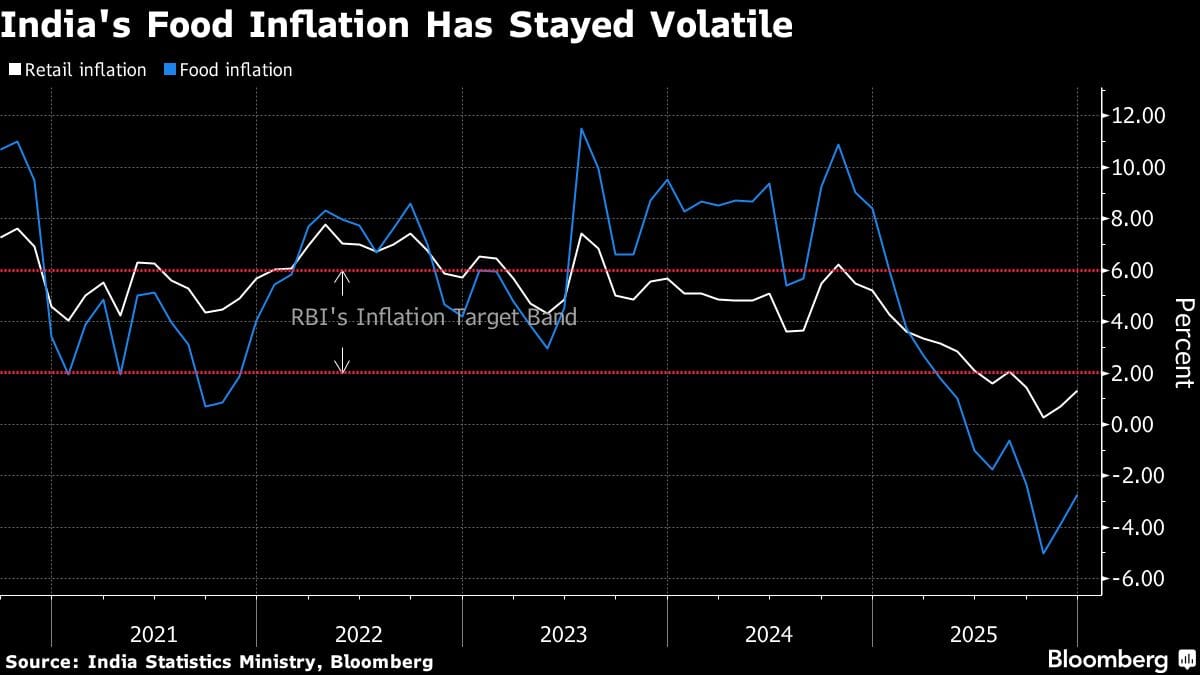
Food prices, which account for nearly half of India’s consumer price index basket, have remained highly volatile in recent years, driving sharp swings in headline inflation and contributing to repeated forecast misses by the Reserve Bank of India. With food inflation largely beyond the influence of interest-rate changes, monetary policy has had limited traction in smoothing price pressures.
The new CPI series is expected to be released on Feb. 12, according to the Economic Survey for fiscal year 2025-26. It will be rebased to 2024 from 2012 in the current series. Bloomberg previously reported that an expert panel was considering a sharp reduction in the food weight.
The panel suggested assigning a weight of 17.66 to “housing, water, electricity, gas and other fuels.” That compares with 10.07 for housing and 6.84 for fuel and light as separate categories in the current series, which was last revised more than a decade ago.
Reducing the food weight would have important ramifications for the Reserve Bank of India’s monetary policy. The central bank targets CPI as its primary inflation gauge and seeks to keep it within a government-mandated range of 2% to 6%.
–With assistance from Pratigya Vajpayee.
Disclaimer: This report is auto generated from the Bloomberg news service. ThePrint holds no responsibility for its content.
Also read: Economic Survey 2025-26: The top 10 takeaways for India