





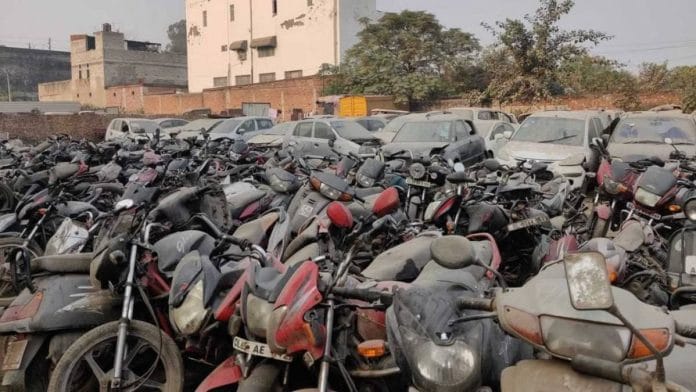



New Delhi: India is staring at a severe problem on its roads with end-of-life vehicles (ELVs) expected to touch nearly 50 million by 2030, from 23 million by 2025-end, with no clear exit strategy, warns government think-tank NITI Aayog in a report, stating that systems that are meant to test, scrap and recycle these vehicles are falling behind the scale of the challenge.
In the report, ‘Enhancing Circular Economy of End-of-Life Vehicles in India’, released last week, NITI Aayog states that older vehicles are not just a safety risk but also a major source of pollution.
“Emissions from older vehicles are significantly more polluting, up to eight times more in the case of BS-I vehicle as compared to BS-VI emission standard vehicle,” it says.
End-of-life vehicles are those that are no longer validly registered, declared unfit by an authorised automated fitness centre or road transport officer, and are voluntarily declared as waste by their legitimate registered owner.
Launched in 2021, the government’s vehicle scrappage policy aims to phase out old and polluting vehicles through a structured ecosystem of Automated Testing Stations (ATS) and Registered Vehicle Scrapping Facilities (RVSF). Private vehicles more than 20 years old and commercial vehicles more than 15 years old must clear fitness tests or be deregistered and scrapped.
The policy also offers incentives such as scrap value, fee waivers and tax rebates (up to 25 percent for non-transport vehicles and 15 percent for transport vehicles) to encourage voluntary scrapping.
However, the NITI Aayog report states that “the current ELV scrapping landscape in India continues to face several challenges in developing a well-functioning scrapping ecosystem”.
Limited availability of ATS, non-existent and underutilised RVSF and complex procedural requirements for de-registration are underlined as key constraints.
These challenges, it adds, are made worse by “the widespread presence of an unregulated informal scrapping sector, which operates at lower costs and offers attractive bids to vehicle owners”.
Based on vehicle registration data and testing norms, it is estimated that India will require around 500 ATS by 2027. Against this, the existing infrastructure leaves a shortfall of 344 ATS, raising concerns about whether the system can handle the volume of vehicles that needs to be tested and potentially scrapped.
RVSFs across the country are operating at sub optimal capacity due to insufficient inflow of ELVs. “A substantial proportion of ELVs continues to be diverted to informal channels, driven by lack of awareness, weak enforcement of de-registration norms, and absence of strong economic incentives for owners to opt for formal scrapping,” the report states.
For instance, informal scrappers tend to offer a higher price—ranging between Rs 15,000 to Rs 20,000 more for a mid-range vehicle such as the Suzuki Swift Dzire— compared to formal entities, it adds.
In the current scrapping system, the de-registration of vehicles happens with or without authorised scrapping facilities. Many vehicles remain officially registered even after being scrapped, as there is no penalty on owners who do not complete de-registration. When vehicles are scrapped informally, transport authorities cannot verify it, leaving legal responsibility with the registered owner.
Also Read: What’s the new vehicle scrappage policy that will create 35,000 jobs & help ‘circular economy’
NITI Aayog recommendations
To improve the scrappage ecosystem in India, the think-tank calls for a coordinated approach that focuses on rapid infrastructure rollout, sector formalisation, procedural simplification, and awareness campaigns.
The report recommends setting up of one ATS per district in states or union territories with limited vehicle population and no existing scrapping ecosystem. “ATS and RVSFs to be established on a time-bound basis. PSU-led models with private operations may be explored to ensure broader geographic coverage,” it says.
To overcome financial stress in the formal scrapping sector, which struggles to compete with informal operators, NITI Aayog recommends formalising the spare parts trade linked to ELVs, higher mandated recovery rates and transparency in value realisation.
To address the issues with de-registration and paperwork, the report recommends that vehicle de-registration should happen only upon submission of a valid certificate of deposit issued by RVSFs.
It also calls upon the transport ministry to “explore legal obligation on vehicle owners to initiate compulsory deregistration of ELVs to ensure responsible disposal and formal processing”.
Finally, the report stresses upon awareness. It says there is “lack of consumer awareness” about formal scrapping and its benefits, and calls for targeted outreach.
“A list of RVSFs and ATS to be displayed on the website of all regional transport offices (RTOs), central and state transport departments,” the report suggests.
(Edited by Nida Fatima Siddiqui)
Also Read: A new automobile scrappage policy is needed. Link it with emissions