


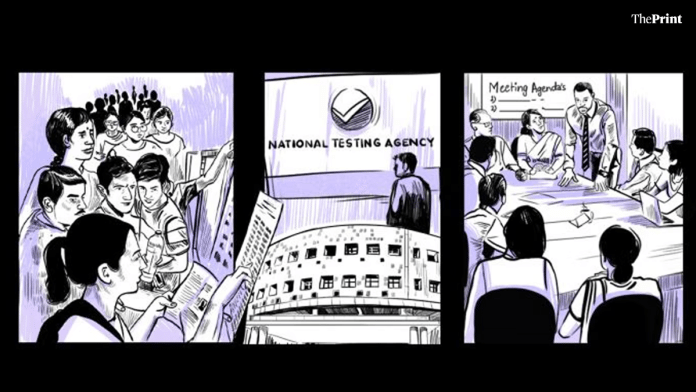
New Delhi: The National Testing Agency (NTA) is undergoing its biggest institutional overhaul since it was set up almost a decade ago, with the central government planning to nearly double its staff strength and set up regional offices. On its part, the agency is building subject-specific question banks and tightening systems for selection of experts and translation of question papers.
The proposed overhaul, coming in the wake of this year’s NEET-UG paper leak, also includes expanding the network of computer-based examination centres, strengthening the agency’s governing body by inducting more experts and introducing stricter checks on the selection of subject matter experts involved in setting and vetting question papers.
The changes come as a government-appointed high-level committee headed by Infosys co-founder Nandan Nilekani is holding consultations with state governments before submitting its final report on entrance examination reforms in January.
The panel was constituted against the backdrop of the NEET-UG 2026 paper leak, which exposed gaps in examination security and centre-level monitoring.
Also Read: Exclusive: How NTA subject experts leaked NEET-UG paper—‘questions on chits, marked NCERT paras’
Doubling National Testing Agency strength
Currently, the National Testing Agency, which conducts most of the country’s biggest entrance and eligibility examinations, including NEET-UG, JEE Main, CUET-UG and UGC-NET, has a regular staff strength of around 50 people, while its contractual workforce numbers nearly 200, according to government officials.
“Considering the number of exams it conducts involving lakhs of students, the staff strength is meagre. The number of permanent employees is very few. There is a need to double the current staff strength and increase the number of permanent employees,” said a senior government official, who did not wish to be named.
The Ministry of Education, it is learnt, has already moved a Cabinet note in this regard.
The Nilekani-led high-powered task force set up to reform competitive exams too has pitched for doubling the NTA’s current staff strength, the official told ThePrint, adding, “A major revamp is happening.”
The Nilekani panel is also in favour of expanding the agency’s functional verticals.
The seven-member Radhakrishnan committee, constituted in the aftermath of the localised leak of the NEET UG 2024 question paper, had recommended restructuring the NTA into 10 specialised verticals. Its suggestion was that each vertical handle a distinct function such as technology and digital infrastructure, examination-centre management, research and development, information security, test security and surveillance, vigilance and forensics, and human resources. The aim was to build dedicated teams with specialised expertise for different aspects of examination management.
Besides, the Nilekani panel is also of the view that NTA should have a regional presence similar to what the Staff Selection Commission (SSC) and Central Board of Secondary Education (CBSE) has. “Right now, NTA does not have regional offices in the states. It is felt that having regional centres will help in better coordination for administrative work. It will make the system more robust,” the official said.
The central government is also in the process of strengthening the NTA general body. “More experts will be roped in,” the official said.
This comes alongside the agency’s efforts to rebuild its panel of subject matter experts after removing around 600 experts following the NEET-UG 2026 paper leak. The NTA has introduced a four-stage vetting process for fresh applicants, involving assessment of subject knowledge, verification of credentials, background checks and confidentiality undertakings.
In July this year, the central government had informed the Rajya Sabha that 15 of the 39 posts in the National Testing Agency were vacant. The reply also revealed that the NTA had at the time engaged 73 officials on contract, alongside 124 outsourced personnel.
Subject-specific question vaults
According to officials, the Nilekani panel is of the view that paper leaks can be reduced substantially if one can reduce the economic value of a question paper. “If we create a system where the individual question maker’s contribution is of no economic value, chances of paper leaks will reduce automatically,” a second official said.
With this in mind, the Nilekani panel has proposed setting up subject-specific question vaults, a recommendation that the committee is yet to formally submit in its report. For instance, the biology question bank would have a few hundred questions set up by a large number of subject matter experts.
There will be similar question vaults for other subjects. For each subject, experts will be roped in round the year to frame the questions. Once a subject matter expert gives their list of questions, another set of experts will decide which questions to select. “This way the individual who framed the questions will also not know which of the questions they provided are being selected. The individual’s contribution will have no economic value,” the first official said.
The NTA, the official added, has started working on creating a consolidated question bank.
Elaborating on how the question bank will work, the official said, “An hour before the exam starts, at the NTA headquarters in Delhi, an authorised person will draw the questions for the exam using the prescribed software and transmit them electronically to the different centres. Soon after transmitting, [the NTA will] disconnect the server from the internet and conduct the exam,” the official said.
The first official added that currently the process of translation of question papers also introduces a vulnerability into the system. “The Nilekani panel is proposing that the questions should be translated into the prescribed languages at the time of framing and put in the question vault. When the exam starts, the candidates will get the questions in the language they have opted for.”
Also Read: Exclusive: In CBI chargesheet, details of how NTA ‘shortcomings’ set stage for NEET paper leak
One exam centre in each district
The National Testing Agency, it is learnt, has invited government, aided and private schools, colleges, universities, and institutions such as IITs, NITs, IIMs, IISERs, AIIMS and ITIs to serve as examination centres. “We are aiming for at least one centre in each district. In case the May 2027 NEET-UG is held online, there should be enough centres,” a senior NTA official told ThePrint, requesting anonymity.
The agency has decided that each new examination centre must have at least 285 fully functional computer workstations. “Besides, centres will also be required to have an adequate number of buffer computers. They have been asked to ensure at least four hours of power backup, as examinations conducted in the CBT (Computer-Based Test) format have faced disruptions in the past due to power outages, particularly in rural areas,” the senior NTA official said.
The NTA is also tightening security requirements, with centres required to ensure complete CCTV coverage of key areas, including entrances, reception and verification areas, frisking enclosures, examination halls, corridors and waiting areas. “The CCTV cameras must be of high-definition quality, with recordings retained for at least 30 days. The feeds must also be available for live remote monitoring by the NTA,” the senior NTA official added.
10 original MCQs from new subject experts
This year, the agency has also tightened its empanelment process for subject matter experts who help set and vet entrance examination papers, making the submission of 10 original, unpublished multiple-choice questions (MCQs), along with answer keys, mandatory for new applicants.
According to officials, the NTA will keep the application process open throughout the year, with no fixed closing date. Applications will be assessed periodically, depending on the agency’s requirements.
“The agency has already started a stricter vetting process for subject experts. However, asking applicants to submit at least 10 original MCQs is a new requirement introduced this year. The agency may also prefer experts with PhDs in their respective subject domains,” another senior NTA official told ThePrint.
The agency had in September announced a stricter four-stage vetting process that includes subject-matter assessment, verification of credentials, background checks and a detailed confidentiality undertaking.
Review of AI-assisted translation
After announcing AI-assisted question-paper translations in September, the National Testing Agency is now building a pool of human reviewers to verify them.
The move follows translation errors flagged in JEE Main 2025 and UGC-NET 2026, where an NTA-appointed panel recommended re-examinations in three subjects.
“The reviewers will play a key role in NTA’s revised translation process, under which an AI-based platform will undertake bulk translation of examination questions, while human experts will check the output for accuracy, subject-specific terminology and linguistic clarity. One cannot completely rely on the AI translations,” said the NTA official quoted above.
(Edited by Amrtansh Arora)