





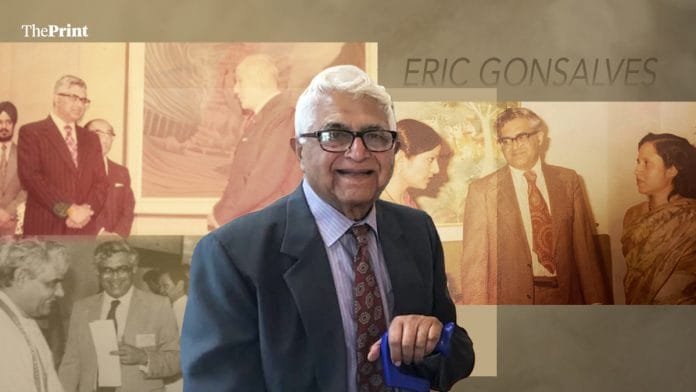



New Delhi: Fifty-five years ago, as a 42-year-old joint secretary (South) in the external affairs ministry, Eric Gonsalves was involved in India’s diplomatic efforts around the fate of erstwhile East Pakistan amid the violence unleashed by the Pakistani military at the start of Operation Searchlight.
Gonsalves, a part of India’s second-ever batch of foreign service officers, passed away Sunday in a hospital in Bengaluru at 97.
In 36 years of service, Gonsalves served in Korea, the US (twice), the United Kingdom, Belgium, and Japan, in addition to his postings across the ministry in New Delhi.
The former Indian diplomat’s oral record of service, published by in 2010 by Indian Council of World Affairs, highlights a long tenure that began as the newly launched Indian Foreign Service started taking shape under Prime Minister Jawaharlal Nehru.
During his posting abroad, Gonsalves, then a 35-year-old diplomat, helped organise the evacuation of roughly 3,00,000 Indians from Rangoon (present-day Yangon) in 1963-64, as the Burmese dictatorship under Ne Win scapegoated the community for an economic crisis facing the Southeast Asian nation.
Along with Alan Nazreth, second secretary at the embassy at the time, Gonsalves received almost two crores worth of gold and jewellery from fleeing Indian families, as the Burmese government banned evacuees from travelling with such items.
The embassy deposited the jewellery into a bank, forcing the then-Burmese government to acknowledge the legal claim of the Indians leaving the country over the items. For a large part of his tenure, he served as the charge d’affaires, according to his own recollection, eventually receiving an official farewell or sending-off—normally given to departing ambassadors—from the Burmese foreign affairs ministry.
As deputy secretary (establishment) between 1958 and 1961, Gonsalves drafted the Pay, Leave and Compensatory Allowances (PLCA) Rules of 1961, which the Indian Foreign Service has used since then. He built on his experiences from his earliest postings at the Neutral National Repatriation Commission in Korea, as well as his posting as vice consul in India’s Consulate General in New York and second secretary at the High Commission in London.
In 1979, he was a part of Atal Bihari Vajpayee’s delegation to China as secretary (East)—the first delegation by an Indian External Affairs Minister in almost a quarter of a century—before he eventually retired as the ambassador of India to Belgium, the European Economic Community (EEC), and Luxembourg in 1986.
Washington and PL480 debts
Gonsalves landed in Washington, DC, as minister (political) in mid-January 1972, only a few weeks after India helped liberate Bangladesh in December 1971. The US had taken Pakistan’s side during the conflict, when President Richard M. Nixon sent the Seventh Fleet, led by USS Enterprise, to the Bay of Bengal to threaten New Delhi.
“The posting to Washington began at the time of the Nixon tilt. We were in the dog house, and I remember a sharp exchange with the Deputy Secretary of State in the early days about some statement by the Government of India,” Gonsalves said, while recording his oral history to diplomat Kishan S. Rana at the ICWA.
He added, “I was called in by the special assistant for South Asian affairs in the National Security Council, which is part of the White House, to say that they wanted to take up the question of the accumulated PL480 funds. These were rupee deposits held by the US embassy in the Reserve Bank, which represented the sale proceeds of aid from the US, mainly in the form of food.”
The PL480 scheme enabled the flow of essential food items, primarily surplus US grains, to India. The Indian government paid for it using rupees held in an account by the American embassy in India. By the mid-1970s, $3 billion had accumulated, requiring negotiations for an eventual write-off.
These negotiations were held amid tensions between the two governments, and eventually, in 1974, the US administration handed over a $2.03 billion cheque to New Delhi as a grant for agricultural development and social welfare projects. The rest was left for the general expenses of American diplomatic missions in India.
“The PL480 agreement was a landmark in Indo-US relations, coming as it did so soon after Bangladesh. It set the climate for some other significant collaborations in science and space and elsewhere. It displayed the essential pragmatism in American policy making,” recalled Gonsalves in the ICWA publication.
(Edited by Madhurita Goswami)
Also Read: Understaffed MEA slowing down India’s sprint towards ‘Vishwa Guru’ status, but needle may be moving