





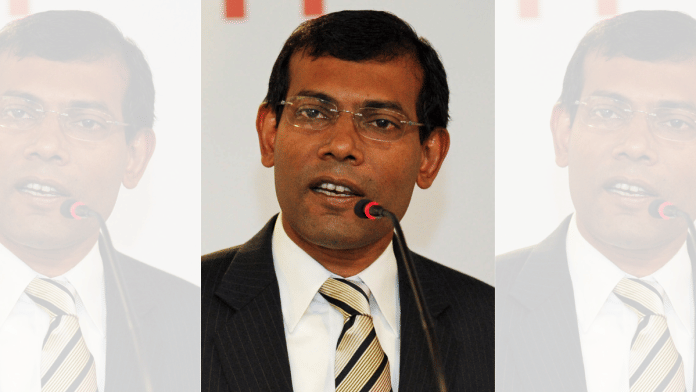



New Delhi: Amid the widening West Asia conflict triggered by US-Israel joint strikes on Iran, former Maldives president Mohamed Nasheed on Wednesday said that building democratic structures and institutions can bring “change” in a country, and “not bombing”.
Interacting with PTI on the sidelines of a conclave here, Nasheed also said that while the old world order is changing and a new one is emerging, “it doesn’t look like the United States is the leader of the free world”.
The West Asia conflict began after the US-Israel combine pounded Iran on February 28, and Tehran, in retaliation, attacked several Gulf countries hosting American military bases, impacting global aviation operations, oil prices and triggering a looming energy crisis.
During the interaction, Nasheed shared how the conflict has impacted the Maldives, a country heavily dependent on inbound tourism for its economy.
“Well, we rely on tourism; that is our biggest strength. And when travel hubs are disrupted throughout the Middle East, such as Dubai and Doha, it has a big impact on tourist arrivals, which is now down by about 30 per cent in the Maldives,” Nasheed told PTI.
Hinting that falling revenues from a drop in tourist arrivals may not bode well for his country, Nasheed said, “See, we have to pay a lot of debt. When tourism is hit, government revenues fall, and when government revenues fall, it’s a challenge… We might be on the brink of a default,” the former president cautioned.
“Also, fuel prices are going up, and so are all other prices… So it’s not going to be easy for our people,” he added.
Nasheed was the first democratically elected president of the Maldives, who served the island nation from November 2008 to February 2012.
He and several other leaders from India’s neighbouring countries are taking part in a three-day conclave hosted by Synergia, a Bengaluru-based think-tank, at the Manekshaw Centre from March 11-13.
Former defence minister of the Maldives, Mariya Didi, spoke during the opening session of the conclave, and underlined the importance of maintaining peace in the Indian Ocean Region.
“Spoke at 10th Synergia Conclave 2026 in Delhi today on ‘Maldives, Its Neighbourhood and the International Community’. In a contested Indo-Pacific, small states survive not through slogans but through strategy, credibility, and balanced diplomacy. The Indian Ocean must remain a zone of peace,” she later posted on X.
Asked how he saw the role of India in the Indian Ocean Region as a “net-security provider”, Nasheed told PTI, “We would like to see… A stronger India would give us more security. We would also like to see a better understanding, at this time, especially with India and China, so that no other complication comes into it.” “In my mind, we see the United States as a bigger problem. So, we would like to see that there is safety and security through an umbrella of Indian security that is not challenged at this time by China,” the former president said, without elaborating.
On the West Asia conflict, he emphasised that while the world is going through challenging times, hopefully, at the end of it, “we will see some kind of calmness, some kind of order”.
“That probably would not look like what we had before, where the United States was the leader of the free world. It doesn’t look like the US is the leader of the free world,” he said.
It will probably be a “more multipolar world”, where there are “different power centres” and people would align with different regions, for different reasons, Nasheed said.
“For security, you may be aligning with someone; for energy, you may be aligning with someone; for climate change, you may be aligning with someone… So, I think it will be done in a kind of multipolar arrangement,” he added.
Nasheed also said that he doesn’t think power can be transferred like that in Iran.
“We (Maldives) are a very small country. We had 30 years of dictatorship, but in 2008, we were able to hold free and fair elections and change the regime. That took peaceful political activity; we were able to galvanise our people to political activism, we were able to build a political party, we were able to amend the Constitution, and we were able to hold free and fair elections. So, that’s how you change governments, not by bombing,” he stressed.
“I hope the world thinks that if certain countries are out of the world order, they can be brought back into the line not by bombing, but by building political structures, democratic structures and institutions, and using those to bring about a change,” Nasheed said. PTI KND ARI ARI
This report is auto-generated from PTI news service. ThePrint holds no responsibility for its content.
Also read: Iran war ‘stark reminder’ for conflict resolution framework anchored in South Asia—NSAB chairperson