





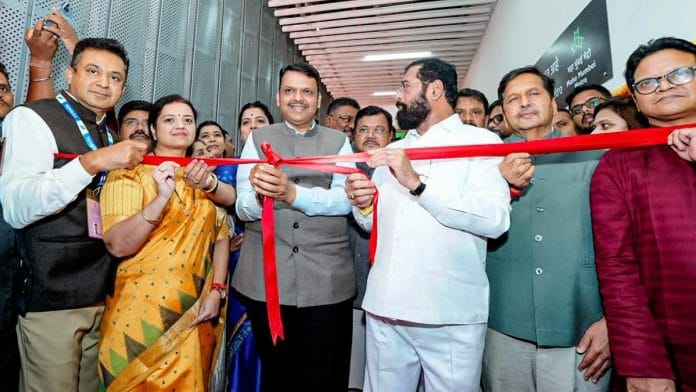



Mumbai: The Devendra Fadnavis-led Mahayuti government on Tuesday inaugurated partially two new Metro lines, bringing Metro rail connectivity to the Thane district for the first time and set rolling the ambitious project of introducing pod taxis in the Bandra Kurla Complex business district.
The two new partially inaugurated metro lines include Metro lines—2B, covering 5.53 km from Diamond Garden Chembur to Mandale, and Line 9, covering 4.7 km from Dahisar to Kashigaon on Mira road in the Thane district.
Apart from that, Chief Minister Devendra Fadnavis and his deputies—Eknath Shinde and Sunetra Pawar—also launched India’s largest single-shield hard rock tunnel boring machine to dig under the Sanjay Gandhi National Park for the Thane-Borivali twin tunnel project.
Speaking at the event, Fadnavis said, “In 2016-17, our government has said that Mumbai’s connectivity should be such that from any corner, one can reach the other within 59 minutes and we are working towards it.”
“Besides, the metro lines which will take off the load on suburban railway lines, we have also boosted our other connectivity like coastal roads. Then there are the (under-construction) twin tunnels of Thane-Borivali, Goregaon-Mulund Link Road that will boost east west connectivity… once all this network is complete, in future, there will be 100 per cent integration of all the projects and seamless traffic that will make Mumbai the country’s most convenient city,” Fadnavis added.
With the addition of these two Metro lines, Mumbai now has an operational metro network of over 100 km.
Fadnavis said that now with these metro lines, Mumbai is the country’s second, after Delhi, to have the highest number of operational metro lines. In total, Mumbai expects to have a metro network of 367 km in the next five to seven years. Construction of most of these lines is underway.
Deputy Chief Minister Eknath Shinde, also the guardian minister for Mumbai and Thane and urban development minister, said, “Today is a historic day for Mumbai and MMR. With these projects, Mumbai is moving towards being congestion-free. Our Mahayuti government is working towards development in the state.”
Also Read: Aarey, politics & court battles: 11-year saga of Mumbai’s 1st underground Metro
Metro lines
Metro line 9 will now connect the Mira Road area to Dahisar on the Western Express Highway, allowing residents faster access to Mumbai’s western suburbs. Until now, Mira Road was only connected by road and a heavily burdened suburban railway line. With this line, the government hopes that the perennial traffic on the Dahisar check naka would be reduced and commuters on the Western suburbs would get cheaper and faster alternative. That total cost of the entire line is Rs 6,607 crore.
There is already a Line 7 that connects Dahisar to Andheri.
According to the MMRDA, the total length of the metro 7 and partial part of the line 9 that has been opened will be 21.2 km and they would make over 275 trips on weekdays and over 200 trips on weekends.
Authorities expect to see 50,000 to a lakh commuters on this line and the entire line will be completed by the end of this year, the MMRDA said. Phase-I of Metro Line 9 will divert 20–30 per cent of commuters from the roads to the metro, thereby making daily commuting more convenient and could reduce traffic congestion by 10–15 per cent, leading to faster vehicular movement and fewer instances of traffic gridlock, MMRDA said. “Because of this metro and the upcoming coastal road, Western Highway will decongest in future,” Fadnavis said.
Those living in the eastern suburbs also have a reason to smile. The partial opening of Line 2B (five stations) runs for 5.53 km through Chembur and Mandale. On this line, commuters can hop on the Mankhurd station for the suburban railway line.
However, the entire line stretching over 23 km, which connects stations like BKC, Kurla, Bandra, Andheri West, will only be operational in 2027. This will boost connectivity between East and West of Mumbai, with multiple interchanges with Metro 3, Metro 1, and Line 4. The cost of this entire project is Rs 10,966 crore.
MMRDA hopes that once this entire line is complete, it will get a ridership of 8.9 lakh daily commuters. The Mandale depot, Fadnavis said, is also an engineering marvel. “This is probably country’s biggest depot or stabilizing yard.”
Tunnel Boring Machine
Fadnavis also inaugurated the Tunnel Boring Machine (TBM) Nayak on the Thane-Borivali twin tunnel project. This TBM will dig an average of 10m daily starting from Thane; the tunnel is expected to reach Borivali by May 2028.
The project is a 11.84-km road that will cut the travel time between Thane, Ghodbunder road and Borivali near Sanjay Gandhi National park to about 15 minutes. With this project, the 23-km distance between Thane and Borivali will be cut to half. Currently it takes about an hour-and-a-half to two hours in traffic.
This tunnel will be a two-lane tunnel with an emergency lane and a cross-connection lane at every 300m. The project has secured all major statutory approvals, including SBWL, NBWL, Forest Clearance (Stage I & II), FRA approvals, and Eco-Sensitive Zone clearance. It is integrated with the upcoming Thane Coastal Road and key regional road networks.
The project was approved in 2023 and Prime Minister Modi had laid the foundation stone in January 2024. The total cost of the project Rs 16,600 crore. Because of this project, vehicles from Nashik, Kalyan, and Navi Mumbai will be able to bypass Thane city and directly access the tunnel.
Said Shinde, “This is a good news for people of Mumbai and Thane. The challenging part of this project is working inside Sanjay Gandhi National park. And working with sensitivity, in consideration with environment is a big challenge. We have accepted this challenge without harming the environment.”
Pod Taxi
This is a first-of-its-kind project in the country where a pod taxi service of length 8.85 km with a total 36 stations will run in Mumbai. Phase 1 will be 3.36 km with eight stations. This will be operational end of the year or early next year, MMRDA said.
The pod taxi is a battery-powered, driverless pod which will be elevated . It will carry a maximum of six passengers and travel along the dedicated path with a speed of 40km/hour. The fare is expected to be Rs 21 per km. These taxis will be AI-based, meaning they will not need drivers.
(Edited By Nardeep Singh Dahiya)
It’s a good initiative. But all the existing Projects are getting delayed, far beyond schedule. Which causing Huge increase
in Projects cost & inconvenient to public.
Govt should focus on completion of all the existing Projects in time