








New Delhi: Following Singapore’s travel advisory, the Chinese embassy’s spokesperson has now shared their experience on how to tackle air pollution, as Delhi’s air remains hazardous.
Beijing, once famous for being the “smog capital of the world,” has witnessed a structural transition, which led to an improvement in the air quality over the past decade.
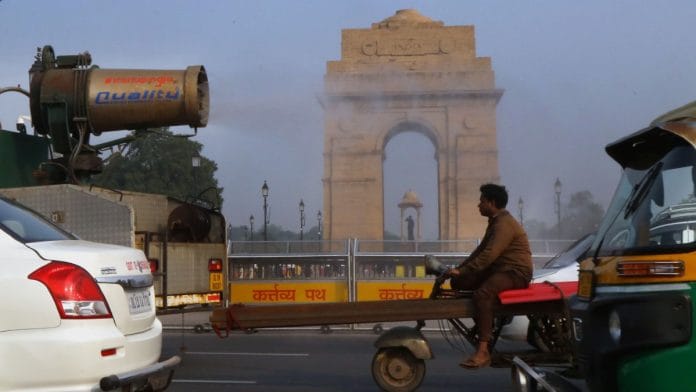
A thick blanket of smog has blanketed the national capital for the past few days, with the air quality index (AQI) reaching the “very severe” category. The AQI was in the “very poor” category today at 9 am and recorded at 328 against 377 a day ago.
Yu Jing, spokesperson of the Chinese Embassy in India, in a post on X Monday said, “Both China and India know the struggle with air pollution amid rapid urbanisation. While the challenge remains complex, China’s sustained efforts over the past decade have delivered noticeable improvements.”
Both China and India know the struggle with air pollution amid rapid urbanization 🌫️📊.
🌫️➡️🌤️ While the challenge remains complex, China’s sustained efforts over the past decade have delivered noticeable improvements.
📌 In the coming days, we’ll share a bite-sized series… pic.twitter.com/0ZG4Rl8ISD
— Yu Jing (@ChinaSpox_India) December 15, 2025
She has since shared several follow-ups underscoring the measures which the Chinese administration took to resolve the pollution. Highlighting the adoption of strict regulations like China 6NI, equivalent to Bharat Stage IV (BS-IV), phasing out of old vehicles, causing high emissions, curbing car growth through graded public transport and accelerating the shift towards electric vehicles.
How did Beijing tackle air pollution? 🌏💨
Step 1: Vehicle emissions control 🚗⚡
🔹 Adopt ultra-strict regulations like China 6NI (on par with Euro 6)
🔹 Phase-out retired old, high-emission vehicles
🔹 Curb car growth via license-plate lotteries and odd-even / weekday driving… pic.twitter.com/E0cFp4wgsV
— Yu Jing (@ChinaSpox_India) December 16, 2025
In her latest post, she observed that industrial restructuring aided in improving air quality. “Beijing shut or relocated over 3,000 heavy industries, with the move of steel giant Shougang alone cutting inhalable particles by 20%. Vacated factories were converted into parks and tech hubs, non-capital functions were shifted out, and manufacturing moved to Hebei while Beijing retained high-end R&D and services.”
How does Beijing tackle air pollution? 🌫️➡️🌱
Step 2: Industrial Restructuring
🔧 Shut down or remove 3000+ heavy industries. Relocating Shougang, one of China’s largest steelmakers, alone cut inhalable particles by -20%.
🏭➡️🏞️ Transform vacated factories into parks,… pic.twitter.com/SYPOsoMaO1
— Yu Jing (@ChinaSpox_India) December 17, 2025
While some users applauded the advice, others criticised it as unsolicited.
This move has divided the internet, as one user wrote, “Beijing’s approach shows that air pollution isn’t solved by shortcuts, but by structural reform. Phasing out heavy industries, reusing industrial land smartly, and coordinating regionally while keeping high-value innovation at home is a long-term, disciplined strategy. Tough decisions, but sustainable outcomes.”
Beijing’s approach shows that air pollution isn’t solved by shortcuts, but by structural reform. Phasing out heavy industries, reusing industrial land smartly, and coordinating regionally while keeping high-value innovation at home is a long-term, disciplined strategy. Tough…
— Pranay (@Pranay07391019) December 17, 2025
While another user posted the pictures of the deteriorating AQI of Chinese cities.
Hello 👋 pic.twitter.com/zYJKWXbke0
— I AM BATMAN 🦇 (@sarika_sum35933) December 17, 2025
This isn’t the first instance of China drawing parallels between the air quality in Delhi and Beijing. In November, Jing, in a post on X, said that Beijing was ready “to share our journey toward blue ones.”
Also Read: Delhi’s air quality stays in ‘severe’ zone for 3rd straight day, calm winds & moisture to blame
Singapore’s advisory
Earlier this week, the Singapore High Commission issued a travel advisory for citizens to take note of flight cancellations and delays due to smog.
“In light of the Indian Central Pollution Control Board (CPCB) invoking Stage 4 of the Graded Response Action Plan (GRAP), the Singapore High Commission has issued the following advisory for Singapore nationals in the Delhi NCR,” Simon Wong, the High Commissioner of Singapore in India, said in a post on X.
Under the Central Pollution Control Board’s (CPCB) Graded Response Action Plan (GRAP) IV, construction and industrial activities are heavily restricted, and schools and offices are encouraged to shift to a hybrid format.
The United Kingdom and Canada authorities have also issued travel advisories related to air pollution in Delhi.
Vaibhav Pant is a TPSJ alum, currently interning with ThePrint.
(Edited by Insha Jalil Waziri)
Also Read: Delhi’s air is choking its sports events—cyclothons and marathons cancelled due to AQI