





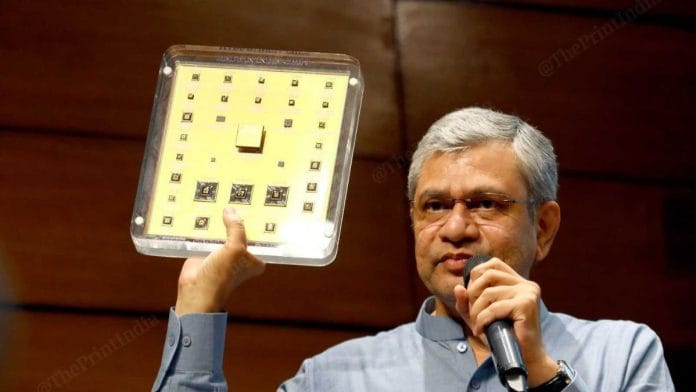


New Delhi: The Union government Monday approved 31 more projects under the Electronics Component Manufacturing Scheme (ECMS), taking the total number of sanctioned applications to 106. The 31 projects cleared Monday involve an investment of ₹7,877 crore, are expected to generate ₹82,243 crore and create 9,588 direct jobs, the Ministry of Electronics and Information Technology (MeitY) said.
The latest batch included the first approvals for domestic manufacturing of components such as filters, coils and speakers, and raw materials including acetylene black and electrolyte additives, along with three capital equipment projects.
Across all 106 approvals, the scheme represents an investment of ₹69,548 crore—higher than its original target of ₹59,350 crore—and a projected production value of ₹5,34,101 crore across 15 states. The projects are expected to generate 74,628 direct jobs, and around 2.5 lakh including indirect employment, the ministry said.
Handing over the approvals Monday, Ashwini Vaishnaw, Minister of Electronics and Information Technology, said the scheme had exceeded its initial scope. “When we brought in the ECMS scheme, there was a clear thought process that we were planning 60 companies initially to be approved. Now we have 106 companies already approved under the project,” he said. He added that the scheme, which set an investment target of ₹59,000 crore, “has already attracted ₹69,000 crore in investment”.
Vaishnaw also said the focus was shifting from approvals to execution. “While securing approval is one thing, witnessing actual progress on the ground is paramount. That is why I always ask my team the same questions: ‘How much construction has been completed?’ and ‘Has production commenced?'” he said. According to the minister, production has begun at 38 projects, while 16 are under construction.
The minister said the approvals now extended to raw materials and machinery, in addition to finished components. “The diversity of the products is also changing. What I am happy about is that these complex components, like laser, transducer, speaker module, antennae, PCB, relays, enclosures, and most importantly, this time we are now getting into material manufacturing also,” he said.
Three companies have also received approval to manufacture capital equipment in India.
Vaishnaw asked industry bodies—Electronic Industries Association of India (ELCINA), India Cellular and Electronics Association (ICEA) and Manufacturers’ Association for Information Technology (MAIT)—to hold workshops on manufacturing such equipment domestically.
Vaishnaw also highlighted India’s growth in reducing their dependence on imported electronics components. India was meeting 45 percent of its demand for printed circuit boards (PCB) and had begun exporting them, and was meeting 60 percent of demand for lithium-ion cells used in digital applications.
It has reached 80 percent self-reliance in laminates, he said. On optical transceivers, he said India had “moved beyond merely meeting 350 percent of the demand to achieving complete self-reliance and commencing exports.” India also meets 75 percent of connector demand and had become self-reliant in relays, which it had also begun exporting, he said.
Vaishnaw placed these approvals against the sector’s expansion over the past decade.
“Electronics manufacturing has grown sevenfold over the past 12 years. The sector has now crossed the ₹13-lakh crore mark, while electronics exports from India have surged elevenfold to exceed ₹4 lakh crore,” he said. Government data show electronics have become the country’s third-largest export category. Electronics production grew 15.8 percent to ₹13.11 lakh crore in 2025-26, from ₹11.32 lakh crore the previous year.
The minister said the scheme’s approach followed a sequence of localisation. “Under the ‘Make in India’ initiative, we began with the assembly of finished products. We then moved on to modules… Subsequently, we progressed to components,” he said, adding that the next stages were materials and capital equipment.
He said there had been “considerable skepticism regarding the feasibility of manufacturing components in India,” and that “there were critics who constantly created obstacles and voiced skepticism, claiming India could not become a manufacturing nation. Today, a clear blueprint of success stands before them”.
MeitY Secretary S. Krishnan said ECMS was among the ministry’s fastest-moving programmes, with approval meetings held almost every week. “Both in terms of investment and output we have exceeded the original target. We are yet to reach the employability target,” he said.
He added several plants were nearing operations. Dixon’s camera module facility in Noida was expected to be operational in four months, while Motherson’s enclosure plant near Chennai and Wipro’s laminate plant were expected in two to three months. Yuzhan Technology, a Foxconn company, was expected to begin operations in six months, he said.
The ECMS was approved by the Union Cabinet on March 28, 2025 and notified on April 8, 2025, with an outlay of ₹22,919 crore. It offers incentives linked to investment and production across components, sub-assemblies, capital equipment and supply-chain products, and covers categories the government has flagged as having high import dependence. Approvals have been cleared in tranches, rising from seven projects in October 2025 to 75 by end-July 2026 and 106 on Monday.
(Edited by Prakhar Agrawal)
Also Read: Cabinet clears Rs 1.9 lakh crore for chip & mobile manufacturing; govt to take royalty from firms