





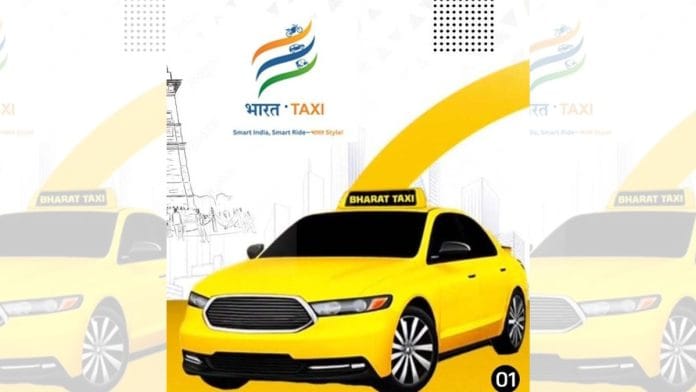



New Delhi: Bharat Taxi, a Ministry of Cooperation-backed ride-hailing service, is seeing strong early traction weeks after its launch, with more than four lakh customers registering on its mobile application, according to data shared by the government.
Bharat Taxi, operated by Sahkar Taxi Cooperative Ltd, began operations in December 2025 from Delhi-NCR and Rajkot.
On Sunday, the Ministry of Cooperation said in a post on X that nearly 40,000–45,000 new users had signed up over the last two days alone.
A senior official of Sahkar Taxi Cooperative Ltd, speaking to ThePrint on condition of anonymity, said the growth curve was expected to steepen further. “In the next few days, we expect to cross five lakh registered customers and onboard over two lakh driver partners on the Bharat Taxi platform,” the official said.
🚕 Bharat Taxi (Sahkar Taxi Cooperative Ltd.) is gaining nationwide momentum!
🎉 4 lakh+ registered customers (as of now)
📈 40–45K registrations/day in the last 2 days
🏆 #9 on Google Play | #13 on Apple App Store
🚖 Driver App ranked #20 on Play Store
As we gear up for the…
— Ministry of Cooperation, Government of India (@MinOfCooperatn) January 4, 2026
The government-backed service expanded its footprint to Delhi’s Indira Gandhi International Airport from 1 January 2026, with a focus on reducing wait times for travellers. “For airport commuters, our aim is zero-wait time,” said the official quoted earlier. While customer and driver registrations have surged, the cooperative has so far not disclosed data on the number of rides completed on the platform.
Bharat Taxi operates on a zero-commission model, positioning itself as an alternative to private aggregators. At present, drivers are not charged any subscription fee. However, the cooperative plans to introduce a nominal per-ride charge in the distant future. “The fee will be very minimal—likely a single-digit amount per ride,” the official said, adding that the structure is designed to remain sustainable without burdening drivers.
According to the cooperative, the model is intended to benefit both drivers and commuters. Drivers, the official said, will gain from profit-sharing and democratic decision-making under the cooperative structure, while customers will be offered fair and transparent pricing. “Our aim is not to attract commuters with unsustainable pricing for a few days. We want to ensure fair and stable fares over a longer period of five to ten years.”
Bharat Taxi’s entry places it in direct competition with ride-hailing giants Ola and Uber. Both companies moved to subscription-based models last year amid driver pushback and changing market dynamics.
ThePrint reached Ola and Uber for comment via email, but did not receive a response. This report will be updated if and when a response is received.
The cooperative has also tied up with Delhi Metro Rail Corporation (DMRC) and Delhi Transport Corporation (DTC) to strengthen last-mile connectivity in the capital. “Using the Bharat Taxi app, commuters will also be able to purchase Delhi Metro tickets,” the official said.
On the safety front, Bharat Taxi has partnered with Delhi Police. A distress alert feature embedded in the app is directly linked to the police control room. “Once the distress signal is activated, the police are immediately notified,” the official said.
According to the official, the focus for now remains on deepening operations in Delhi-NCR and Rajkot. The next phase will see expansion to other cities in Gujarat and Maharashtra.
In October last year, ThePrint was the first to report on the government’s plans for a cooperative-backed taxi service.
Registered in June 2025 with an authorised capital of Rs 300 crore, the Multi-State Sahakari Taxi Cooperative Ltd is backed by eight major cooperatives. These include the National Cooperative Development Corporation (NCDC), Indian Farmers Fertiliser Cooperative Ltd (IFFCO), Gujarat Cooperative Milk Marketing Federation (GCMMF), National Cooperative Exports Limited (NCEL), National Dairy Development Board (NDDB), National Bank for Agriculture and Rural Development (NABARD), Krishak Bharati Cooperative Limited (KRIBHCO) and National Agricultural Cooperative Marketing Federation of India Ltd (NAFED).
(Edited by Amrtansh Arora)
Also Read: Why cab drivers in Mumbai, Pune & Nagpur are at odds with app-based aggregators