





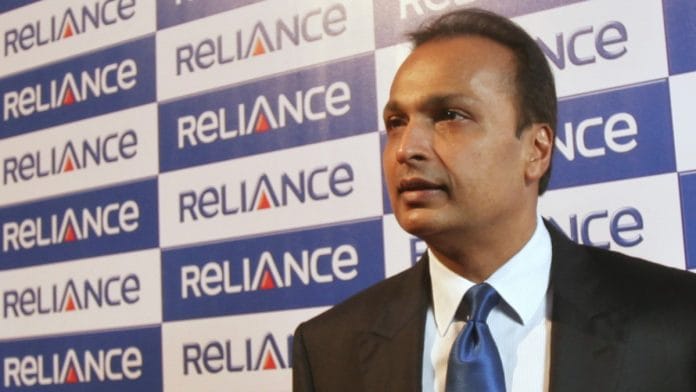



New Delhi: Businessman Anil Ambani suffered a setback in a bank fraud case after the Bombay High Court set aside interim protection against being declared a “fraud” by a consortium of banks, holding that the stay was founded on “flawed assumptions of fact and in law” and hence, risked eroding “public confidence in the banking system”.
A division bench led by Chief Justice Shree Chandrashekhar and Justice Gautam A. Ankhad said Monday that a December 2025 order by a single-judge bench of Justice Milind Jadhav was passed in disregard of settled principles governing injunctions.
The earlier order had restrained banks from acting on a 2020 Forensic Audit Report (FAR) that examined the use of approximately Rs 31,580 crore advanced to Reliance Group entities. Bank of Baroda, IDBI Bank, Indian Overseas Bank, and audit firm BDO India LLP then challenged the order.
The case stems from the 2018 insolvency proceedings of Reliance Communications Limited (RCOM) and its subsidiaries, which triggered a forensic audit that alleged the diversion of approximately Rs 31,580 crore to connected parties through “dubious methods”.
The three banks involved in this were the Bank of Baroda, IDBI Bank, and Indian Overseas Bank.
Ambani had successfully argued before the single judge that the FAR was a “nullity” because its author, Srinivas Rao of BDO, was not a qualified chartered accountant, a requirement he claimed was mandatory under the Reserve Bank of India’s (RBI) Master Directions.
In their appeal, before this division bench, the banks and BDO contended that the stay was “patently illegal” and “perverse”, arguing that the 2016 RBI directions actually permitted the use of external forensic experts who were not necessarily CAs.
The division bench has now cleared the way for the three lenders to resume fraud-classification proceedings regarding the alleged diversion of approximately Rs. 31,580 crore.
It said that the single judge “overlooked the relevant considerations for the grant of interim injunction and took into consideration the irrelevant materials” and “suffers from procedural irregularity and impropriety, and is illegal”.
The division bench found that Reliance Group Chairman Anil Ambani’s challenge to the 2020 FAR was “grossly delayed” and said that he would suffer no “irreparable injury” by facing bank investigations.
The court emphasised that judicial interference in such matters must be rare, as the Reserve Bank of India (RBI) directions are “intended at securing public money” through the timely identification and mitigation of fraud risk.
RBI Master Directions
The central legal dispute focused on whether the RBI’s Master Directions 2024 about fraud risk management, aiming to secure public money, retroactively invalidated bank actions initiated under the 2016 framework.
The division bench ruled that the 2024 directions operate prospectively and do not nullify prior executive decisions, asserting that actions taken under the 2016 regime “shall remain alive for all future purposes”.
Ultimately, the court held that the 2024 directions “built upon” and “consolidated” the previous rules rather than abrogating them retrospectively.
The court clarified that “the actions taken under the Master Directions 2016, which are not repealed, shall remain alive for all future purposes”.
It rejected Ambani’s argument that a lack of a specific “saving clause” invalidated previous proceedings, stating that executive decisions and bank actions are not automatically voided by new regulatory updates.
The single judge had previously invalidated the Forensic Audit Report because it was not signed by a registered chartered accountant.
However, the division bench found this interpretation overly restrictive. Citing the Master Directions of 2016, the court noted that banks were expressly permitted to use “external auditors, including forensic experts or an internal team for investigations”.
The court further noted that the auditor, BDO India LLP, was an accounting consultancy firm “impaneled” by the Indian Banks Association for forensic audits and by SEBI for listed companies.
The bench highlighted that the lead investigator, Srinivas Rao, possessed “more than two decades in forensic audit” and specialised experience in fraud investigations.
The court criticised the timing of the challenge brought by Anil Ambani. It noted that the Forensic Audit Report had been available to him since 2021, but the eligibility of the auditor was only questioned years later. The court observed that he “prevaricated his stand from stage to stage and took different stand(s) in different proceedings”.
The bench asserted that the “challenge to the eligibility of the BDO or inconclusiveness of the Forensic Audit Report is grossly delayed and could not have been entertained”.
The division bench questioned the authenticity of a 29 September 2025 RTI inquiry filed by Siddhi Vora—who Ambani’s counsel later described as a professional engaged by RCOM—challenging its use to trigger the lawsuit through what it termed an “illusory cause of action”.
This inquiry resulted in a 24 October 2025 response revealing “new facts” that BDO India LLP was not registered with the ICAI and that the report’s signatory, Srinivas Rao, was not a qualified chartered accountant.
The court characterised the sudden introduction of these details as being in the “realm of speculation”, noting that since Ambani had possessed the Forensic Report since 2021, the reliance on this recent RTI was a “belated and baseless attempt” to bypass legal bars on delay and stall the banks’ investigations.
Judicial impropriety and “rewriting the plaint”
In a stinging critique of the single judge’s procedure, the division bench held that the judge had ventured into issues neither pleaded nor argued by the parties.
Specifically, the single judge raised a “very crucial factor” regarding the appointment and impartiality of BDO India LLP, despite admitting that the litigants never questioned the auditor’s independence.
The bench also criticised the judge for ruling on technicalities—such as violating a two-month audit timeline and the unauthorised nature of the audit period—while explicitly acknowledging that the litigants had not argued these points.
Furthermore, the judge was rebuked for relying on external RBI letters and public domain notices that were never part of the legal record or produced as evidence during the proceedings.
The judgment states that by referring to materials in the public domain that were not part of the legal record, the single judge “has rewritten the plaint.”
The court held: “The learned Single Judge overlooked the relevant considerations for the grant of interim injunction and took into consideration the irrelevant materials. The impugned judgment suffers from procedural irregularity and impropriety, and is illegal”.
“By referring to certain notices, notifications etc. which are not part of the pleadings and some fundamental issues, which according to him go to the root of the matter, the learned Single Judge has rewritten the plaint,” the bench added.
Protecting public funds
Finally, the court highlighted the gravity of the underlying allegations, noting that the Forensic Audit Report identified approximately Rs 31,580 crore received from banks, significant portions of which were allegedly diverted to connected parties through “dubious method”.
The bench concluded that granting an injunction in such a case, where massive public funds are at stake, was “patently illegal”.
The court ruled that “no irreparable injury would be caused to the respondent (Ambani) if the proceedings against him are continued”, as he still maintains the right to defend himself during the bank’s internal hearing process.
(Edited by Sugita Katyal)
Also read: Anil Ambani pledges cooperation in ED probe in loan fraud case, tells SC he’s ‘not a flight risk’