





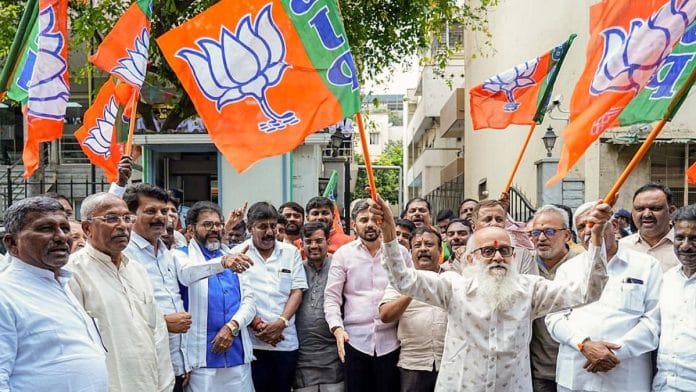


Over the next month, four Indian states — the eastern states of Assam and West Bengal, and the southern ones of Kerala and Tamil Nadu — will vote in new legislators. These are not the country’s richest states, nor are they its largest. But for Prime Minister Narendra Modi’s Bharatiya Janata Party, the elections are nevertheless of surpassing importance.
That’s because this isn’t just another test of Modi’s governance or his popularity. The BJP – and its parent organization, the Hindu nationalist Rashtriya Swayamsevak Sangh — have a deeper, more significant project in hand: The remaking of India, and the homogenization of its multiple cultures, languages, and ways of worship.
The elections will take place in those parts of the country that have most emphatically rejected its totalizing “Hindutva” project — so far. Over the next month, we will discover whether these last bastions of resistance have fallen.
Of the four states, the BJP has never even come close to forming a government in three. In the fourth, Assam, it surged into power over the past decade — but that was in part because it successfully induced local politicians with a mass following to join the party.
The RSS was founded in the western state of Maharashtra; Modi himself is from neighboring Gujarat. Today, the BJP’s power base lies in the poor, populous Hindi-speaking northern states. Political currents in the better-off states of the south and the socially more liberal east remain largely unknowable to the movement’s leaders.
Several of these states have sizeable Muslim populations — but even their Hindu residents speak a different language, have different cultural markers, follow different religious leaders, and celebrate different festivals than their compatriots in the north and west. And their political trends have always run differently from those in the rest of the country: Communists ruled West Bengal for more than three decades, and are still a power in Kerala, while Tamil Nadu has a stable two-party system born of a century-old rationalist movement.
Therefore, the RSS and BJP view these regions as eccentric at best, and schismatic at worst. For them, winning there is a cherished ambition, as much a dream as winning California would be for a MAGA high priest.
They are closer to that goal today than ever before. A decade of cultivating ethnic and religious divides in Assam will pay off; the BJP is likely to be reelected comfortably. In Kerala, they’re already further than they’ve ever been, winning local elections in the state’s capital last year. They are now the main challenger in West Bengal, and a dynamic component of the opposition alliance in Tamil Nadu.
Given these stakes, the federal government in New Delhi must have been sorely tempted to put a thumb on the scales in support of the ruling party’s local units. And, right on cue, the Election Commission of India — once a non-partisan, widely respected body — decided to conduct an enormous revision of the electoral rolls.
Over the past few months, the commission has removed over nine million names in West Bengal alone; the BJP’s rivals say that these deletions have been designed to bolster that party’s chances. Certainly, there are some in the BJP who might see trashing Indian democracy as a price worth paying if the reward is defeat for the last indomitable holdouts against its all-conquering empire.
Yet in its palpable eagerness to win, the BJP misses two things — something it has unknowingly won, and another it has already lost.
First, its quiet success. For decades, these states have marched to their own beat, holding elections and choosing leaders out of step with national politics. Today, their homegrown officials respond to, and define themselves against, the BJP’s pretensions. Doesn’t that count as a victory for Modi, the RSS, and Hindutva?
And yet they have lost. If they do well in Bengal, for example, they will feel no sense of triumph, for they know it will be on the back of a compromised voter roll. They won’t have proved to anyone’s satisfaction that their mission has genuine popular purchase in the east. Enough Indians will continue to believe that, even after decades of trying, the BJP’s project has gone as far as it conceivably can. The party wanted converts, but all they’ll get is captives.