



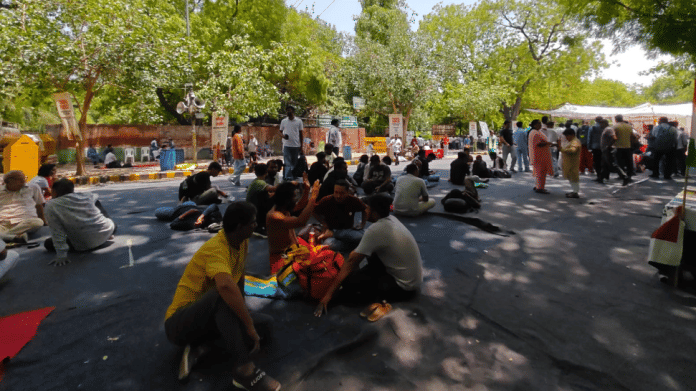
New Delhi: The heat is on at Jantar Mantar, and in more ways than one. Policemen stand guard as the June sun beats down mercilessly on the Cockroach Janata Party’s protest. Twenty days in, and slogans continue to echo like waves at the protest site, breaking against a much-diminished phalanx of cameras and journalists.
The demands haven’t changed but it is significantly quieter than it used to be when the protest began. Every few minutes, someone returns to the microphone to demand the resignation of Union Education Minister Dharmendra Pradhan and reforms in the education system.
Activists occupy much of the space as students trickle in and out through the day. A saffron-clad baba offers life lessons to anyone willing to listen. Plastic chairs lie scattered like envelopes without addresses across the site, and water containers mourn in the corners as volunteers keep the protest going.
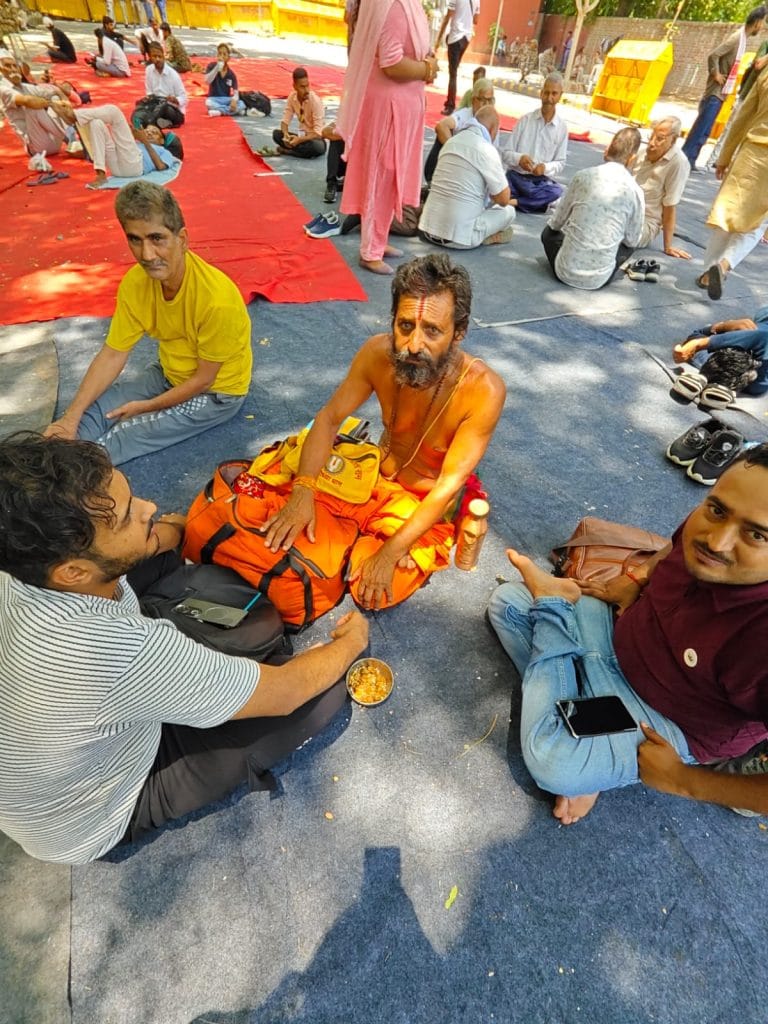
The packed crowds that marked the movement’s early days are no longer a constant presence; it’s more ebb and flow now. Yet one person is almost always there—founder Abhijeet Dipke. He greets supporters, poses for photographs and patiently speaks to anyone who seeks him out.
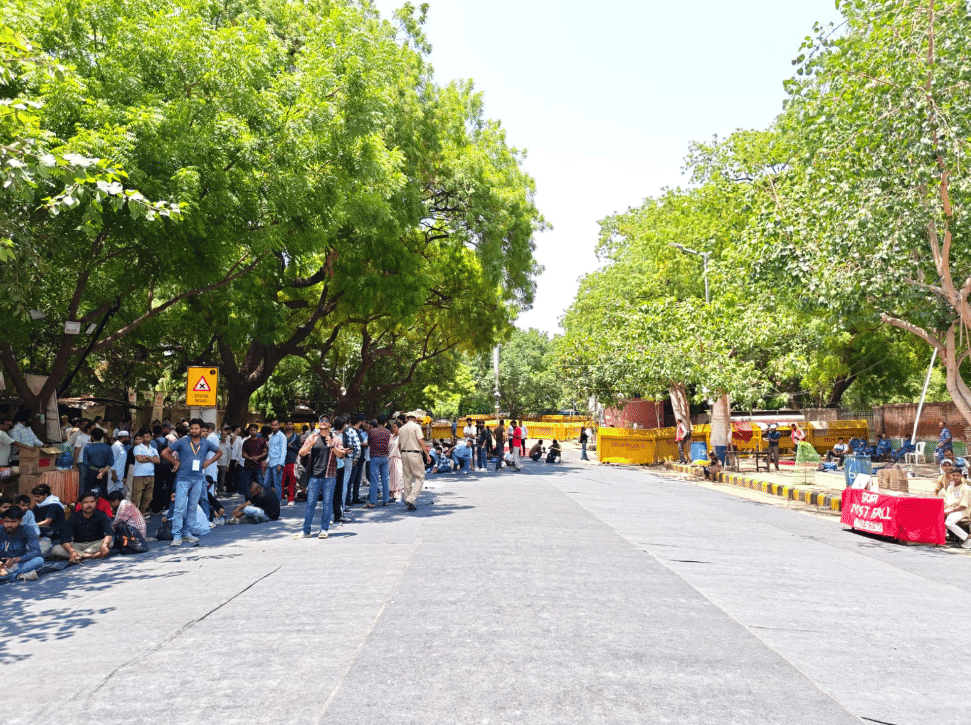
The fortifications are unbreached; Delhi Police barricades remain firmly in place across the road. Off to one side, a little red table marked ‘Press’ serves as a reminder of the media attention the protest once attracted, though the legion of television cameras has largely disappeared. Even so, the movement remains rooted at Jantar Mantar. Its slogans are unchanged, its social media following has crossed 23 million, and its volunteers continue to show up every day.
“What started online had to come to the streets,” Dipke told ThePrint. Declaring India’s education system to be “on a ventilator”, he said it could still be revived through public pressure. The sit-in, he insisted, would continue until Pradhan resigned.
Asked why the crowd appeared thin, Ashutosh, a member of the CJP’s core team, rejected the insinuation that that the agitation is losing momentum. “Our protest is still successful. The site is packed in the evenings. Gen Z doesn’t wake up early, but they are there to support us,” he said.
ThePrint visited the protest site on three separate occasions over the course of the agitation. While supporters continued to come and go, the turnout during those visits remained modest compared to the scale organisers had initially hoped for, drawing comparisons with the farmers’ protests of 2020-21 that many within the movement took inspiration from.
The movement has also struggled to convert some of its online campaigns into on-ground action. In one instance, the CJP had asked supporters to write messages on diapers that were to be delivered to Pradhan as a symbolic protest. That campaign never materialised; Dipke attributed its cancellation to heavy rain.
Also Read: At Jantar Mantar, Cockroach Janta Party, Delhi Police & an Aadhaar whodunnit
Sympathy, but no political ownership
For all its online popularity, the Cockroach Janata Party has not got formal backing from any major political party. The protest found some early political visibility when Communist Party of Indian(CPI) leader Annie Raja and Communist Party of India (Marxist–Leninist) Liberation general secretary Dipankar Bhattacharya attended the first demonstration at Jantar Mantar along with climate activist Sonam Wangchuk. Sources reveal that the movement was also discussed at an Indian National Developmental Inclusive Alliance (INDIA) meeting after Bhattacharya raised the issue.
Several Opposition leaders have publicly expressed support without formally joining the agitation. Aam Aadmi Party national convener Arvind Kejriwal has backed the demand for Pradhan’s resignation, saying the movement reflects widespread anger among students over repeated examination controversies. Samajwadi Party chief Akhilesh Yadav, Shiv Sena (Uddhav Balasaheb Thackeray) chief Uddhav Thackeray and Nationalist Congress Party (Sharad Pawar) leader Rohit Pawar have also voiced solidarity with the protesters.
Congress leaders also stand by the protest. Rajya Sabha member Abhishek Manu Singhvi told ThePrint that the success of a protest should not be measured solely by the size of the crowd. “Times have changed,” he said, arguing that the movement had found resonance online and reflected genuine dissatisfaction among young people over the education system.
Yet the Congress has not officially endorsed the Cockroach Janata Party’s agitation. Instead, its student wing, the National Students’ Union of India (NSUI), and the Indian Youth Congress have organised separate parallel protests on examination-related issues rather than joining the sit-in at Jantar Mantar.
From Instagram satire to Jantar Mantar
The Cockroach Janata Party did not begin as a political outfit. It emerged as a satirical social media movement after Supreme Court Justice Surya Kant, during a hearing on recruitment irregularities, likened unemployed youth with fake degrees to “cockroaches” and “parasites”. Instead of rejecting the label, Dipke embraced it, turning the “cockroach” into a symbol of resistance.
Within weeks, the movement had amassed more than 23 million followers on Instagram, driven by growing frustration over examination irregularities, unemployment and the rising uncertainty facing young Indians.
The online campaign soon spilled onto the streets. The CJP’s first protest at Jantar Mantar drew hundreds of supporters carrying copies of the Constitution and the national flag. Dipke later announced demonstrations in other cities, including Pune and Nagpur, before returning to Delhi for what by then had become an indefinite sit-in.
The group’s demands have remained unchanged: the resignation of Dharmendra Pradhan and structural reforms in the education system. Delhi Police did not permit an indefinite protest, but volunteers continued to occupy the site. Organisers have also complained of inadequate facilities, including disruptions to the water supply.
As another speech begins and another slogan rings through the loudspeaker, Dipke settles into yet another conversation with a supporter. Nearly three weeks after the movement arrived at Jantar Mantar, the protest remains—smaller than it once was, but still waiting for a response from the government.
(Edited by Nardeep Singh Dahiya)
Less than 10% students opt biology in class XII and 5% appears in NEET. They spend about 50k in coaching. CJP is concerned with their plight. Interestingly, crowd comprises mainly of humanities discipline. Suicide of 20 aspirants is highlighted but suicide of +10k farmers took backseat.