



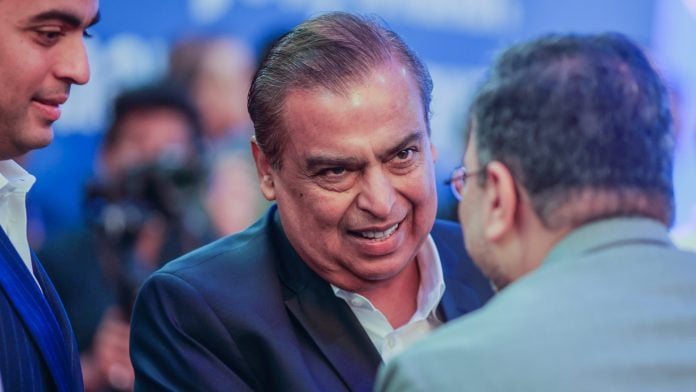
Jio Platforms Ltd. surged in its trading debut after billionaire Mukesh Ambani’s telecom giant raised a record $3.1 billion in India’s biggest initial public offering, bucking a poor track record for the country’s mega deals.
The shares rose as much as 23% to 1,375 rupees in early trading, versus an IPO price of 1,119 rupees apiece, valuing the company at over $131 billion. At that level, Jio is set to become India’s second-most valuable listed company after parent Reliance Industries Ltd., overtaking rival Bharti Airtel Ltd.
“It is a bumper listing and highly welcome in the current market situation,” said Shankar Sharma, founder of GQuant Investech. “Sometimes a big listing can alter the mood of the investing nation, and we all hope Jio does that to the Indian market.”
In the buildup to the deal, which was led by Akash Ambani, the patriarch’s oldest son, company executives pitched Jio, Reliance’s telecom and digital services arm, as a full-throttle tech giant. In the end, its valuation fell short of some earlier expectations amid a selloff in Indian stocks and volatility in global equity markets. Still, strong demand for the offering fueled expectations of a robust debut.
The listing also marked a milestone for the next generation of the Ambani family, decades after Mukesh helped work on Reliance’s IPO at the age of 20. Four generations of the family took the stage for the bell-ringing ceremony in Mumbai, including matriarch Kokilaben Ambani, in a show of family unity.
The ceremony was heavy on emotion and nostalgia. Akash told investors Jio would create value for the next 50 years, much as Reliance had over the previous five decades, while siblings Isha and Anant struck a similar note. Mukesh appeared visibly moved at several points.
The listing has also shuffled the pecking order among India’s top business houses. Reliance Group has now become India’s most valuable conglomerate, with a combined market cap of over 30 trillion rupees, overtaking Tata Group. Shares of Reliance, which holds two-thirds of Jio, fell 1.9% amid weakness in the broader market.
Jio’s strong start also defied the recent record of India’s biggest IPOs, which have often stumbled out of the gate. The four IPOs that raised at least $2 billion this decade posted a weighted-average decline of 9.9% on their first day, with only one — National Stock Exchange of India Ltd. last month — recording a gain on debut, data compiled by Bloomberg show.
The longer-term picture is hardly more encouraging. Each of India’s five biggest previous IPOs is now trading below its offer price, underscoring how blockbuster share sales have often struggled to reward investors.
Hyundai Motor India Ltd., whose 279 billion-rupee IPO held the record before Jio’s, trades about 3% below its offer price. NSE, which raised about $2.4 billion last month, has also slipped below its issue price.
Still, some analysts see Jio as better placed for longer-term gains. Nomura initiated coverage of Jio with a buy rating, citing its market leadership and the prospect of a sharp improvement in free cash flow. Analysts including Bineet Banka set a target price of 1,340 rupees.
The optimism is partly fueled by extraordinary demand for the offering. Jio’s IPO was fully subscribed within 100 minutes of opening, according to BSE Ltd. data. The deal attracted more than $78 billion of bids and nearly 14 million applications.
At 1,119 rupees a share, the company is valued at about 15 times fiscal 2026 enterprise value to Ebitda on a post-issue basis, implying a premium to industry peers, according to Geojit Investments Ltd.
“Jio’s expansion has helped accelerate digital adoption, which in turn has brought millions of Indians into the financial ecosystem, including the stock market,” said Raamdeo Agrawal, chairman and co-founder of Motilal Oswal Financial Services Ltd. “Jio’s growth potential remains significant.”
Risks, though, include Jio’s dependence on telecommunications licenses and spectrum, with delays in approvals, non-renewal of licenses or difficulties acquiring additional spectrum threatening to weigh on the business, according to Religare Broking Ltd.
This report is auto generated from the Bloomberg news service. ThePrint holds no responsibility for its content.