





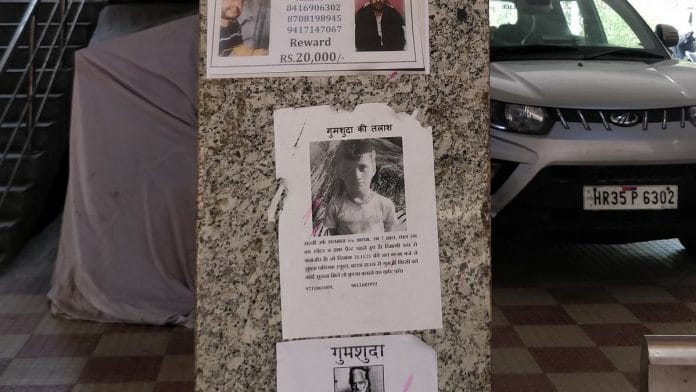

New Delhi: No fewer than 98,375 children and more than half a million adults went missing in India in 2024, the latest National Crime Records Bureau (NCRB) report says. For the leap year that 2024 was, that figure averages 269 children and 1,421 adults every day. In non-numerical terms, that’s like the entire population of Noida or Jamshedpur, as per the 2011 census, disappearing in a year.
Even worse, the number of missing people in 2024 showed an increase of 7.3 percent over the previous year, with the increase in number of missing children showing an even more alarming growth of almost 8 percent. The only silver lining to this very black cloud was the fact that recovery and tracing of missing persons remained robust, approaching the number of missing in 2024; recovery numbers include those from previous years as well.
Released on Wednesday, Crime in India 2024, as the NCRB report is titled and for which data for is collected by the Ministry of Home Affairs, said: “A total of 5,20,164 persons (1,67,414 male, 3,52,729 female and 21 transgender) were reported missing in 2024. The number of persons reported missing has increased by 7.3 per cent in 2024 from 4,84,584 persons missing during 2023. During the year 2024, a total of 5,03,602 persons (1,65,465 males, 3,38,116 females and 21 transgender) were recovered/traced.”
“Missing Children: A total of 98,375 children (22,768 male, 75,603 female and four transgender) were reported missing in 2024. The number of children missing has increased by 7.8 per cent in 2024 from 91,296 children missing during 2023. During the year 2024, a total of 98,826 children (23,902 male, 74,919 female and 5 transgender) were recovered/traced,” said the report.
The NCRB data says 48,800 children remain missing from previous years, thus bringing the total number of missing children to 1,47,175. West Bengal has the highest total of missing children at 22,742, followed by Madhya Pradesh with 19,131 cases and Odisha with 13,495 cases. In 2024, West Bengal reported 15,849 cases of missing children, while Madhya Pradesh reported 14,296 and Tamil Nadu 8,032.
The National Capital has logged a total of 10,843 missing children of which more than half—5,491—are from 2024.
The numbers related to finding these children do bring some cheer, however. The data says that 98,826 children were traced in 2024, showing a 67.1 per cent recovery rate on the total number. The national figure for children who continue to remain missing, unrecovered or untraceable—including those from previous years—is 48,349.
The numbers for adults are mind-boggling too. India had a backlog of 4,07,673 cases of unrecovered and untraced missing persons from previous years, with the total at 9,27,837 cases. Maharashtra leads this roll of missing persons in 2024 with 79,368 cases, followed by 65,338 in Madhya Pradesh and 63,116 in West Bengal. The National Capital logged 23,058 cases of missing persons in the same year, the NCRB report says.
The total number of recovered and traced persons in 2024 was another silver lining at 5,03,602, translating into a recovery rate of 54.3 per cent. But 4,24,235 missing persons in all remain unrecovered or untraced.
Women are far likelier to end up as a missing person statistic: 3,52,729 went missing in 2024, while the number of men reported missing in the same year was 1,67,414.
Also Read: Crimes by juveniles up 11% in 2024 vs 2023, highest number of cases in Bihar, says NCRB report
The good fight
A senior officer of the Delhi Police posted with Crime Branch told ThePrint that most of those reported missing who they recovered were children, some as young as 12 or 14. Among the reasons the officer detailed, exam pressure, elopement, family issues, abusive environments, and unemployment were common.
“We have identified that social media, which is popular among children, is another cause of the problem. Children leave homes to settle in other cities,” the officer said.
Once a child is recovered, counselling by a designated counsellor of the Delhi Government is the next step. “Delhi has a large migrant population. One problem we have identified is the delay in reporting, and once the case is registered, the migrant parents often return to their villages, making it difficult to trace them too. We keep pursuing the leads we have established, even if the child has no contact with the family.”
Another officer with the Crime Branch said that while the numbers are high, “it is also because the police are registering every single case. Even if a child goes missing for a few hours, we still register a case. This is why there are more cases.” Going on to speak how the police traces the missing children, he said: “In cases where a child has no mobile phone, we establish communication with railway stations, bus stands. We also tie up with Non-Governmental Organisations (NGOs) from different villages, towns and cities. We ensure contact is established by scanning surveillance camera footage multiple times.”
Of great help, he said, was ZIPNET, or Zonal Integrated Police Network, the online platform used to share real-time information on missing persons, apart from criminals, across state borders. “Our action on missing children and persons remains comprehensive. We train and sensitise every rank official to work on these cases,” said the officer.
Help is indeed at hand sometimes. Rajeev Dimri, All India General Secretary of All India Central Council of Trade Unions, told ThePrint, “In several cases of bonded labour, we have seen people, including women and children brought from Bihar, Jharkhand, Odisha and the tribal belts. They are brought to cities like Delhi and Mumbai as domestic workers. None of the people are brought through agencies.
“In most of the cases where we rescued people, we found that this was not limited to houses… people were found working for a third of fair salary, in factories, hotels and restaurants. The employers have access to their debit cards and the people never get paid fully. Once we receive a tip-off, we coordinate with agencies and help with the rescue.”
Human trafficking
The NCRB report says that the Ministry of Home Affairs has released funds from time to time in order to strengthen the law enforcement response against trafficking in persons by setting up Anti-Human Trafficking Units (AHTUs) in all districts of states and Union Territories.
“They are tasked with investigation of human trafficking cases and building up of database on such cases, including on criminals involved. A sum of Rs 100 crore from the Nirbhaya Fund has been allocated for setting up new AHTUs and for strengthening of existing AHTUs. As per data provided by states and Union Territories, so far 819 AHTUs are functional and 20 States/UTs have achieved their target of setting up AHTUs in all districts.”
Data provided by states and Union Territories shows 2,135 cases of human trafficking registered by AHTUs in 2024. In the previous year, 2,183 cases were registered, and 2,250 in 2022. The most cases were registered in Telangana with 423; Maharashtra followed with 337, and Andhra Pradesh with 159 cases. The National Capital reported 65 cases in 2024, down from 106 in 2022 and 117 cases in 2023.
Another senior Delhi police officer told ThePrint, “Cases pertaining to human trafficking in Delhi are usually complaints we receive for bonded labour where women and children are trafficked from other parts of the country and brought to Delhi.”
Another officer said immediate action was taken on every complaint. “Along with Sub-Divisional Magistrates and NGOs, with whom we have tied up, we keep taking routine action. We also keep checking red-light areas in order to identify complaints.” Delhi’s Kamla Market Police Station, covering Delhi’s infamous prostitution zone, deals with cases pertaining to similar matters and quick action is taken, an officer said.
(Edited by Nardeep Singh Dahiya)