





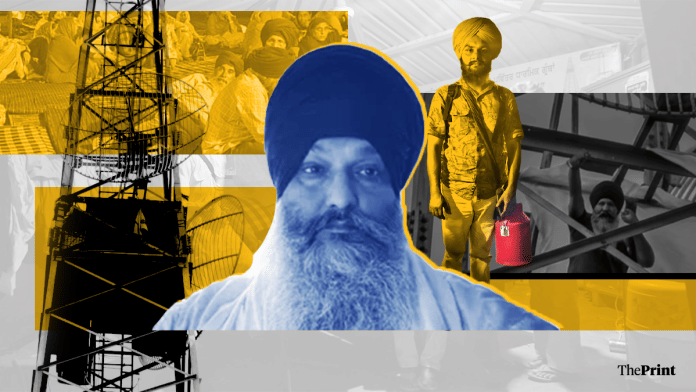


Samana (Patiala): In what officials describe as one of the most unusual rescue challenges they face, the Patiala district administration is working against a hard deadline to bring down a protester from atop a 400-foot telecom tower where he has spent over 18 months—an unprecedented and precarious feat.
The district authorities Wednesday formally requested technical assistance from the Army to evacuate Gurjit Singh Khalsa (43) from the top of the BSNL tower in Samana. As part of dry runs and trials of the extraction plan, volunteers of the Army, fire brigade, and National Disaster Response Force Thursday practised possible manoeuvres at the tower, where Khalsa has been lodged since 12 October 2024.
An ex-serviceman, Gurjit Singh Khalsa, climbed the tower to launch a sit-in protest, demanding a dedicated anti-sacrilege law in Punjab. Several voices had been raising the demand since the acts of sacrilege of the Guru Granth Sahib in 2015. The acts, at the time, triggered a political storm and have since dominated political debates in the state.
In Khalsa’s case, what began as a symbolic protest soon turned into one of the longest sit-ins in recent memory. A physically fit Khalsa, who climbed the tower on his own using a straight, narrow set of stairs, is now not fit enough to climb down on his own.
The initial push to bring Khalsa down was triggered by the Punjab assembly’s passing of the anti-sacrilege legislation on 13 April as an amendment to the Jaagat Jot Sri Guru Granth Sahib Satkar Act, 2008. The law was notified on 20 April, after receiving the Governor’s assent.
His rescue acquired urgency after the Dharam Yudh Morcha, the body that organised Khalsa’s protest and had been staging a parallel protest at the Banda Singh Bahadur roundabout in Samana until the law was passed, issued a 24 April deadline to bring the ex-serviceman down. Moreover, Khalsa publicly stated in a recent phone interview that he would descend on his own if no arrangement was made, which, officials privately admit, could be “catastrophic”.
Supporters told ThePrint that Khalsa now weighs nearly 110 kg and has had minimal lower-body movement for months, if not longer. This raises concerns about muscle atrophy, balance, and the ability to safely negotiate the steep descent.
“The risk is not just slipping—it’s that his legs may simply not support him,” said Gurpreet Singh, the morcha coordinator, pointing to the possibility of sudden collapse mid-descent. Any such incident at that height could prove fatal.
Medical concerns are not hypothetical. Khalsa has reportedly fainted multiple times during his protest. A team of doctors earlier managed to reach him for basic tests, but continuous monitoring has not been possible. From the ground, the risk is obvious—coming down may now be harder and more dangerous than going up ever was.
Ironically, the fulfilment of the protesters’ core demand has now exposed the administration to a different kind of crisis. According to Patiala administration officials, they have had detailed discussions with the fire brigade and the national disaster relief management teams on the rescue operation.
“Over 400 feet, wind speed, sway, and limited footing complicate any operation. Telecom towers are not built for evacuation, as ladders are narrow and limited platforms restrict movement. Moreover, there is no harness system, since Khalsa climbed up without a professional safety setup, and none exists for descent. Long immobility would have reduced his coordination and strength. All these challenges will have to be met by the Army, which seems to be the most suitable option in the given situation,” said a senior officer of the Patiala administration, speaking to ThePrint.
In a video message, Patiala Additional Deputy Commissioner Damanjeet Singh Maan said Wednesday that the Army had been roped in for technical support. “It is going to be a joint effort,” he said, adding that the Army was expected to send in a team to assess the situation first.
Also Read: Punjab got anti-sacrilege law after three failed attempts in past decade. And this one has teeth
How it all began
“Since the 2015 acts of sacrilege against Guru Granth Sahib, protests have been happening at many places across Punjab to demand stricter punishment for those who disrespected the Guru Granth Sahib. Many people felt very strongly about it, and Khalsa is one of them,” recounted Gurpreet Singh.
Ex-serviceman Khalsa lives with his mother, wife, and teenage son in the Kheri Nagaiyan village in Samana. “No one really knows why he chose this tower and this form of protest. All we know is that he, along with two others, went around and checked many towers before settling on this one,” said Gurjant Singh, one of the two ‘sevadars’ attached to Khalsa ever since the protest began.
Khalsa climbed the tower on 11-12 October 2024. “He announced his protest in the morning through a phone call. He said that he will climb down only once a sacrilege law is passed in Punjab that provides harsh punishments for those who disrespect the Guru Granth Sahib and religious texts, such as the Gita, Quran, and Bible,” said Gurpreet Singh.
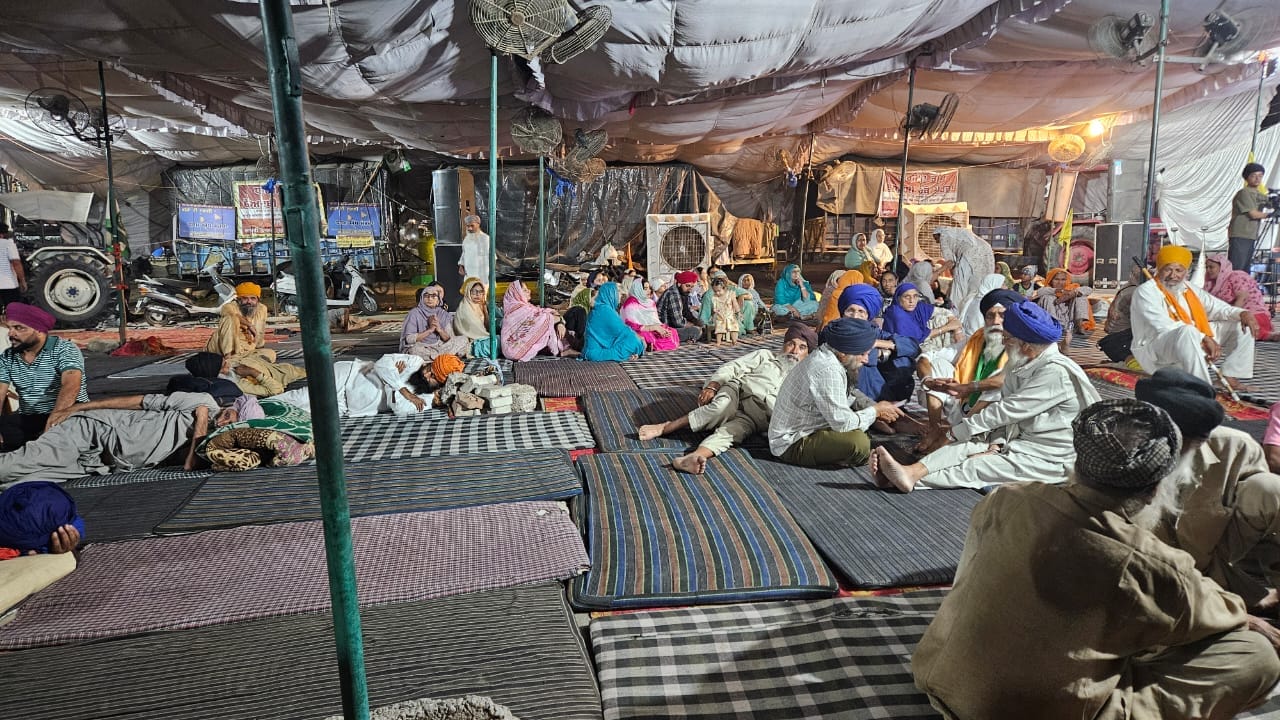
The tower near the tehsil office is adjacent to a children’s park, where a parallel sit-in protest began in support of Khalsa. “Initially, it was called the tower morcha. But later, we named it Sarv Dharam Beadbi Roko kanoon Morcha,” said Gurpreet Singh.
Protests atop high towers are not unusual in Punjab. On several occasions, teachers and other government employees have climbed water tanks to mark their protest and highlight their demands.
“What was different in this case was that this is not a water tank. It is a telecom tower which doesn’t have a regular staircase to reach the top. It is a set of straight stairs, and the height at which Khalsa ji is perched is unprecedented. From the ground, his setup is barely visible,” said Gurjant Singh.
The tower is imposing. One must look carefully to locate the makeshift room, set up barely 20-30 feet from the narrow top, which has been Khalsa’s home for the past 18 months.
There has also been talk about his protest making it to the ‘Guinness Book of World Records’. “Yes, we have heard about some persons in Samana having approached them, but what became of it we do not know,” said a supporter.
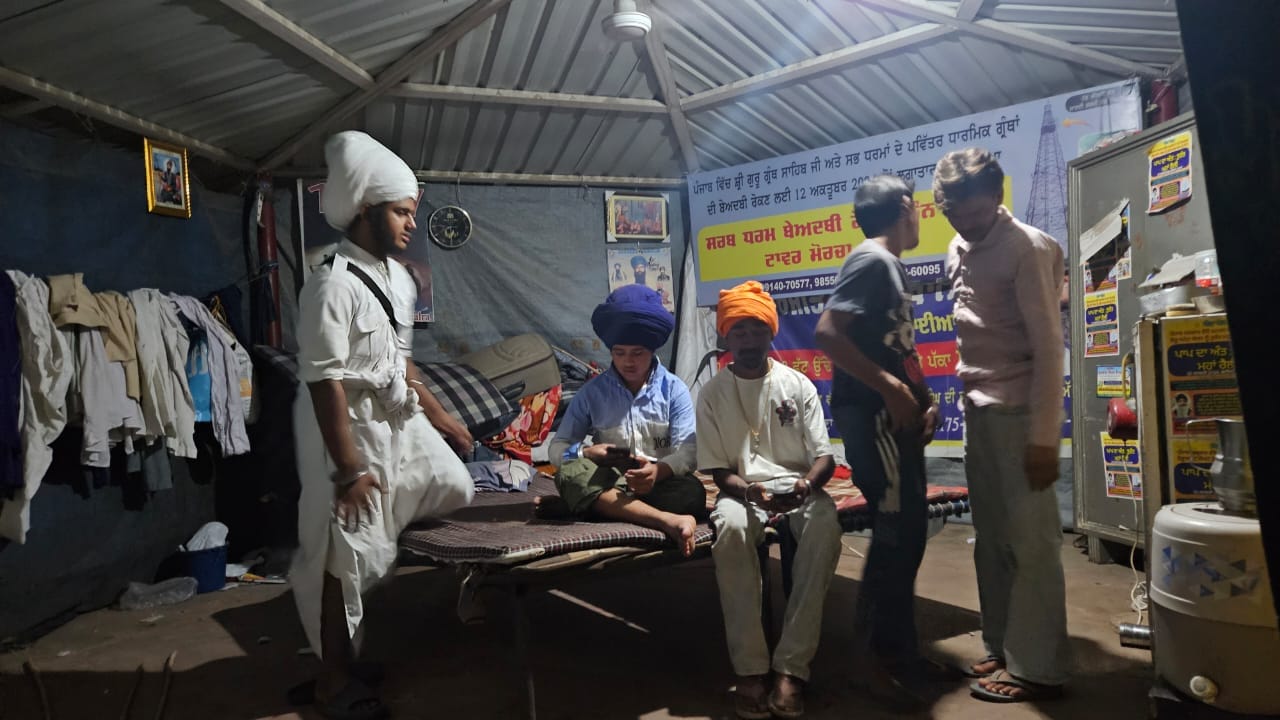
At the base of the tower, life goes on in an uneasy normalcy. Apart from a handful of police officers under the tower and a tented accommodation for his ‘sevadars’ in the park, there is nothing that shows a man living on top of the tower. Residents swarming the park for evening walks seem to have got used to Khalsa’s presence at the top of the tower.
“The administration had stopped bothering about the protest. That is when, in February this year, we decided to shift the sit-in protest [by the other Dharam Yudh Morcha leaders] from inside the park to the Banda Singh Bahadur roundabout,” said Gurpreet Singh.
Also Read: ‘Defaming Punjab’: State Congress chief Warring sends Zee5 legal notice for ‘Lawrence of Punjab’
Life at 400 feet
In the early days, videos circulating online showed Gurjit Singh Khalsa exposed to the elements—sitting on a narrow ledge, with little more than resolve to hold him there. However, as days turned into weeks, the protest adapted. Supporters build a tent to shield him from the sun and rain using plastic sheets. The bedding also evolved, from thin mattresses to wooden planks, and eventually, a small cot. A battery system for light was lowered daily for charging and hauled back up.
Everything about life at that height is improvised. Food arrives twice daily. Water is rationed carefully. Waste is managed through a makeshift system—a modified chair and collection bags handled on a small extension of the platform.
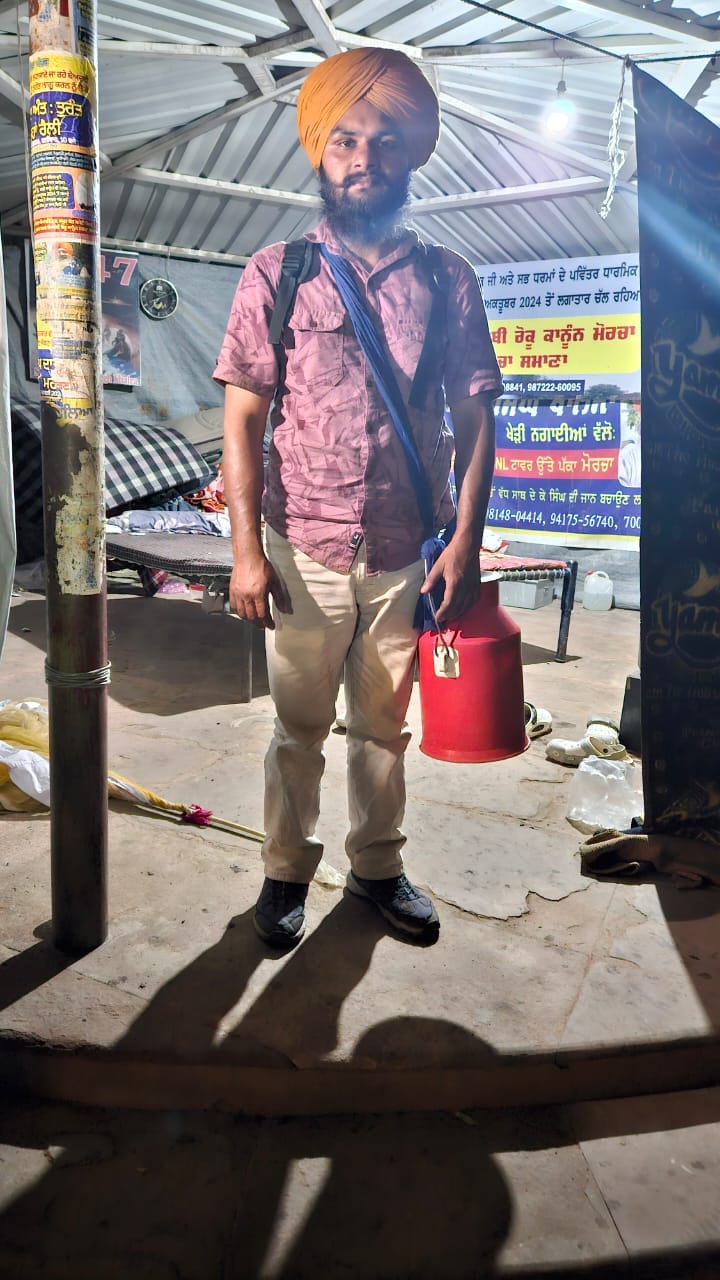
Gurjant Singh and Sahib Singh climbed to the perch every day, at least twice a day, and have largely been responsible for creating the shelter. They carried food, water, and whatever else Khalsa needed to the top. The climb itself was punishing: a vertical ascent along narrow iron rungs, with little room for error.
Gurjant Singh said, “For the first eight to nine months, Pargat Singh also did the same ‘seva’ but had to opt out because of his family circumstances.”
“It takes almost half an hour to reach the top and another 15 minutes to climb down,” added Gurjant Singh, who was carrying on his body a large casket of water, a large battery, food and other essentials Khalsa needed. “The weight of all this is almost 30 kg, but now we are used to it and in any case ‘vaaheguru (God)’ is with us all along.”
Before he began his climb, Gurjant Singh signed a declaration and gave it to the policemen sitting under the tower. “The declaration says that I will be responsible for any accident that might happen on the way up or down. We have to sign it every time before the climb. Instead of giving us safety harnesses or facilitating us, the administration just wants to run away from all responsibility,” he said.
“It’s extremely windy at the top, and balancing oneself is a challenge. Also, the perch gets extremely hot in the summer, and so does the metal structure. Despite it all, the fact that a person is sitting on the tower hasn’t prompted the BSNL authorities to shut down the tower,” he added.
Over time, Khalsa has remained in touch with the world through his mobile phone—giving interviews, going live on social media, and turning his solitary protest into a visible, if distant, presence. “He is mostly doing ‘paath’, reading scriptures,” said Gurjant Singh.
But the body has its own limits. Months of near-immobility have taken a toll. “I am not sure if I will be able to move my legs properly because I have been virtually caged in this small space. But if I am not moved by the 24th, I will attempt to come down on my own, leaving everything to God,” Khalsa said in an interview with a YouTube channel Wednesday.
There have been warning signs: he reportedly fainted over a dozen times during his time on the tower. “Some months ago, when Khalsa ji was very unwell, we had to take a private doctor with us to get his blood sample,” Gurjant Singh said.
“Khalsa ji was determined from Day 1 that he would not give up his protest. The administration initially tried to convince him to come down. But he has consistently refused. He has even claimed to have taken his licensed weapon with him on top, telling us that if anyone tried to bring him down forcibly, he would shoot himself,” said Gurpreet Singh.
Sit-in claims victory
At the Banda Singh Bahadur roundabout in Samana, members of the Dharam Yudh Morcha are impatiently waiting for the hero of the protest to attend the ‘ardaas of the akhand paath (unbroken recitation of the Guru Granth Sahib)’, expected Friday.
“We are hopeful that he will be here with us for the ardaas,” said Gurpreet Singh, who added that the Act—now in place—would not be a reality had it not been for Khalsa.
“In 2021, we started the ‘aath pehar tehal lehar’, as part of which villages were encouraged to volunteer to watch over Gurdwaras and other religious places in teams and shifts to ensure no incidents of sacrilege occur. Then, when Khalsa ji announced that he would be sitting on top of the tower till the law is in place, we shifted our focus to the protest and started a sit-in dharna in the park,” said Gurpreet Singh.
“As the protest gained momentum over the months, we announced that no funds would be sent by anyone to the organisers of the morcha,” added Gurpreet Singh.
“Last year, during the summer, Khalsa ji’s condition deteriorated a lot, and the government panicked. They called us for a meeting. In a meeting in early May last year with Chief Minister Bhagwant Mann, it was decided that a state act would be brought in to provide for harsher punishments for anyone who disrespects religious texts of any religion, with special provisions for Guru Granth Sahib, which is considered to be a living Guru by the Sikhs. We were told to prepare a draft bill for the proposed act. The bill we prepared was tabled in the Vidhan Sabha but was sent to a select committee for consideration,” said Gurpreet Singh.
While the protesters were assured that the select committee would give recommendations within six months, nothing happened. “The period of 6 months finished in January, and in February we escalated our protest by shifting from the park to the Banda Singh Bahadur roundabout,” added Gurpreet Singh.
While all this was going on, Baba Sewa Singh Rampur Kherawale began negotiations with the government and suggested that the pre-existing 2008 Jaagat Jot Satkar Act be amended to add provisions for harsh punishments. “A joint meeting was held in March with Baba Sewa Singh ji, us, and other members of the Sant Samaj with the government on 21 March, after which the chief minister announced an amendment to the existing Act,” said Gurpreet Singh.
(Edited by Madhurita Goswami)
Also Read: Punjab’s anti-sacrilege law doesn’t guarantee justice. What more needs to be done