







Chennai: Nearly a fortnight after a forest fire broke out on 15 April in the Wenlock Downs area of the Parsons Valley Range in the Nilgiris in Tamil Nadu’s Ooty, a fresh blaze erupted an hour’s drive away in Masinagudi late Monday.
From Wenlock Downs, the forest fire had spread over nearly 5,000 acres over the last two weeks. However, forest department officials claimed to have largely contained the blaze, even as rescue operations continue.
While no human or wildlife fatality has so far been reported, the assessment is still ongoing.
The blaze threatened to level parts of the ecologically sensitive Mudumalai Tiger Reserve and its protected ranges within the larger Nilgiri Biosphere Reserve, a key biodiversity hotspot in the Western Ghats. High-speed winds blasting across the Parsons Valley, Pykara, and Singara ranges caused the flames to spread rapidly, said forest officials.
The fire is being attributed to strong gusty winds and dry forests, among various other factors. These, along with the difficult hilly terrain, have severely hampered efforts to contain the fire, as well. The forest department has now resorted to aerial operations.
Speaking to ThePrint, Mudumalai Tiger Reserve director R. Kiruba Shankar identified high temperatures as “the primary cause of the fire”, besides low humidity, which remained at “roughly 30 percent across the last ten days”. “The fire spread aggressively due to shifting high-speed winds that carried the flames across ridges and valleys,” he said.
The blaze reportedly affected more than 20 locations, including areas near Avalanche Valley. These locations have been experiencing drought-like conditions, with extremely dry vegetation.
Large stretches of dry deciduous forests have now been destroyed. The blaze is expected to impact critical habitats of tigers, elephants, and several bird species.
“There is a lot of fuel, because of dried vegetation, undergrowth of dry grass, and fallen logs and leaves,” said Kiruba Shankar. “The winds escalated the fire, and the difficult terrain has made the rescue operations difficult. While the blazes are now in control, the containment measures and assessment of the fire are being undertaken.”
Forest fires have become an almost annual phenomenon in the Nilgiris, with several outbreaks between February and June over the last five years.
In 2021, the Nilgiris experienced 14 forest fire incidents, with significant damage in the Wenlock Downs area from eight fires. However, the rains later brought some respite.
In 2022, there were comparatively fewer fire incidents, including 8 incidents in the summer.
By 2023, these fire incidents had risen to more than 25, including 17 in Wenlock Downs.
By early April 2024, the Nilgiris had seen 37 fires, including a significant incident in March. Multiple fires broke out across Nilgiris and Mudumalai last year, too.
After March 2024, the current fire incident is the largest that the region has experienced—and it appears far worse.
Since 15 April, the rescue and firefighting efforts have had to be significantly scaled up.
Tamil Nadu Fire and Rescue Services personnel, along with personnel from the State Disaster Response Force (SDRF) and National Disaster Response Force (NDRF), are currently working in the region.
More than 500 personnel, including teams from neighbouring Coimbatore, Dindigul, Sathyamangalam, Dharmapuri, Salem, and other divisions, have been called in for ground operations.
Nilgiris District Collector Lakshmi Bhavya Tanneeru earlier requested SDRF for aerial intervention, realising that the fire’s intensity and uphill spread required support beyond ground personnel.
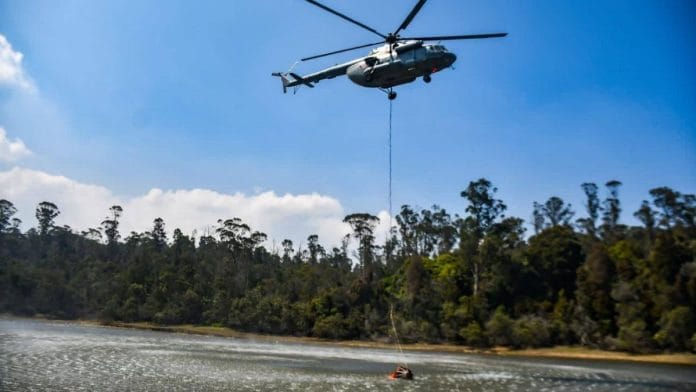
Two Indian Air Force Mi-17 V5 helicopters had been deployed from the Sulur Air Force Station last week to douse the fires using ‘Bambi bucket’ operations, during which water is drawn from nearby reservoirs and dropped on the fires. The high wind speed in the upper reaches, however, made aerial manoeuvring risky, leading to suspension of helicopter operations.
Currently, ‘Bambi bucket’ operations are being attempted again.
Local villagers living on the fringes of the forest, including tribal communities in Masinagudi, Moyar, Pykara, and nearby hamlets, are having to deal with thick smoke from the fire. The blaze has restricted their daily movement and disrupted their livelihoods. This is especially relevant for those who rely on minor forest produce and livestock grazing.
Also Read: Phoenix in the wild: An endangered plant in UP’s Terai rises from ashes of forest fires
‘Human-induced’
The intense heat and dry conditions of the pre-monsoon months, such as dry vegetation, play a key role in causing forest fires. But, there are also human-induced factors to consider.
Professor B. Ramakrishnan, working with the wildlife biology department at Ooty’s Government Arts College, noted that this year’s fire was more severe compared to those of recent years.
He linked this intensity to changing climate patterns, as well as the build-up of vegetation.
“The fires earlier were not as intense as this year’s. Over the last four to five years, the incidents were sporadic, and the damage was minimal,” said Professor Ramakrishnan.
“The dry season had been a risk in the region, but earlier, we received short spells of rain in the summer months. Climate change has checked that phenomenon. Now, there is no short spell which can prevent forest fires,” he explained.
Another problem? The overgrowth of vegetation, in which invasive species dominate.
Earlier, teak, axlewood, rosewood, sandalwood, bamboo, Indian gooseberry, and grass (vayals) dominated the ranges.
The British extensively altered this landscape in the years preceding Independence, introducing non-indigenous species such as pine, eucalyptus, and wattle to the Nilgiris. Since then, there has been significant commercial exploitation as well. These changes, according to experts and studies, have transformed relatively fire-resistant ecosystems into highly flammable ones.
With no big fires before the 15 April incident, the vegetation had overgrown and become “more conducive to the spread of fire on a large scale,” Professor Ramakrishnan told ThePrint.
Human activities in the fringes of the forest—grazing, resource collection, and occasional intentional burning—often trigger fires, as well. Some fire incidents are also suspected to be deliberate, triggered either under the belief that it will drive away wild animals or to encroach into forests.
A forest official in the Mudumalai range said, “There is no one specific factor responsible for forest fires. Possible causes include accidental sparks from dry plantations, waste burning, grazing activities, or even deliberate moves to burn the vegetation.”
Echoing these sentiments, A. Kumaraguru Arumugam, a conservation scientist who is also director at the Biodiversity Conservation Foundation, said, “There are two reasons behind the Nilgiris’ forest fires. The high temperatures—after the pine trees become completely dry—are often the cause…. Also, there are activities in which a fire is intentionally started.”
“High wind speed acts as a catalyst in the spread of the fire,” he added.
According to Kumaraguru, overgrazing and land encroachment cannot be ignored.
“Many people want cattle grazing to be allowed in forest areas. They are motivated to encroach on land by the land mafia. They develop hamlets for cattle, and later, they seek ‘patta (ownership papers)’ for the land, which doesn’t remain a forest anymore,” said Kumaraguru.
(Edited by Madhurita Goswami)
Also Read: Number of forest fires drop from 3.45 lakh in 2020 to 2.03 lakh in 2024, loss of wildlife not known