





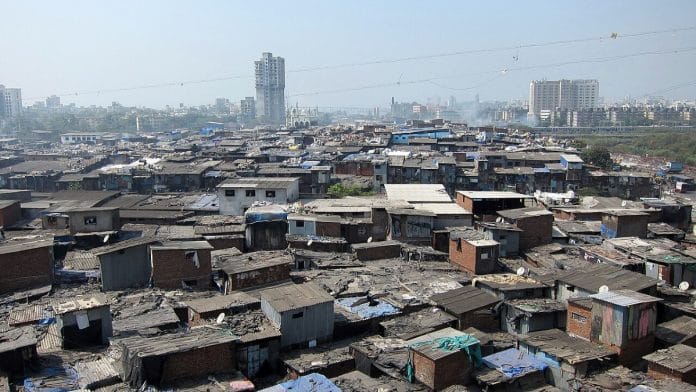



Mumbai: The Maharashtra government is struggling to fulfill the basic prerequisite for the ambitious makeover of the Dharavi slum sprawl. Two years after initiating the exercise, it has been unable to survey all the residents of Dharavi, known as Asia’s largest slum, to determine their eligibility for free, in-situ housing, as part of the multi-crore project.
Over 25 percent of the hutments surveyed have not provided complete documents, either because they are opposed to the project in its current form, or have property disputes within the family or disputes with their landlord, officials involved in the exercise said.
A few others have steadfastly refused to even participate in the survey.
The state government’s Dharavi Redevelopment Project (DRP) Authority has now given a 15-day ultimatum to all residents as a “last opportunity to submit the requisite information and documents related to their respective structures,” as per a notice published by the authority in public domain.
“…It has been observed that despite repeated written and oral communications, you have not submitted the information and documents required for the process of eligibility determination till date,” it read.
“Therefore in strict compliance with the principles of natural justice, procedural fairness, and transparency, this final notice is hereby issued by DRP/Slum Rehabilitation Authority granting a last opportunity to all concerned household heads within the Dharavi Redevelopment Project area to submit the requisite information and documents relating to their respective structures,” the notice added.
The DRP had started the survey in March 2024 and was initially hoping to complete it by the end of fiscal 2024-25.
“The survey exercise has gone on for longer than we expected. But, we are at a saturation stage now. Wherever possible, we have completed surveying hutments and documents. Now, it is just these 25-30 percent people who are left, and we are trying our best to convince them to come forward,” Dharavi Redevelopment Project secretary Vipin Paliwal told ThePrint.
According to the stated norms for the project, those living in hutments that existed on or before 1 January 2000 will be rehabilitated into free houses of 350 square feet each within Dharavi itself.
Those living in structures created between 1 January 2000, and 1 January 2011, will get houses for Rs 2.5 lakh outside Dharavi, within the Mumbai Metropolitan Region (MMR), as part of the Pradhan Mantri Awas Yojana (PMAY) scheme. They will also be offered rental housing options.
The plan to redevelop Dharavi has been in the works since 2003, but despite several efforts to get it off the ground, it has been a non-starter. In 2022, the Mahayuti government revived the project by inviting fresh bids and the following year, it awarded the contract to redevelop Dharavi to Adani Realty.
According to state government data, Dharavi spans 259 hectares, of which 173.9 hectares are designated for redevelopment. Currently, 147.4 hectares are estimated to be occupied by slums.
The much-delayed survey
Paliwal said that overall, there are about over a lakh hutments in Dharavi that needed to be surveyed.
The survey is being done in four stages. At the first stage, officials did a physical recce of different neighbourhoods in Dharavi and noted down the details of hutments. Then the second step involved giving the hutments unique identification numbers. Post that, there was a Lidar survey—a high-precision mapping technique that employs remote sensing technology.
After digitally mapping every structure, the final stage of the survey involves collecting and verifying documents to determine eligibility.
Paliwal told ThePrint, of the roughly over one lakh estimated hutments in Dharavi, DRP has been able to survey 91,321 in the past two years. The rest—estimated to be somewhere between 13,000 to 20,000—haven’t even allowed their hutments to be numbered, he said.
Of these 91,321 who have cooperated with the surveyors, 24,161 hutments haven’t been able to submit all the documents required.
“Some don’t have complete documents, some have fights over property, some are on rent and their landlords are not giving documents, some hutments are shut. And some are still holding out, pressing for some of their demands to be incorporated in the project,” Paliwal said, adding that the opposition is stringent in two areas in particular—Dharavi Kumbharwada and 13 Compound.
Kumbharwada is the centre of pottery craftsmanship in Dharavi. The 13th Compound is a hub for plastic recycling where ragpickers process Mumbai’s dry waste.
Special camps and individual notices
Paliwal said, over the next few days, DRP officials will individually visit all the 24,161 hutments to request them to comply with document submission.
“The DRP has also named a specific official to counsel all those completely opposed to the project, understand their demands and see how they can be accommodated to the best extent possible. For example, the people of Kumbharwada want their entire community to be together,” he added.
The DRP had in November last year held a 15-day camp to fast-track the survey and document submission process. It set up centres at five places in Dharavi and heavily advertised the special camp. The authority managed to collect documents from about 2,000-2,500 people during this time.
“If people absolutely refuse to comply, then we will be compelled to go ahead with the process of determining eligibility without them as it is not fair to make others, who have been cooperative throughout the process, wait beyond a point,” Paliwal said.
“Ultimately, our aim is to ensure as many people as possible get a fair chance at being able to be declared eligible under the project as per the state government’s criteria,” he added.
(Edited by Amrtansh Arora)
Also Read: How Covid hotspot Dharavi, Asia’s largest slum, fought against all odds to flatten the curve