








New Delhi: India’s electricity transition is no longer limited to a handful of renewable-rich states. The latest Indian States’ Electricity Transition (SET) 2026 report released Monday shows that transition progress is spreading across the country—even if not at the same speed everywhere.
The report, third edition of the joint assessment by US-based non-profit Institute for Energy Economics and Financial Analysis (IEEFA) and Ember, independent global energy think-tank, evaluated 21 Indian states across three criteria: decarbonisation, readiness and performance of the power ecosystem, and market enablers.
“All the 21 states assessed have advanced on multiple fronts, even as the pace and areas of focus vary,” Vibhuti Garg, Director – South Asia, IEEFA, and co-author of the report, said in a communication.
At a macro level, the report identifies Maharashtra, Rajasthan, Gujarat, Assam, Punjab and Himachal Pradesh as strong overall performers, largely because they score well in two of the three criteria.
The first—decarbonisation—tracks how states are expanding renewable electricity and reducing emissions from power generation. Karnataka remained the top performer, followed by Himachal Pradesh and Kerala.
Karnataka’s “high renewable energy share of approximately 37 percent in the total power procurement mix contributed to its relatively lower power sector emission intensity, reflecting the state’s growing green electricity portfolio”, the report states.
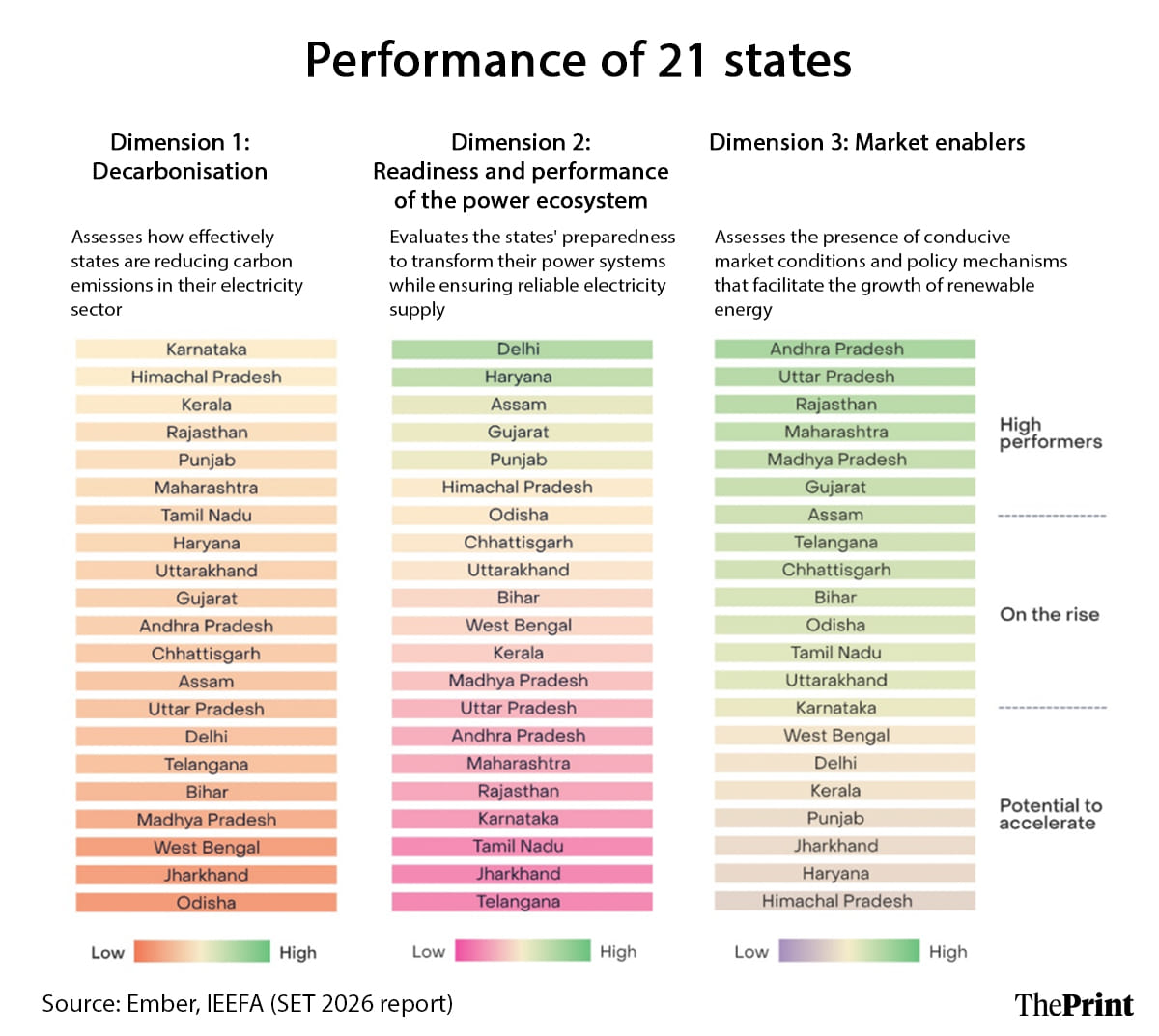
The second criteria—readiness and performance of the power ecosystem—assesses uptake of distributed solar, reliability of power supply and discom (distribution company) performance.
Under this, Delhi and Haryana remained strong performers, supported by robust distributed solar growth, reliable power supply and relatively sound discom performance.
Delhi’s distributed solar numbers stand out. The report notes it has achieved 303 MW of distributed solar capacity, accounting for “97 percent of Delhi’s total solar capacity”.
The third criteria—market enablers—tracks initiatives such as EV adoption, green hydrogen policies and green tariffs.
Andhra Pradesh emerged as a high performer in this dimension, driven by its integrated renewable energy policy and progress in green hydrogen. “With the deployment of smart meters, Andhra Pradesh is actively moving forward to implement the solar-hour-aligned time-of-day (ToD) tariff mechanism,” the report states.
“India’s electricity transition is maturing into a multi-speed transition, where instead of a single leader across all areas, we are witnessing new leaders in specific areas. This requires a more targeted approach to policies and interventions to ensure the momentum is evenly spread,” co-author Ruchita Shah, Energy Analyst at Ember, said in a communication.
States that need improvement
West Bengal stands out for its limited progress despite strong renewable potential.
Renewable energy accounted for only 7 percent of the power procurement mix in FY2024, and the state had utilised just 20 percent of its renewable potential by FY2025. The report cites that energy efficiency gains remain weak despite adopting a State Energy Efficiency Action Plan in March 2023.
Under ecosystem readiness, West Bengal recorded zero power shortages in FY2025, but distributed solar remained low at 80 MW (4 percent of renewable capacity). Smart meter rollout was minimal at 2 percent as of March 2025. On market enablers, EV adoption remained limited at 4.4 percent and the state continues to operate under an outdated 2012 renewable policy.
Telangana also scored low due to weak implementation.
Renewables made up just 14 percent of the procurement mix in FY2024, while renewable potential utilisation remained below 10 percent as of March 2025. Telangana ranked weakest in ecosystem readiness dimension, driven by poor distributed solar uptake and weak discom performance.
Jharkhand continues to struggle, with renewables at only 8 percent of procurement in FY2024 and just 2 percent of potential utilised by FY2025. EV uptake remained nascent at 4.6 percent, while storage and hydrogen pilots have yet to take off.
Recommendations
The report has recommended that states should align power procurement planning with the Ministry of Power’s Renewable Consumption Obligation (RCO) targets across wind, hydro, distributed renewables (≤10 Mega Watts), and other clean sources.
“By embedding RCO trajectories into procurement strategies, states can accelerate renewable energy deployment, reduce fossil fuel dependence, and provide a predictable, long-term demand signal for clean energy,” the report states.
To address financial stress in discoms, the report suggests performance-linked financial support, timely subsidy payments, cost-reflective tariff revisions, and stronger billing and collection systems through digitisation and smart metering.
It also stresses that states must regularly update resource adequacy plans to meet rising demand not only from EVs and green hydrogen, but also from data centres—whose electricity demand is projected to jump from 13 terawatt hours in 2024 to 57 terawatt hours by 2030.
“States should proactively map and forecast demand to avoid supply bottlenecks and ensure that this new energy demand is met through clean energy sources,” the report states.
Co-author Saloni Sachdeva Michael, Clean Energy Specialist at IEEFA, said states can improve faster through reforms such as “strengthening discom finances, ensuring timely subsidies, adopting cost-reflective tariffs, and enhancing billing and collection through digitisation and smart metering”.
(Edited by Nida Fatima Siddiqui)
Also Read: Karnataka, Gujarat best in renewable energy transition, Jharkhand, Bihar lag—think tank report
Is there anything West Bengal is not lagging in ? Seriously why the hell is TMC so incompetent when it’s not so incompetent in playing politics ?