





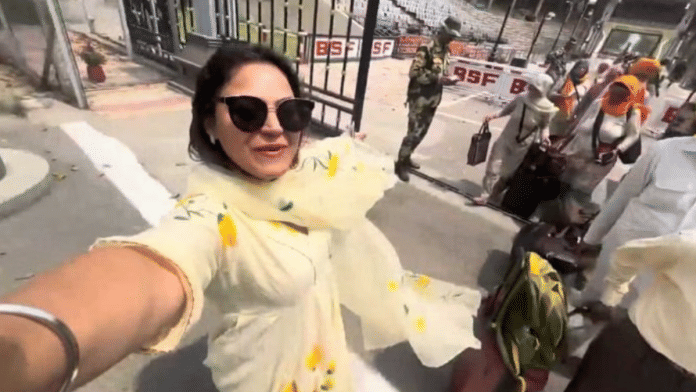



New Delhi: It’s been 10 months since Hisar-based YouTube influencer Jyoti Rani, also known as Jyoti Malhotra, was arrested on charges of violating the Official Secrets Act (OSA), 1923. Her trial, however, is yet to begin. In fact, the court has not even formally begun hearing the charges against her.
The prime evidence against Malhotra is a video of Pandoh Dam in Himachal Pradesh found on her phone, which the police claim is a ‘Category B’ vital installation, videography of which is restricted under the OSA. A 2,500-page chargesheet was filed in October last year, and the court took cognisance of it. The matter has not even advanced to arguments on framing of charges, as the police informed the court of filing a supplementary chargesheet. A Hisar court has heard the matter on four occasions since November last year, but the supplementary chargesheet is yet to be filed.
Meanwhile, the Punjab and Haryana High Court rejected Malhotra’s bail plea, citing the prosecution’s argument that the case was “sensitive”, with the influencer facing serious charges related to “endangering sovereignty and security” of India.
Laughable, says Ravinder Singh Dhul, Malhotra’s legal counsel, on the charges pressed by the police. The case lacks jurisdiction in the first place, he says.
Malhotra’s father agrees cautiously. “I am not sure why she has not been given bail. The photos and videos the police claim she has clicked are being clicked by almost every tourist in these locations,” said the 59-year-old.
“No person in authority is willing to listen to the truth of the case as they don’t want to be seen as soft on her considering the Pakistan angle in the case,” he told ThePrint.

Malhotra was arrested in May last year over a series of alleged communications with Pakistani intelligence operatives (PIOs), including sharing photographs and videos of a sensitive location. Her case was one of a spate of cases lodged by police forces in northern states in the wake of Operation Sindoor over sharing confidential and sensitive information with Pakistani nationals. India had launched Operation Sindoor against terror launch pads in Pakistan and Pakistan-occupied Jammu and Kashmir in response to a terrorist attack in Pahalgam that claimed 26 lives.
The Hisar district police had arrested Malhotra after booking her under provisions of the stringent OSA, 1923, after she allegedly confessed to her communication and association with an employee of the Pakistan High Commission in New Delhi. The employee, named Muhammad Ehsan-Ur-Rahim alias Danish, was later declared persona non grata by the Ministry of External Affairs, and thus expelled.
5 hearings, supplementary chargesheet awaited
The formal crackdown against Malhotra, who ran the YouTube channel ‘Travel with Jo’, began after the Punjab Police informed the Haryana Police about her alleged extensive association with PIOs. Malhotra was then called for questioning by the Crime Investigation Agency (CIA) team of the Hisar district police, where she allegedly revealed the extent of her association with Pakistani nationals, including the High Commission employee in New Delhi.
As part of the investigation, the Hisar district police also seized digital devices, including a laptop and mobile phones, belonging to Malhotra for forensic examination and scrutiny of files stored and shared with PIOs.
Some of those videos were of the Pandoh Dam in Himachal Pradesh, for which the police approached the Bhakra Beas Management Board (BBMB), which manages the dam. “It is also brought to your kind notice that Pandoh Dam is a strategic installation of BSL Project, BBMB Sundernagar, HP and as per the directives of Ministry of Home Affairs falls under ‘Category B’ vital installation and videography of its restricted zones is strictly prohibited under Official Secret Act 1923,” responded the Director (Security) of the BBMB to the Haryana Police.
Additionally, the BBMB remarked that “the unauthorised recording of such sensitive content poses a serious threat to the security of the vital installation”, in response to the Haryana Police’s letter seeking details of a video about the dam.
This explanation by the BBMB management regarding the “sensitivity” of the location shot in the video and the violation of the provisions of the Official Secrets Act, 1923, is one of the primary bases of the case against Malhotra.

“On 23.07.2025, a confidential letter from Director Security, BBMB Chandigarh, stated that Pandoh Dam is a vital installation and videography of restricted zones is prohibited under the Official Secrets Act, 1923. From this reply, it was found that Jyoti Rani violated the Official Secrets Act, 1923,” the investigating officer told the High Court.
On the other hand, Dhull argued before the High Court that it is not a “prohibited area, and that most of the details & photographs of ‘Pandoh Dam’ are already in the public domain, as the same have been posted on the website of the concerned department.
The Punjab and Haryana High Court last Saturday rejected Malhotra’s bail application, citing prima facie evidence against her that supported the Haryana Police case that she was indulging in anti-national activities and passing on secret and confidential information to Pakistan Intelligence Operatives (PIOs).
Dhull, argued before the court that the Haryana Police had no material evidence to justify invoking the OSA and that they were not the competent authority to lodge a complaint under this law. Hence, he said that his client has decided to challenge the High Court’s rejection of the bail application before the Supreme Court.
“Our argument on the points of non-maintainability of FIR in view of the specific provision contained in Section 13 of OSA has not been considered by the High Court. As per the instructions of the client, we will be approaching the Supreme Court,” Dhull told ThePrint.
“There is a plethora of cases decided by the Supreme Court and High Courts in the country based on the competent authority to lodge a complaint against any accused under OSA. This has to come from the Ministry of Home Affairs or any officer granted authority by the MHA,” Dhull further said.
On the other hand, the trial court in Hisar is yet to consider charges slapped on Malhotra by the district police. She has been charged under sections of the OSA, 1923 that penalise spying and illegal communication with foreign agents and Section 152 of the Bharatiya Nyay Sanhita, 2023 that deals with offences endangering the sovereignty, unity, and integrity of India.
Also Read: Gangsters, murders & gun culture—67 songs glorifying crime taken down in Haryana STF crackdown
‘From the first meeting in 2023 to sharing population details’
The Hisar Police informed the High Court that Malhotra confessed to meeting Danish in 2023, when she visited the High Commission for a visa to Pakistan.
The police further alleged in submission to the court that they exchanged numbers and were in regular touch with each other, followed by Malhotra making two trips to Pakistan. There, she met one of Danish’s acquaintances, Ali Adhyan, the police have alleged.
“During her stay, Ali Adhyan also arranged meetings with Pakistani security officials and Italian officials where she came into contact with Shakir and Rana Shahbaz. She obtained Shakir’s mobile number and saved it in her mobile phone under the name ‘At Rachawa’ to avoid suspicion,” the Haryana Police have said in their response to Malhotra’s bail application before the high court.
The Haryana Police’s investigating officer further alleged that “she remained in constant contact with all the above-mentioned individuals through social media platforms such as WhatsApp, Snapchat, and Telegram, and exchanged anti-national information”.
“The interrogation of Jyoti Rani revealed that Ehsan-ur-Rahim was in contact with the Pakistani intelligence agency operatives,” the IO further submitted, adding that Rahim was expelled from the country by the MEA on charges of spying for Pakistan.
Following her disclosure and Danish’s expulsion by the MEA over espionage charges, the Haryana Police registered an FIR, which was followed by her arrest. During the course of the investigation, Malhotra was found to be communicating via WhatsApp calls with several Pakistani contact numbers, as well as through texts, which were deleted from the chats, the police investigation revealed.
Additionally, the Haryana Police officer submitted before the High Court that Malhotra obtained her visas to Pakistan directly through Danish, rather than through religious organisations with whom she claimed to have been travelling to Pakistan.
“Her disclosures show she was provided special accommodation and an internet hotspot by Pakistani intelligence-linked persons during her visits. She admitted that increased followers and monetary temptation motivated her to strengthen links and share secret information. She met Pakistani intelligence-linked persons privately in Lahore and shared sensitive details of her movements in India,” the Haryana Police alleged in its response to Malhotra’s bail application.
“All the above facts indicate that the petitioner/accused Jyoti Rani was working in coordination with Pakistani intelligence agencies and was involved in anti-national activities.”
(Edited by Nardeep Singh Dahiya)