





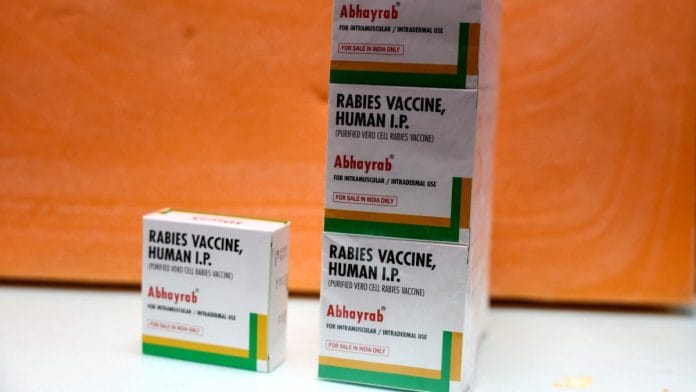

New Delhi: A batch of Abhayrab, one of the most commonly-used rabies vaccines in India, has come under scrutiny after vials seized from a residential address in Delhi were found to be “Not of Standard Quality” and misbranded by the Central Drugs Laboratory (CDL), Kasauli.
The vials, labelled as Abhayrab batch KE25012, were seized during a raid at a residential address in Delhi’s Mukherjee Nagar in April and sent to the government vaccine testing laboratory for examination. The laboratory found that the sample failed the potency test.
It also identified multiple differences between the seized vials and the genuine reference samples of the same batch held by the laboratory.
Hyderabad-headquartered Indian Immunologicals Ltd (IIL), which manufactures Abhayrab through its Human Biologicals Institute division, said Friday that the laboratory report recorded 17 differences between the seized vials and the retention samples of genuine KE25012.
“Upon analysis, the samples were reported as Not of Standard Quality (NSQ) and misbranded. The same laboratory report records (17) seventeen differences between that vial and the retention samples of the same batch held at the Laboratory, which we had submitted for batch release,” Sunil Tiwari, VP & head of quality management at Indian Immunologicals Limited, said in a statement.
“On that basis, the vials examined are not a product manufactured by Human Biologicals Institute,” the statement added.
The Central Drugs Standard Control Organisation (CDSCO) has asked state drug controllers to maintain “strict vigilance” over the movement, distribution and availability of KE25012 and take appropriate regulatory action.
In a public notice issued on 5 September, CDSCO said drug regulatory and law enforcement agencies were maintaining “strict and continuous surveillance” against the illegal manufacture, distribution and supply of misbranded and spurious drugs, with coordinated action to identify and disrupt unauthorised drug supply networks.
Four people have been arrested in connection with the case. The CDSCO notice said the arrests were made by Delhi Police and that further investigation and appropriate legal action were under way.
The notice also confirmed that “no part of the batch concerned was exported to any other country”.
The case comes after an earlier counterfeit Abhayrab episode involving batch KA24014, which prompted alerts from health authorities in the US, UK and Australia in February.
Rabies is a viral disease that spreads mainly through the saliva of an infected animal, usually through a bite. Once clinical symptoms appear, the disease is almost invariably fatal. This makes timely and effective post-exposure vaccination critical for people bitten or scratched by an animal suspected of carrying the virus.
A 2025 peer-reviewed study by ICMR, published in The Lancet Infectious Diseases, which surveyed nearly 79,000 households, found that dogs accounted for more than 75 percent of animal bites in India in the past year. It is estimated that rabies kills around 5,726 people in India every year.
India contributes around 36 percent of rabies deaths worldwide. Yet around 20 percent of people bitten by animals do not receive an anti-rabies vaccine, and among those who begin vaccination, almost half do not complete the required course. The vaccine helps the body develop antibodies that can recognise and fight the rabies virus. Administered soon after a possible exposure, it can help stop the virus from developing into the fatal disease.
Also Read: Dog bites & rabies deaths: What data reveals about complex crisis behind stray dogs debate
Was the genuine KE25012 batch affected?
Indian Immunologicals has maintained that the genuine KE25012 batch was manufactured, tested and released through its authorised system.
In a statement dated 4 September, the company confirmed that the samples seized by authorities from the unlicensed premises in New Delhi were sent to the Central Drugs Laboratory, Kasauli, for testing and were reported as “Not of Standard Quality (NSQ) and misbranded”.
It, however, clarified that the genuine batch was tested and released by the Central Drugs Laboratory under Batch Release Certificate CDL/2025/8392 dated 7 November, 2025. The released quantity was 83,370 vials, it said, and these were supplied only through its authorised distribution channel.
IIL also said, “No market complaint has been received in respect of the batch Number KE25012.”
The company said it submitted its batch manufacturing, quality-control, reconciliation and distribution records to CDSCO on 14 August. It also made a representation to the Drugs Controller General of India (DCGI) on 4 September, asking authorities to trace the source of the seized vials and act against those responsible, while offering its cooperation with the investigation.
CDSCO said every batch of Abhayrab is released for sale only after independent testing and batch-release certification by the government vaccine testing laboratory, CDL, Kasauli. It also said vaccines administered at hospitals, clinics and government healthcare facilities, or dispensed through licensed pharmacies, reach patients through the authorised and regulated supply chain.
The regulator also confirmed that “no part of the batch concerned was exported to any other country”.
17 differences between real & seized vials
According to IIL and media reports based on the laboratory findings, the discrepancies included labelling, artwork, QR-code verification, cap colour, licence details and packaging text, as well as differences in the way text was printed and presented.
Specific packaging differences included the use of an apostrophe instead of a comma, “L Posteur” instead of “L Pasteur”,
and differences in font, text spacing and the company logo.The government laboratory also found that the seized sample failed the potency requirement, although it passed tests for sterility, moisture and identity.
The CDSCO has now asked state drug-control authorities to monitor the movement, distribution and availability of KE25012 and take action if necessary under the Drugs and Cosmetics Act, 1940, and the rules made under it.
Accounting for nearly 40 percent of the country’s rabies vaccine market, according to a report by Reuters, Abhayrab is used for post-exposure protection in India. It is given as a series of doses after exposure to a potentially rabid animal. Other commonly used rabies vaccines include Rabipur, Verorab and Indirab.
Given Abhayrab’s widespread use, the issue has also raised questions among people who may have received the vaccine. Hyderabad-based paediatrician Sivaranjani Santosh, in a post on X, advised people who may have received the vaccine to check with a healthcare professional.
“If you have received Abhayrab KE25012 or if you have received Abhayrab on or after 7th Nov 2025, please contact the health care professional. You will have to take the vaccine again if you have the slightest doubt of it being the counterfeit version,” Dr Sivaranjani wrote on X.
For people who have received Abhayrab, the present findings do not mean that every Abhayrab dose administered in India is suspect. “Every batch of Abhayrab is released for sale only after independent testing and batch release certification by the Central Drugs Laboratory,” the company said.
“Vaccine administered at a hospital, clinic, government facility or licensed pharmacy reaches the patient through that released and authorised supply chain and is not affected by this matter,” it added.
(Edited by Amrtansh Arora)