





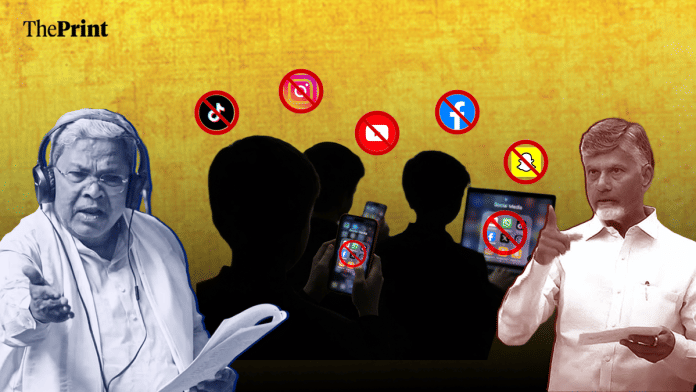



New Delhi: A landmark announcement in two states on the same day—a ban on social media for under-13s in Karnataka and Andhra Pradesh.
In both state assemblies it was the chief ministers, Siddaramaiah and N. Chandrababu Naidu, who announced the ban. In Karnataka it is for those under 16, in Andhra for those under 13, with Naidu saying his government was still debating whether to extend the restriction to up to 16. Naidu added a deadline: The under-13 ban would be enforced within 90 days.
But the biggest question remains unanswered: How? The announcement in neither state has come with legislation, an enforcement mechanism, or clarity on how the ban would actually work.
The most glaringly obvious challenge is constitutional. Information technology falls under the Union list of the Seventh Schedule—Parliament, not state assemblies, holds legislative authority over it. The Information Technology Act, 2000 and the Digital Personal Data Protection Act, 2023, which already require platforms to obtain “verifiable parental consent” before processing children’s data, are both central laws. Any state-level legislation seeking to regulate social media platforms would risk duplicating or directly conflicting with the existing central framework.
Dhruv Garg, a tech policy lawyer at the Internet Governance and Policy initiative (IGAP), says this is the threshold problem. “The very first question is whether it is even constitutional to bring such a ban at the state level. IT comes under the Union list—that itself raises a big question on how a state can implement this ban.”
An industry insider, speaking on condition of anonymity, put the likely outcome plainly. “The ban isn’t going to be enforceable largely, since IT law is a central subject. But this would definitely be an indicator that the central government will need to consider limiting social media access to young, impressionable minds in India—especially since many other geographies are already legislating on this issue.”
Technical hurdles
Nikhil Narendran, Vice President of the ITechLaw Association and Partner at Trilegal, says the jurisdictional problem is significant, though not without nuance. “State government does not have the power to ban social media but has the power to regulate the health of its residents. Practically, it is very difficult to geo-block across different states.”
He also flags a technical complication that goes beyond state borders: Proximity—a user physically in Karnataka but operating a SIM registered in Tamil Nadu, for instance, sits in a regulatory grey zone that a state-level ban has no clear answer to.
On enforcement, Narendran says the modus operandi is entirely unclear. “Will this happen through blocking orders? Would there be criminal suits against social media intermediaries who don’t comply? Or will access to these platforms be treated as a banned activity with parents being responsible? Will it be incorporated into one of the existing laws? One will have to wait for the bill to understand the mechanism. In any event, this will be difficult to implement at a state level.”
Even setting aside jurisdiction, a state-level ban faces a structural problem that no geoblocking order can fix: Social media platforms have no mechanism to toggle access based on which Indian state a user is in. A child restricted in Karnataka faces no such restriction the moment they cross into Tamil Nadu or Maharashtra.
There is also the question of age verification at scale. If the ban requires KYC, it likely means routing minors’ biometric data through private platforms. “Are you going to give power to an external company or tech platforms to conduct that KYC? What is the feasibility, what is the technicality of that?” asks Garg.
Garg also notes the wider policy context. “There is a growing global trend toward greater regulation of children’s access to social media, driven by concerns around online safety, exposure to harmful content and excessive screen time. However, the efficacy of outright bans is still being tested in many jurisdictions, and enforcement remains a key challenge. Most platforms rely on self-declared age, and stronger verification mechanisms—such as ID-based checks or device-level controls—raise their own privacy, data protection and operational feasibility concerns.”
If such a ban were to be operationalised—whether at the state or central level—experts say it would likely require working through at least three distinct steps.
The first is the legacy problem: Existing accounts belonging to under-age users would need to be identified, made defunct, and eventually removed along with associated data.
The second is gatekeeping new users, either through age verification—which requires identity documents and raises the KYC concerns above—or through age assurance, a softer mechanism involving parental declaration or algorithmic estimation.
The third, and most demanding, is continuous assurance: Ongoing monitoring rather than a one-time check at sign-up, requiring platforms to routinely re-verify users.
Meta, asked for comment, backed the intent while flagging the limits of applying restrictions to a handful of major platforms. “We want the same thing as lawmakers: Safe, positive online experiences for young people,” a spokesperson said. “We’ll comply with social media bans where they are enforced, but with teens using around 40 apps weekly, targeting a handful of companies won’t keep them safe. Bans should apply equally across the many apps teens use.”
The company also cautioned that poorly designed bans risk pushing teenagers toward “less safe, unregulated sites, or logged-out experiences that bypass important protections.”
Friday’s announcements were not isolated. Goa IT Minister Rohan Khaunte signalled interest in a similar restriction last month. The Economic Survey 2025-26 called for age-based limits on access at the national level, and at the India AI Impact Summit in February, Union IT Minister Ashwini Vaishnaw confirmed the Centre was in active discussions with social media platforms on age-based restrictions.
“Right now, we are in conversation regarding deepfakes, regarding age-based restrictions with the various social media platforms on what is the right way to go forward on this,” he said—the first public indication from a senior central government official that a national framework was being considered.
French President Emmanuel Macron, also at the summit, made a direct pitch to PM Modi to follow France’s own ban for children under 15, flagging it as a G7 priority.
The international backdrop has shifted sharply in the past year. Australia became the first country to enforce such a ban, which took effect on 10 December 2025—a federal law applying to major platforms including Instagram, TikTok, Snapchat, X, YouTube and Reddit, with fines of up to AUD 49.5 million for non-compliance. Meta removed 544,000 accounts in the weeks that followed.
But the rollout quickly exposed the practical limits of the policy: Teenagers were found drawing facial hair to fool age-estimation algorithms, using older siblings to bypass facial recognition, and switching to smaller unregulated apps and VPN downloads surged in the days around the ban. Two high court challenges are now proceeding.
A December poll showed 70 per cent Australians supported the ban in principle and only 33 per cent believed it would actually work. “The jury is still very much out on Australia,” says Garg, “and that is a federal ban with full national machinery behind it.” Since Australia’s move, France, Portugal, Denmark, Spain, Norway, Malaysia and Brazil have all either passed or advanced similar legislation. The UK opened a formal three-month consultation on the question on 2 March—four days before Friday’s announcements in India.