





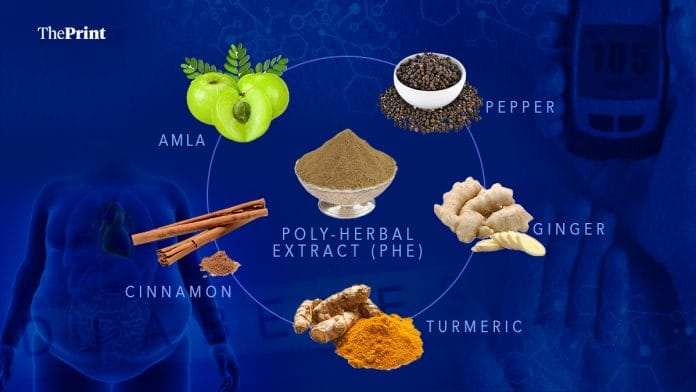



Hyderabad: Scientists at Indian Council of Medical Research-National Institute of Nutrition (ICMR-NIN) have developed a poly-herbal formulation combining five common kitchen spices that they believe will help tackle the long-term complications of diabetes and obesity. Human clinical trials for the poly-herbal extract (PHE) will be conducted soon, running over 18 months, scientists at the Hyderabad-based institute told ThePrint.
The new PHE combines ginger, cinnamon, black pepper, amla and turmeric in precise proportions. According to the scientists, the formulation is expected to not only help manage blood sugar and weight but also target the biological processes that can cause kidney damage, nerve problems and vision loss over time.
“Current medicines primarily focus on controlling glucose levels. But diabetes and obesity also cause long-term complications. This poly-herbal extract aims to target those underlying processes,” Dr G. Bhanuprakash Reddy, scientist at ICMR-NIN, told ThePrint.
Existing treatments for diabetes and obesity focus largely on glycaemic control—monitoring and maintaining blood sugar within a safe range. While this prevents immediate problems like fatigue or dangerous spikes in sugar, researchers say it does not stop the long-term damage caused by these conditions.
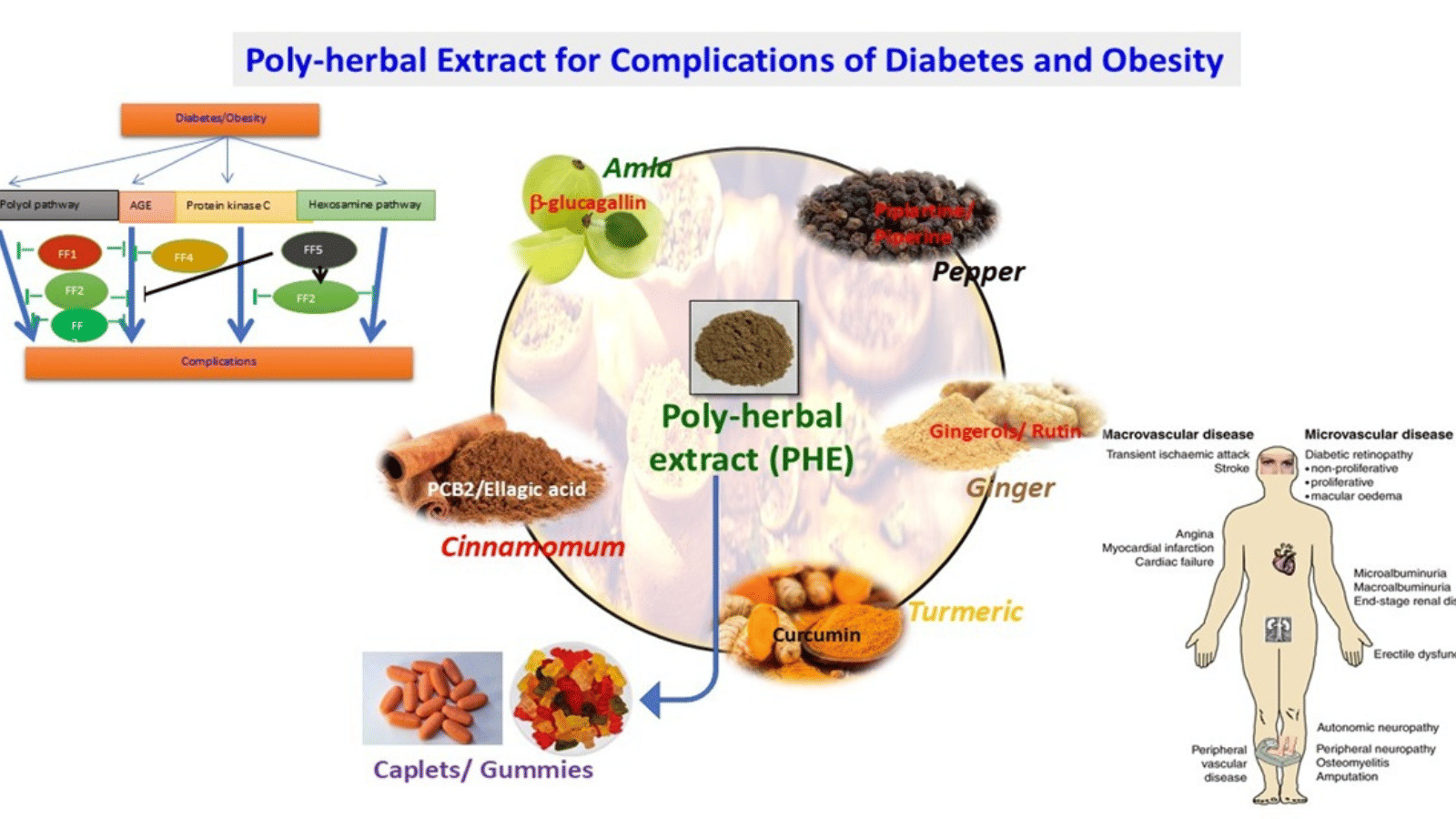
Even when blood sugar is controlled, patients can experience low-grade inflammation, oxidative stress and the accumulation of compounds called Advanced Glycation End-Products (AGEs). These molecules form when sugar attaches to proteins or fats in the body, gradually damaging blood vessels, kidneys, nerves and the retina.
High blood sugar also activates the aldose reductase-mediated polyol pathway, which converts glucose into sorbitol. Sorbitol accumulation in tissues can lead to cataracts, retinal damage and nerve problems. Drugs called aldose reductase inhibitors (ARIs) have been developed to block this pathway, but often fail due to poor absorption or side effects.
“This initiative (PHE) marks a shift toward integrative health solutions,” Dr Bharati Kulkarni, Director of ICMR-NIN, told ThePrint. “We are currently evaluating its efficacy in clinical trials to translate these rigorous scientific findings into accessible products for human use.”
Speaking on the new formulation, Dr Rajiv Kovil, Mumbai-based diabetologist and researcher, said poly-herbal approaches rooted in Ayurveda were promising.
“Current diabetes care still largely targets glycaemic control. Long-term risks of diabetes and obesity include cardiovascular disease, kidney failure, fatty liver, neuropathy, retinopathy, infections and even neurodegeneration. Obesity amplifies these risks. Comprehensive care must address weight, inflammation and metabolic dysfunction—not just glucose numbers,” he said.
“Poly-herbal approaches rooted in Ayurveda are promising, especially with ICMR-backed scientific validation. Ingredients like turmeric and amla have known metabolic benefits. However, robust clinical trials, standardisation, dosing clarity and safety data are essential. Such formulations may complement—not replace—evidence-based diabetes care if proven effective,” Dr Kovil told ThePrint.
Also Read: White rice linked to diabetes, especially in South Asia, says 21-nation study done over 10 yrs
How novel poly-herbal extract works
Dr Reddy explained that each of the five ingredients used in the PHE was carefully chosen for its ability to target certain processes in the body. Turmeric contains curcumin, which fights inflammation, while amla provides antioxidants and vitamin C. Ginger helps lower blood sugar, cinnamon improves insulin sensitivity, and black pepper enhances absorption of the other compounds.
“Initially, we studied each ingredient separately. Based on that, we developed this unique formulation. It is designed specifically to act on the molecular pathways that connect diabetes and obesity to their complications,” Dr Reddy told ThePrint.
He added that preclinical studies in rodents showed that the poly-herbal mix (PHM), the precursor to PHE, could prevent kidney damage, eye problems, nerve damage, and even some early cardiac issues. “The data shows that these complications were prevented in preclinical models,” Dr Reddy said.
Next step: human clinical trials
The extract is now set to enter clinical trials in humans under ICMR’s MedTech grant mechanism that provides funding to promote indigenous medical technologies. Dr Reddy said the trial is still at an early stage, with final approvals and planning under way.
“We are working with an industry partner for clinical evaluation,” he said. “The human voluntary study, scale of extraction, and evaluation of dosages are all pending.”
The formulation is expected to complement standard diabetes care rather than replace existing medicines. “This will be given alongside standard care. Animal data suggests it may even reduce the need for certain medications, but that has to be confirmed in humans,” Dr Reddy said.
He further emphasised the importance of dosage and formulation. “These ingredients are common in Indian cooking, but the protective effects require precise quantities. Too much can cause gastric irritation. That’s why a standardised extract is needed rather than just increasing intake of the spices at home,” he said.
The clinical trial is expected to run for 9-12 months, with full evaluation, including data analysis, taking around 18 months. If successful, the extract could become a functional food-based product, regulated by the Food Safety and Standards Authority of India (FSSAI).
Researchers at ICMR-NIN said their goal is to tackle the underlying causes of diabetes and obesity complications, not just the symptoms, using traditional Indian spices and herbs tested through modern scientific methods.
The reporter was in Hyderabad on a Union health ministry-sponsored visit.
(Edited by Nida Fatima Siddiqui)