





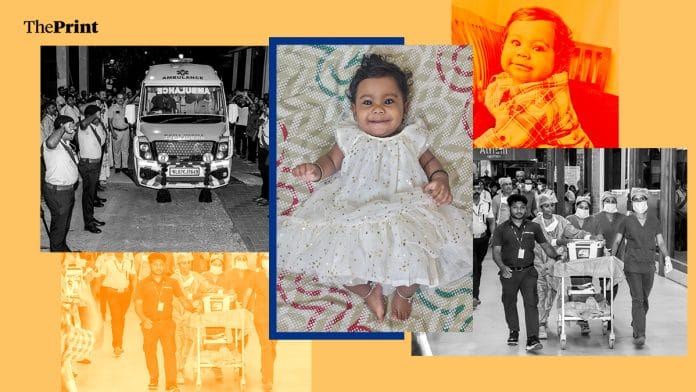



New Delhi: When doctors at Kerala’s Amrita Hospital declared 10-month-old Aalin Sherin Abraham brain dead after a road accident on 5 February, her parents made a decision that would go on to impact multiple families, and spark a conversation around organ donation.
Within hours, the infant from Mallappally in Kerala’s Pathanamthitta district became the youngest organ donor recorded in the state. Her two kidneys were transplanted into a 10-year-old girl on dialysis, while her liver was transplanted into a seven-month-old child with a congenital liver disease.
Her heart valve was sent to the Sree Chitra Tirunal Institute for Medical Sciences and Technology, in Thiruvananthapuram, and her corneas to an eye bank.
The transplants were coordinated by the Kerala State Organ and Tissue Transplant Organisation (K-SOTTO), with procedures carried out in Kochi and Thiruvananthapuram.
For Aalin’s parents, Arun Abraham and Sherin Ann John, the decision was influenced by prior exposure to organ donation awareness campaigns. “We were aware of the need for organ transplants and so it was not very difficult for us. We (the couple) were on the same page,” Abraham told The Print.
Kerala Chief Minister Pinarayi Vijayan hailed the decision. “By becoming Kerala’s youngest organ donor, little Aalin has granted a new lease of life to five others, a monumental act of compassion that reflects the true spirit of Kerala,” he posted on X.
Aalin was laid to rest Sunday with full state honours at St Thomas CSI Church, Nedungadappally, Kottayam.
Also Read: Organ donation does not end with surgery. India must help recipients, donors survive
2 small kidneys, one recipient
Doctors in Kerala said the medical coordination in this case was complex because the donor was a young child. Each of Aalin’s kidneys measured about 5 cm. According to Dr Noble Gracious S.S, executive director-cum-member secretary of the K-SOTTO, a single kidney of that size would not have been adequate for a 10-year-old recipient.
“The transplant team decided to implant both kidneys into the same child—a girl who had been on dialysis at a government medical college hospital and was listed for a deceased donor transplant,” he told ThePrint.
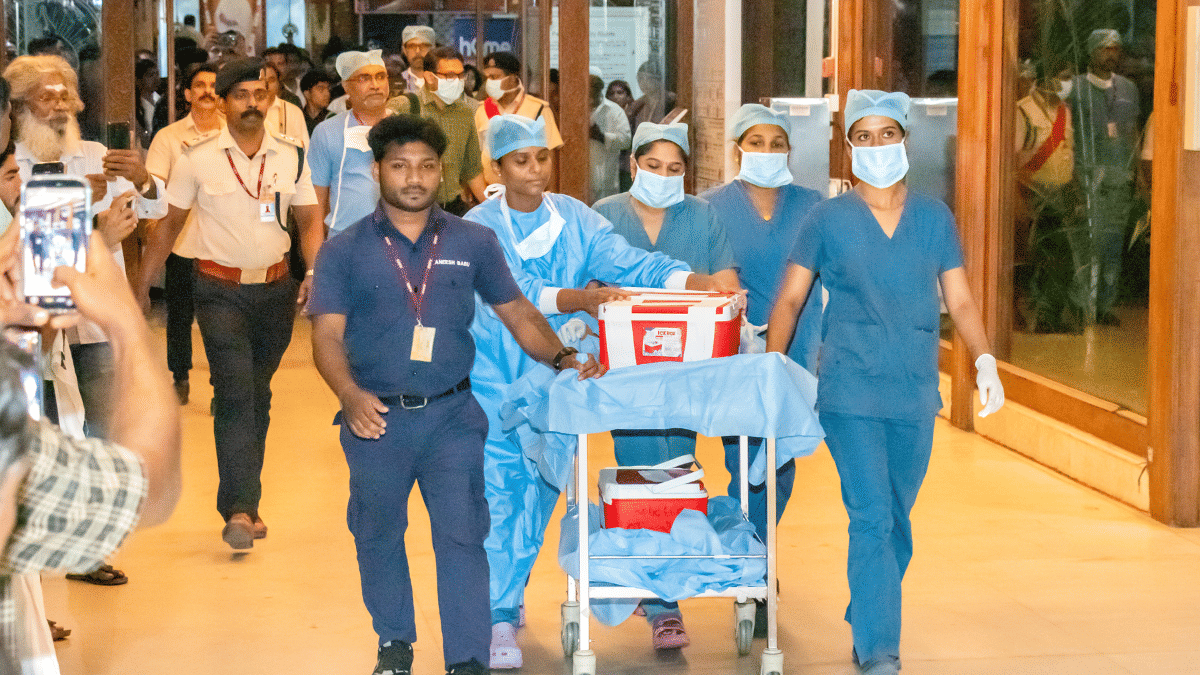
Paediatric patients, the doctor said, are rarely listed for deceased donor organs because the chances of a size-matched child donor are low. “Most children with kidney failure undergo living donor transplants, usually from parents or close relatives,” he added.
In this case, the recipient had been listed, and when the alert came in, the state registry identified her as a suitable match. The surgery began late Friday night and continued into Saturday morning.
The liver transplant took place at KIMS Hospital, a private hospital, in Thiruvananthapuram. The recipient was a seven-month-old child with a congenital liver condition.
The surgical team, led by Dr Shabeerali T.U, Senior Consultant & Chief Coordinator, Hepatobiliary, Pancreatic & Liver Transplant Surgery, said the size mismatch was not a major issue since both donor and recipient were under one-year of age.
“The primary technical challenge was about handling very small blood vessels,” he said.
The liver transplant operation lasted around 10 hours. However, no suitable patients were found for the heart and lungs due to size constraints. But the heart valve was retrieved and sent to the Sree Chitra institute for future use and eyes were donated to an eye bank.
Rare donation
Doctors attribute both biology and systemic issues for the low number of organ donations, where the donor is a child.
Dr Gracious said most brain stem deaths, which is a total and irreversible cessation of all brain-stem functions—the legal prerequisite for deceased organ donation in India—occur in older patients due to intracranial bleeds, strokes or trauma. As a result, child donors are uncommon.
This, he explained, is one reason many paediatric patients are not routinely listed on deceased donor waiting lists. Instead, transplant teams usually plan living donor procedures, with organs donated by parents, siblings or grandparents.
Over time, this creates a cycle in which the system is not fully geared towards paediatric deceased donation, further limiting its frequency.
According to Dr Gracious, Kerala recorded around 11 deceased donations in 2024. In 2025, the number rose to 25. In 2026, till 15 February, there were six donations.
A major bottleneck, he said, is brain stem death certification.
Although brain stem death certification is mandatory for donation under the Transplantation of Human Organs and Tissues Act, it is not routine practice in many hospitals. The law requires certification by a board of four doctors. Two separate examinations must be conducted, with a mandatory interval of six hours in adults and 24 hours in children.
In paediatric cases, once the first certification is completed, doctors must wait 24 hours before conducting the second. During this period, the child has to be maintained on a ventilator with stable circulation, Dr Gracious said.
Keeping a brain-dead donor medically supported for that duration can be medically and logistically challenging, he said.
Even after certification, hospitals must obtain family consent, coordinate with transplant authorities, identify recipients, arrange operation theatres, mobilise surgical teams, and manage organ retrieval and transport. The entire process requires substantial human resources and coordination, which not all centres are equipped to handle, he said.
Paediatric deceased donation remains particularly rare also because most brain stem deaths occur in older individuals, the pool of potential child donors is limited.
Consequently, few children are listed for deceased donor transplants.
In the Kerala case, both the 10-year-old kidney recipient and the seven-month-old liver recipient had already been listed on the deceased donor waiting list.
The national picture
India has seen a steady increase in organ transplants over the past decade, performing over 18,900 procedures in 2024, up from around 5,000 in 2013. However, deceased donations remain low. There were around 1,128 deceased donors in 2024, and the deceased donor rate is still below 1 per million population.
This is far lower than top-performing countries like Spain, which has more than 40 donors per million.
Most transplants in India continue to come from living donors, highlighting a persistent gap between demand and supply despite growth in overall transplants. Thousands of patients remain on waiting lists for kidneys and livers across the country.
(Edited by Ajeet Tiwari)
Also Read: The desperate hunt for organ donors in India. Families fight red tape, distrust, ignorance
Public awareness for organ donation received a significant and heartening boost recently. We must applaud the noble sacrifice made by the family of baby Aalin Sherin Abraham, as well as the visible commitment shown by the CSI Church and the Kerala Government toward this vital cause.
However, we must lament a sobering reality that analysis and prevention of the very road accidents that lead to such tragedies rarely receive the same level of mobilization. It needs legislative action. It must be mandatory to use approved car seats for infants and children, treating their safety with the same legal earnestness as adult seat belt requirements for both front and rear passengers.