





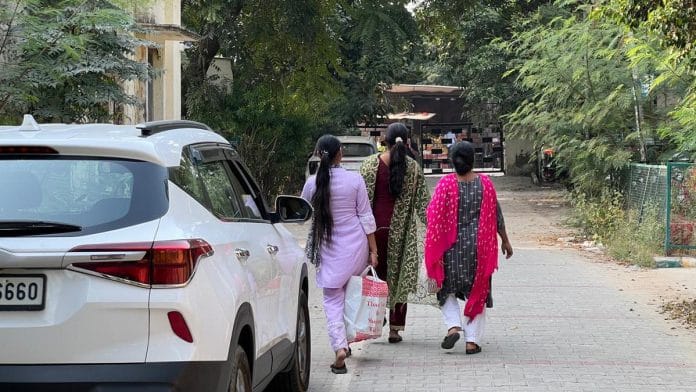



Kapurthala: For five hours, 28-year-old Ranjit waited outside a private clinic in Amritsar, desperate for help. The doctor refused to see her until a female attendant arrived. None came. Finally, they called the cleaning lady to escort Ranjit inside.
“She called me a ‘smackan’,” Ranjit said, referring to a derogatory term for drug addicts. “I remember the despair I felt when the doctor refused to let me in. The whole visit was over within five minutes. At that moment I felt that recovery was impossible for me.”
She was not just a heroin addict. She was a female heroin addict. And in Punjab’s war on drugs, the battle faced by women like her has been rendered almost invisible. Women addicts are often abandoned by their families, shamed by their neighbours, and branded as ‘dangerous’ by the medical community that’s supposed to help them. There are barely any facilities to treat them.
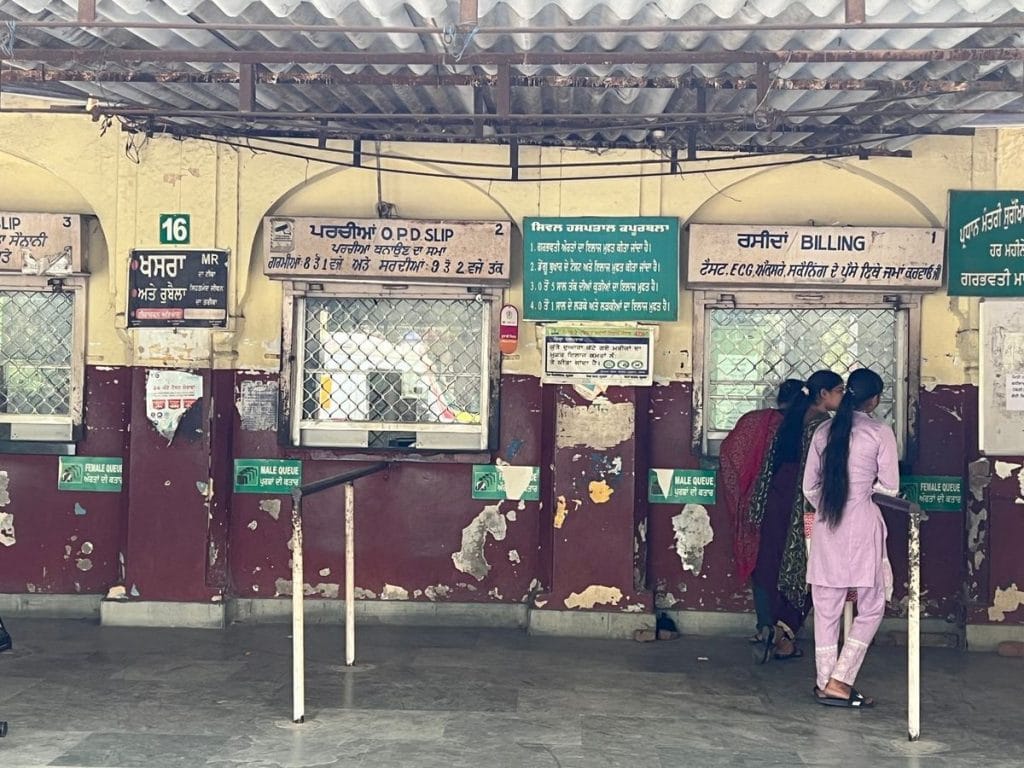
Now 33, Ranjit waits for her turn at the billing counter of Navjeevan De-addiction Centre at Kapurthala Civil Hospital — paint peeling off the corridor walls, a handful of women seated on plastic chairs nearby. She’s been getting methadone treatment here for three years, travelling nearly 60 km by bus from Beas for weekly visits.
She has no other affordable option. Among 31 state-sponsored de-addiction centres across the state, Navjeevan is the only one that provides specialised services for women.
The exact prevalence of addiction among women is hazy due to a culture of silence and a lack of recent studies. However, a 2023 Rajya Sabha reply cited state-specific data from the 2018 National Survey on Extent and Pattern of Substance Use in India, which estimated that 7.87 lakh women in Punjab use cannabis (6.44 percent prevalence), 45,000 use opioids (0.37 percent), and 52,000 use sedatives (0.43 percent).
When Navjeevan conducted a pilot outreach program in 2017 in Kapurthala district, targeting 225 women, they found 400. Outreach workers estimate that the real number exceeds 1,000 in just that one district.
It is more common to find parents abandoning their daughters for engaging in drugs. The males get the privilege of being ghar ka chirag, and so resources and help are poured in for them more voluntarily compared to the females
-Dr Sumeet Kaur Madaan, psychiatrist at Kapurthala Civil Hospital
Doctors at Kapurthala say patterns of drug abuse are similar for men and women. Most patients are between 15 and 35 years old and are dependent on heroin or chitta, alcohol, and pharmaceutical opioids such as pregabalin and buprenorphine.
Under Yudh Nasheyan Virudh, the ‘war on drugs’ launched by the Punjab government last March, the state has so far focused on dismantling the supply chain that makes drugs accessible in the state. Within the first month, the police also lodged 407 FIRs against women for drug smuggling. However, there has been little to no emphasis on treatment for women addicts.
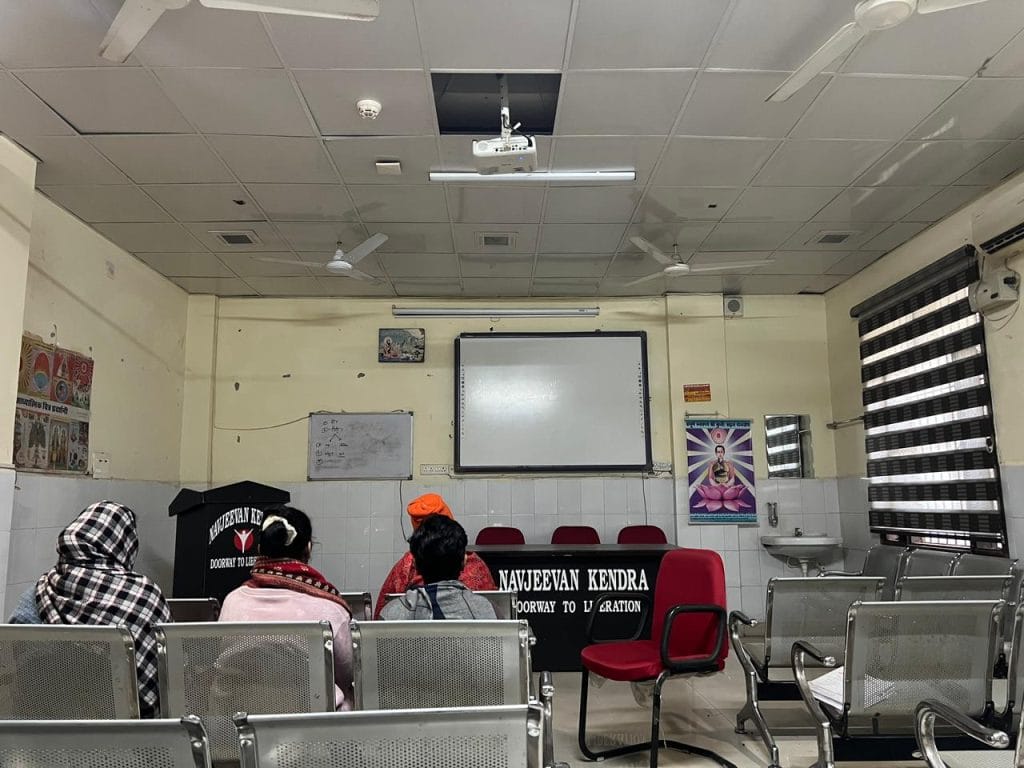
Government officials claim that the biggest hindrance is that women themselves don’t seek help due to social stigma.
“We are aware of the problem [of drug addiction among women]. The main thing should be to get rid of the stigma. Even if there’s infrastructure it would be of no use because women won’t come out,” said Shaleen Mitra, Officer on Special Duty to the Punjab Health Minister, who leads the strategic design and implementation of Yudh Nasheyan Virudh. “Even if you go to Kapurthala, there would only be a few women admitted.”
But at Navjeevan, women sometimes travel over 100 kilometres to make it to the OPD, which operates between 9 and 11 am; doctors say they see as many as 15-20 women daily. For some, the distance offers much-needed anonymity.
“It ensures secrecy, no one here knows me, it is safe. Back at my place, people told my brother that it was a disgrace that his sister was a ‘blackiya,’” said Khushpreet, who comes to the OPD at least thrice a month from Ludhiana’s Khanna, 121 kilometres away.
Also Read: Dalit women reclaiming Punjab’s farmlands. ‘We are born on this land, have a right to it’
Too ‘dangerous’ to touch
At Kapurthala Civil Hospital, the men’s and women’s de-addiction wards are designed differently. While CCTV cameras monitor the women’s ward, there are none in the men’s.
“It is to ensure safety, as dealing with women patients is viewed as riskier,” said a staff member. The fear isn’t that women will hurt themselves but that they might create ‘trouble’ for staff.
It’s a sentiment that ripples through the private medical sector. Many clinics simply shut their doors to women, viewing them as a liability rather than a patient group in need.
“Female drug addicts require a lot of care, they need separate wards and staff, they can also press false legal charges, this is why many are hesitant to help them,” says Damanpreet who runs a private de-addiction facility in Amritsar.
Women addicts are often treated as ‘doubly deviant’— violating not just social norms by taking drugs but also violating their prescribed gender roles and moral codes. Due to such perceptions, female users are frequently perceived as harder to treat.
The male staff members started scolding me instead of helping. They said that it was dangerous to touch me because I was a woman and drug addicts can trap them in legal tussles by their false antics
-Kamalpreet, recovering addict
For the women who do seek help, this culture of suspicion can be deeply dehumanising and discouraging. For Ranjit, who initially sought treatment in the early stage of her addiction, the experience in Amritsar caused her to abandon it altogether for several years.
Similarly, Kamalpreet, 30, discovered that seeking treatment meant navigating a world where doctors, outreach workers, and even NGO staff kept her at arm’s length. She recalled a harrowing moment at a facility in her hometown of Moga when she collapsed from dizziness and exhaustion.
“The male staff members started scolding me instead of helping. They said that it was dangerous to touch me because I was a woman and drug addicts can trap them in legal tussles by their false antics,” said Kamalpreet.
The irony is that women addicts are often the most vulnerable to exploitation. While the system views them as a legal risk, they face disproportionate physical and sexual health issues.
“Women drug addicts are more likely to develop sexually transmitted diseases than their male counterparts. The susceptibility of female anatomy and power dynamics in heterosexual relations are responsible for higher cases of STDs among females, ” said Dr Sandeep Bhola, head of the psychiatry department at Kapurthala Civil Hospital.
At Navjeevan, 22-year-old Sheetal tested positive for HIV during her preliminary examination. Like many other women, her addiction left her vulnerable to sexual exploitation.
“A truck-driver who used to peddle drugs assured me of constant supply in exchange for sexual favours. I was young, foolish and addicted, so I saw this as an opportunity,” she said.
Sheetal has just gone through a divorce and is living with her brother, with no prospects for employment in the near future.
‘Degenerate’
On a weekday morning, about five or six women waited for their appointments, some accompanied by family members.
One mother stood beside her daughter, but made no bones about her disapproval.
“People say daughters are caregivers, but I have to tow around my daughter to get her treated for this mess. There should be some difference between men and women at least,” she said. Her daughter’s face fell.
While male addicts are often forgiven their transgressions because they are seen as breadwinners and a support system for the family, women rarely receive the same leniency.
My in-laws forced me into a divorce. I expressed willingness to recover but was left with no option… I was called a sex worker by the woman in my locality
-Ranjit, recovering addict
“It is more common to find parents abandoning their daughters for engaging in drugs,” said Dr Sumeet Kaur Madaan, a psychiatrist at Kapurthala Civil Hospital. “The males get the privilege of being ghar ka chirag, and so resources and help are poured in for them more voluntarily compared to the females.”
Drug use among women is often hushed up within families, wrapped in silence and shame. Many internalise that shame.
Also waiting in line, Khushpreet’s guilt is deep and profound. She calls herself a ‘degenerate.’ For years, medical help was denied to her out of fear of social embarrassment. She was told by her mother to simply ‘control’ herself.
“Due to my ill-doings my sister’s education was put on halt,” she said. “An aunt advised that it is because of this exposure that girls do such immoral things. I have ruined not only mine but my sister’s life as well.”
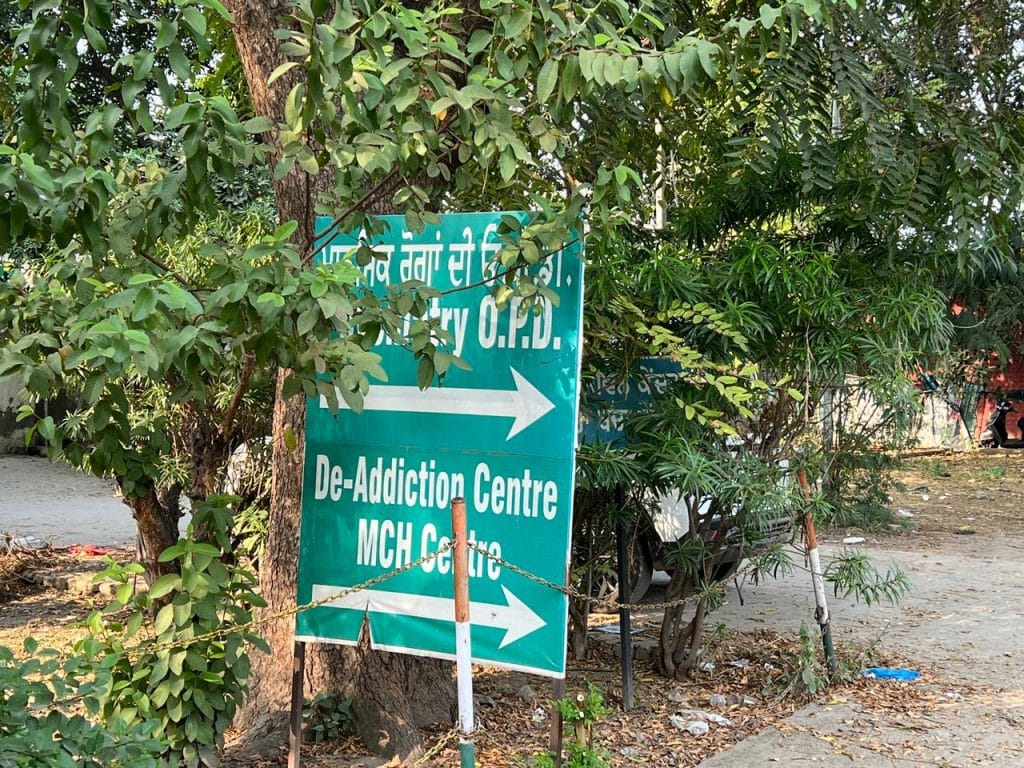
Making amends isn’t easy but she wants to be sober before her sister’s marriage in July.
Ranjit’s addiction cost her both her job and her marriage. She said she began using heroin while working at a parlour to save money to join her husband in the US, who had left three years earlier through the dunki route.
“After our work shifts, a male colleague at the parlour would ask me to join him for relaxation. We would drink liquor,” she said, speaking wearily. Eventually they graduated to heroin. “Within a week, I was addicted to chitta. My memories of that period are now a blur. Throughout my shifts I was intoxicated.”
She was fired. Her male colleague was not.
“He was allowed to retain his job as he promised he would never do it again and would seek treatment at the nearest de-addiction facility. The manager told me that an addict woman causes more problems and that clients would run away from the parlour because of me.”
Ranjit did not have an option to seek treatment at the nearest de-addiction centre, as it was exclusively for males. And she was further traumatised by the humiliating experience at the Amritsar clinic. As a result, her addiction only worsened.
In families where honour and respectability are tied to women’s bodies, addiction is treated less as illness and more as a moral stain.
“My in-laws forced me into a divorce. I expressed willingness to recover but was left with no option,” Ranjit said pensively.
She now lives with her mother in Beas, but here too she has to listen to taunts. Petty neighbourhood disputes have devolved into spiteful remarks about her character.
“I was called a sex worker by the woman in my locality,” she said, adding that male addicts did not face the same kind of censure.
Also Read: Punjab’s war on drugs fell victim to abuse. 8 years on, an overhaul begins
An unseen battle
Last month, the Bhagwant Mann-led government launched the second phase of Yudh Nasheyan Virudh to make Punjab ‘drug free’. While the first phase focused on crackdowns and arrests, the second centres on community mobilisation, door-to-door outreach in villages and the recruitment of people in recovery as “motivational speakers”.
Health department officials say the current emphasis is on awareness and encouraging health-seeking behaviour. They are also disseminating information about Section 64A of the Narcotic Drugs and Psychotropic Substances (NDPS) Act 1985, which grants immunity from prosecution for minor offences if an addict voluntarily seeks treatment at a government hospital.
But once again, there is no women-specific strategy. Doctors working on the ground say awareness alone will not address structural gaps.
Bhola pointed out that treatment protocols and policy frameworks largely stem from research on young male samples. Women, whose needs differ biologically and socially, are peripheral to both planning and infrastructure.
Even when women complete treatment, returning to ordinary life comes with different challenges.
Inderjeet, 26, is back at Navjeevan after her fifth relapse in three years. She said stigma has shadowed her every step.
“Every time I go out, people maintain a distance from me. My parents only worry about my marriage and no support is given to me for re-integration into society,” she said. “In isolation, I keep going back to drugs for solace.”
Ankita Thakur is an alumna of ThePrint School of Journalism. She interned with ThePrint.
(Edited by Asavari Singh)