





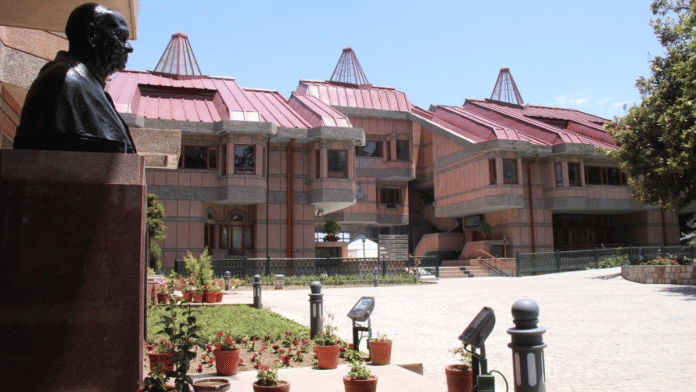



New Delhi: After four years of relentless preparation, two failed attempts and one interview, S finally walked through the gates of India’s most powerful classroom. High in the hills of Mussoorie, the Lal Bahadur Shastri National Academy of Administration, or LBSNAA — with its manicured lawns, grand slogans on the walls, and reputation as the cradle of the civil services — is where every successful UPSC candidate begins their journey. For those who prepare year after year, entering LBSNAA is the dream. For S, that dream became a reality in 2023.
The first phase of training was exhilarating, she said. Corridors buzzed with chatter, hostel rooms echoed with laughter, and debates ran late into the night. Days were packed with lectures, field visits and activities designed to shape young administrators for life in the districts. But when the trainees returned from their district attachment, the environment had changed.
“‘No-device’ zones appeared. Photographs were discouraged. Memos, warnings and punishments became part of daily life. You could tell something had changed just by the number of notices being issued,” S told ThePrint. “It stopped feeling like a training academy for officers and started feeling like a boarding school.”
She is now posted as a sub-divisional magistrate.
Former trainee officers say discipline and formal rules have always been part of life at LBSNAA. What they argue has changed in recent years is the campus atmosphere. Routine guidelines, they say, have hardened into a regime of tighter controls—mark deductions as punishment, frequent hostel room inspections, and a growing distance between trainees, faculty and staff. Former directors warn that fear-based discipline can dilute the purpose of officer training.
“If training is driven primarily by fear of penalties, you risk producing officers who are good at following instructions but hesitant to take responsibility in complex, real-world situations,” said a former LBSNAA director said, requesting anonymity.
Also read: Gun-toting IAS trainee vs academy director. 1981 scandal shaped dissent in civil services
Director’s role in LBSNAA training
At the academy, the director and course coordinator shape almost every aspect of life—from curriculum and guest faculty to field visits and institutional culture. That leadership, several former officers say, determines not just how trainees are treated, but how they respond. Members of recent batches say their time at LBSNAA bore little resemblance to what seniors described as a “golden period”, with many simply waiting for the training to end rather than embracing it.
“All this depends on the director. We should remember that we are training officers,” the former director cited above said. “We should not teach them through fear. Officers should follow rules because they are right, not because they will get punished. The entire point is to train them to become good officers. With more strictness, you will only get rebels.”
In 2024, LBSNAA issued detailed social media guidelines for officer trainees, restricting activity across platforms including X, YouTube, Snapchat, LinkedIn and Meta. Notices were circulated, and instructions were put up on campus notice boards. The move followed growing concerns over online content being created from within the academy.
The academy has also seen frequent leadership changes in recent years. Srinivas R. Katikithala served as director from September 2021 to September 2023, after which IAS officer Sriram Taranikanti took charge. Trainees who passed out during the current tenure describe their time at LBSNAA as “horrible”, marked by stricter rules and tighter controls.
“All this depends on the director. It is his connections that bring in guest lectures,” another former director said. “Officers should be treated like officers—only then will they respond like officers. If you treat them like students, they will respond like students.”
Taranikanti, a 1992-batch IAS officer of the Tripura cadre, has spent much of his career in district administration and regulatory institutions. While his earlier postings focused on training serving officials and overseeing sectoral systems, LBSNAA represents a different challenge: a residential, foundational training environment meant to shape officers at the very start of their careers. He is due to retire in July 2026.
Some officers who worked with him in the Tripura cadre describe him as difficult to work with and not very sociable.
“He was a good officer, but he didn’t get along with many people here in the cadre,” said an IAS officer from Tripura, speaking on condition of anonymity.
Journalists and senior editors in Tripura recall him as competent but largely inaccessible, someone who kept a low profile. They even said that his behaviour was standoffish.
Memos and mistakes
Rules around punctuality, dress code and mobile phone use have existed at LBSNAA for decades. Earlier, trainees say, mistakes were usually met with verbal warnings. Today, they argue, there is little room for error.
“In one class, someone yawned and the teacher asked him to go take a swim,” said a 2024-batch IAS trainee from the Uttar Pradesh cadre. “It was an honest mistake. We have tight schedules, and we should be allowed to yawn. A jail is a better place than this.”
Former trainees say there were days when more than 40 memos were issued. ‘Violations’ ranged from being a minute late and talking in corridors to not wearing the tie the right way, sleeping in class, or speaking out of turn. In some cases, they say, trainees didn’t even know what they had done wrong.
But a former trainee says that memos have been given since the beginning of the training in LBSNAA. The problem is that it used to “teach, not torture”.
“Memos were always part of training, but earlier they were meant to teach, not torture,” said a former trainee. “Now, it has become a joke. They distribute memos as if it is candy. For every small thing, there is a memo. And after that, you have to face the discipline committee, then marks are cut, then daily assessment and exam.”
As part of the punishment, they are made to report for physical training 45 minutes before the regular 6:45 am session.
Officers who trained nearly a decade ago say the severity with which memos are served now is new.
“I received memos and even punishments, but they weren’t as brutal as [what] the current batches have witnessed,” said a 2016-batch IAS officer posted in Odisha. “In our time, punishment would mean being sent to the library. Now marks are being cut. This is intense.”
There are also concerns about the content in the classroom. During a lecture on professional conduct, one faculty member reportedly used photographs of women officers to demonstrate how not to dress in the field.
“She showed pictures of women wearing tight clothes while going to the gym and said, ‘See how the constable is looking at her, so we should be mindful about dressing’,” said an officer from the 2023 batch. “I objected, but nothing changed. If this is how you think about women in the academy, what change are you expecting us to bring?”
Not everyone is against stricter discipline, though.
“What is being described as ‘tightening’ is, in many ways, a return to long-standing norms after a period of drift,” said Shailaja Chandra, a former IAS officer. “Training cannot be built on either indulgence or excessive control. It requires structured freedom, close mentoring, and an academy that knows every trainee well enough to guide, caution and, when needed, correct.”
Training by design
Many officers trace the recent shift at LBSNAA to the fallout from the Pooja Khedkar case, which shook the UPSC system. No one imagined that someone could enter the service and fool everyone. One immediate response was a clampdown on social media use within the academy.
“It was the right thing to do. Some trainees had crossed limits. They had even started making vlogs,” said the 2024-batch IAS officer. “Notices were distributed, guidelines were framed, and now people don’t click pictures or post photos on social media from campus.”
Restrictions don’t just cover the trainees, but have been extended to their families as well. Earlier, rules were relaxed for family visits, but now they require multiple permissions and follow a strict no-photography policy.
“When discipline is detached from rational foundations, it becomes an exercise of personal discretion — one that others are expected to follow without question,” said an officer who trained at LBSNAA last year. “When institutions enforce rules born from whims and fancies, discipline ceases to be a principle and becomes a tool of control. In cases of violations, punishment should follow an established procedure rather than being driven by impulse, anger, or wounded ego.”
Phone use has also been curtailed. Devices are banned from corridors, the mess and much of the campus. One trainee officer said it’s permitted only inside hostel rooms, where inspection can happen anytime.
“Raids like this never happened earlier,” said a 2016-batch officer from West Bengal. “Things were strict in our time, but this is another level.”
Under such restrictions, former directors say, the academy runs the risk of distancing its trainee officers.
“There are no bad trainees, only bad trainers,” said another former director. “There is another way to teach discipline. I used to chat with people over tea, understand the new generation and design the course accordingly.”
For years, the director’s post was often held by officers with experience in training institutions or the Department of Personnel and Training (DoPT). Several former directors, including Upma Chowdary (IAS, Himachal Pradesh cadre) and Sanjeev Chopra (IAS, West Bengal cadre), brought extensive administrative and training experience to LBSNAA. Under Taranikanti, however, critics say the academy is being run by someone encountering a training institute for the first time.
“You have put a person in charge who has no experience of a training institute, and that becomes difficult. Managing a training academy requires different skills,” said a former director. “Experience matters.”
Some officers also point to growing elitism within the academy.
“Faculty members keep telling trainees they are the ‘cream’ of society,” said one officer. “One of the core objectives of the government is to remove colonial elitism from bureaucracy and society. It is time to introspect whether this elitism is being curtailed or nurtured in these foundation courses.”
(Edited by Prashant Dixit)
There is a serious concern that the functioning of the academy has taken a “Tughlaqi farman” style approach, where instructions are followed in a rigid, unquestioned manner, and authority is exercised in ways that feel punitive rather than educational. A culture appears to have developed in which officer trainees are subjected to treatment that feels less like professional training and more like control through intimidation.
The training atmosphere is perceived as feudal in nature, where authority operates on whims rather than transparent norms. Trainees often feel that discipline is used as a tool for psychological pressure rather than professional development. Instead of mentorship, there is an environment of fear and humiliation.
There is also concern about the messaging being informally conveyed that the IAS is an elitist service, and that media, judiciary, and other Group A services are somehow below its stature or should be treated as obstacles. Such thinking is deeply problematic in a constitutional democracy, where governance depends on institutional balance, mutual respect, and cooperation.
Another troubling aspect is the obsession with unnecessary dramatization around cleanliness drives, inspections, and staged performances. Trainees are compelled to participate in exaggerated displays whenever senior officers visit, creating artificial situations rather than genuine learning experiences. This “performance culture” adds stress without professional value.
Communication methods used in the name of discipline are also an area of concern. Trainees report being shamed or spoken to in ways that target their upbringing, family background, region, or language. Such conduct is deeply demoralizing and contradicts the inclusive ethos expected of civil service leadership.
There is a perception that even non-teaching staff in administration, medical, and support services are encouraged to treat trainees harshly — almost as if they must “teach them a lesson” about how government staff treat the public. This normalizes disrespect rather than correcting it, and risks reinforcing the very administrative culture that governance reforms are trying to change.
Particularly worrying are issues related to medical sensitivity. Trainees with genuine health vulnerabilities or physical limitations feel their conditions are sometimes dismissed, and they are pushed into physically demanding activities under extreme weather conditions. Resilience building should never come at the cost of medical safety.
Food quality, living conditions, and resource management — matters that directly affect trainees’ well-being — appear to receive less attention than symbolic or cosmetic concerns. This imbalance affects morale and performance.
There is also a perception of favoritism linked to cadre networks, where certain groups receive more visibility through invited speakers and institutional attention. Whether intentional or not, such patterns damage the sense of neutrality and fairness expected in a national training academy.
Measures such as regulating social media use, promoting simplicity, and teaching humility are positive and necessary. However, when discipline turns into moral policing or regressive imposition of personal values, it begins to resemble authoritarianism rather than character building.
Being an honest and corruption-free officer is essential, but it is not sufficient. An officer must also be humane. If trainees are subjected to domination, humiliation, and psychological pressure during training, it raises a serious question: how will they exercise power when they themselves are in positions of authority?
Training institutions do not merely teach governance — they model it. If the model reflects elitism, fear, and unchecked authority, that is what will be reproduced in the field.
⸻
Write about LBSNAA director Tughlaqi farmans are followed by directors, deputy directors to torture officer trainees. The likes of Ritika Narula, Gautam Thapliyal, Bagadi Gautam, Aswathy behaves like fiefdom holders to torture officer trainee on their whims and wishes.
IAS is as an elitism service taught directly by course coordinator by saying media, judges and other Group A services are below your stature and you need to handle them as obstruction.
The obsession to get OTs do unnecessary dramas with respect to cleanliness, shows and actings where the Director will come for inspection and LBSNAA faculty will act and force OTs to play along in their overacting to create the beat drama. Next level is the women faculty officers who will go on floor by abusing OTs about their upbringing, family, Region or language. In the name of discipline they will shame and demoralise OTs to please their officer ego and also instruct staff of administration, medical and other departments to insult OTs and treat them like prisoners or freeloaders saying it should be the way govt staff treats common people. Worse is the medical staff, and mess staff who treats OTs like beggar dependents, genuine medical reasons are not considered, physical disability and capability is questioned and many times despite being medically vulnerable OTs are forced to do activities in extreme unadapted weather conditions. Staff has gone rude like bouncers and unsullied body guards of the fiefdom. Quality of food and resources have gone poor but no attention to matters that actual concern life of OTs.
Then cadre love is shown by inviting guest speakers from
Particular cadre where the course coordinator comes from to enhance lobby of favouritism. The only academy teaches is their greatness, benevolence and magnanimity of being IAS and mistreat younger collleagues by mentally harassing them at every process with trivial requirements.
Social media ban is a welcome step, teaching humility and etiquettes of simple living is high thinking is a very essential one but imposing morality and regressive thinking in the name of discipline is a hogwash to elitism and dictatorialship. Just being honest and corruption free is not the requirement of an officer, one need to be good to others and when the academy harasses their own OTs with dominating powerful position, what the OTs are going to do when they get such power.
The academy may be the place where formal brainwashing of the trainees with socialism takes place whereas the informal brainwashing before selection to the academy is done by reading ‘The Hindu’ newspaper. After destroying the economy with rural employment guarantee scheme, the next socialist scheme may be in the making by these socialist civil servants.