








New Delhi: When UPSC results are announced now, one anonymous social media account begins its own investigation. Called Khurpenchh – Hindi for “picking out faults” – the popular X handle has built a large social media following by scrutinising the credentials of civil servants and aspirants – digging into forged certificates to inflated claims of bureaucratic achievements.
The Khurpenchh team operates behind pseudonyms; they are part whistleblower, part provocateur and part vigilante. The page’s administrator, who has been running it for the last four years, describes their work as “investigative content creation.” Khurpenchh combs through the lives of candidates and civil servants alike, examining reservation certificates, property records and even past social media posts to expose candidates who took the shortcut to success.
For decades, the UPSC result list symbolised the culmination of years of hard work — a moment of pride for families and coaching institutes claiming another “topper.” But the rise of online watchdogs like Khurpenchh has added a new layer of scrutiny: India’s tightly guarded civil services ecosystem is no longer confined to official inquiries. The scrutiny has become influential enough that some officers say it has made bureaucrats more cautious about their public presence online.
While the UPSC is aware of the account, experts say such allegations cannot be adjudicated through anonymous social media posts and questions about eligibility or certification must be addressed through formal verification processes.
“Fact-checking is important and welcome. Officers should focus on working with honesty and integrity rather than chasing awards. At the same time, any such scrutiny must be thoroughly verified, and the intention should be to ensure accountability—not to malign anyone’s image,” said retired IAS officer Shailaja Chandra.
But the 28-year-old administrator behind Khurpenchh disagrees.
“We don’t just post anything. We do thorough research, analyse every possibility, and only then put it out,” he told ThePrint. “Our aim is to call out anyone who cheats the system and thinks they can get away with it.”
The account’s anonymity, however, remains a point of contention. Critics often dismiss it as the work of disgruntled UPSC aspirants — a claim the administrators deny.
“We never appeared for UPSC. We are both engineers — one mechanical and one electrical,” the Lucknow-based man said.
The curious case of certificates
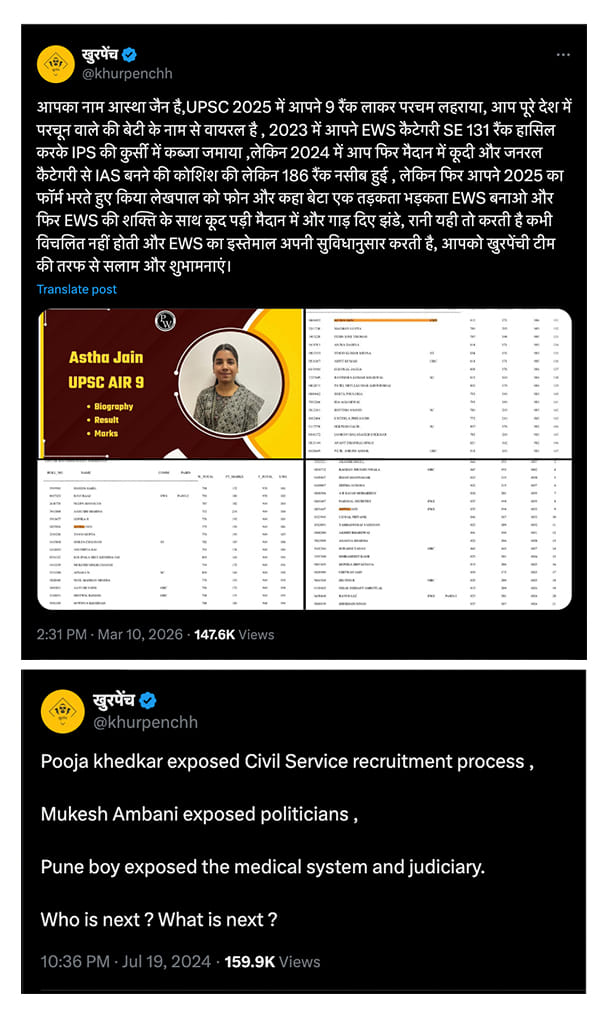
Much of Khurpenchh’s scrutiny revolves around reservation certificates used in UPSC attempts. Consider the case of Astha Jain, who secured All India Rank 9 in the 2025 UPSC examination. Khurpenchh chose her after she went viral for getting a top rank despite being in the Economically Weaker Sections (EWS) category.
आपका नाम आस्था जैन है,UPSC 2025 में आपने 9 रैंक लाकर परचम लहराया, आप पूरे देश में परचून वाले की बेटी के नाम से वायरल है , 2023 में आपने EWS कैटेगरी SE 131 रैंक हासिल करके IPS की कुर्सी में कब्जा जमाया ,लेकिन 2024 में आप फिर मैदान में कूदी और जनरल कैटेगरी से IAS बनने की कोशिश की… pic.twitter.com/VYjHlMT49N
— खुरपेंच (@khurpenchh) March 10, 2026
As congratulatory posts for Jain flooded social media, Khurpenchh got to work. The page alleged that Jain had used the EWS category inconsistently across different attempts.
Khurpenchh claimed Jain secured rank 131 in the EWS category and was selected for the Indian Police Service in 2023. Then, Khurpenchh claims, she appeared for the exam again in 2024 and got into IAS, this time in the general category. Jain then contacted the Lekhpal, a village-level revenue officer, to secure an EWS certificate, the page tweeted.
In a thread posted in Hindi on March 10, Khurpenchh wrote: “Then, while filling out the 2025 form, you allegedly contacted a lekhpal and asked him to arrange a “fresh and flashy” EWS certificate. Armed once again with the power of the EWS category, you entered the exam—and this time, you planted your flag at the top.”
Soon after, several other accounts amplified the claim. Online discussions quickly turned accusatory, with some users branding Jain a “fraud”.
But social media debates do not decide government regulations. Officials say such claims often ignore how reservation eligibility works.
Under the rules, EWS eligibility is determined year-wise, based on a family income ceiling of Rs 8 lakh and specified asset criteria in the preceding financial year. A candidate may therefore qualify for EWS in one attempt and not in another, depending on changes in income or assets.
“There could have been an issue with her certification. Sometimes technical errors happen, and the DoPT may revoke a category claim,” said a recently recruited IAS officer, requesting anonymity. “In such cases, if a candidate has cleared all stages of the exam in the general category, the service is allotted under the general category.”
“If her EWS certificate had been accepted at that time, she would likely have been allocated the IAS in that very attempt,” the officer added.
It began with Puja Khedkar
When Khurpenchh was created in 2022, exposing bureaucrats was not the plan.
The account was set up by two childhood friends from Kanpur, both engineers who now run their family businesses. They are currently based out of Lucknow but make no money from the page or the many affiliate social media accounts they run.
Much of the early content was just memes and commentary on the UPSC ecosystem. Slowly, it expanded to the coaching industry, including scrutinising popular UPSC teachers for what the admin calls “fake motivational content”.
“We started posting humorous things about our observations. We wrote about Awadh Ojha and Vikas Divyakirti — popular UPSC teachers — and slowly we got into other things about the bureaucracy,” said the admin.
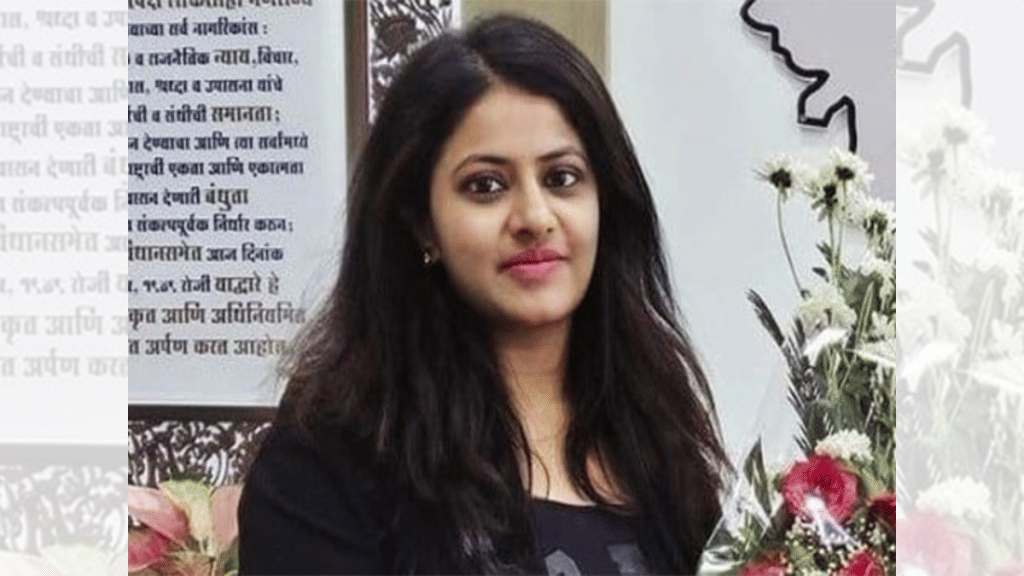
The page’s direction changed during the Puja Khedkar controversy, when allegations about the former IAS probationer’s documents led to an investigation and her removal from service.
While the issue was first pursued through an RTI by Pune-based activist Vijay Kumbhar, Khurpenchh amplified the case through multiple posts and threads that circulated widely among aspirants.
According to the administrator, this case decided what they wanted to do with their page.
“We looked at the last five years. We extracted data of those who used EWS and PwD certificates and later analysed it. That is when we started posting about other candidates. When we began questioning them, some of them left social media,” the admin said.
जिंदगी तो देश के नेता और अधिकारी जी रहे,
आम आदमी तो टैक्स भर रहा और हार्ट अटैक आने का इंतजार कर रहा ।#PoojaKhedkar #UPSCscam pic.twitter.com/lbISLGv8eu
— खुरपेंच (@khurpenchh) July 13, 2024
Then came their big break. IPS officer Abhishek Pallav caught Khurpenchh’s eye because of his large social media following and viral Instagram Reels. He also had a disability certificate.
“We asked how someone who claims to have a disability with xyz condition can dance actively in Bollywood videos. When our post went viral, he contacted us, but we did not entertain him,” he said.
Since then, the account, now with over 2 lakh X followers, has increasingly positioned itself as an online whistleblower, raising questions about civil servants and aspirants — from alleged misuse of reservation categories such as EWS, PwD and OBC non-creamy layer to accusations of corruption or inflated claims behind awards and achievements. The page also routinely targets politicians, including MPs and MLAs.
Tip-offs, RTIs and research
Behind Khurpenchh’s viral threads is a system the administrator describes as a mix of tip-offs, RTIs and online research.
Many investigations begin with information sent by UPSC aspirants, coaching insiders or anonymous sources. The team then claims to verify information using public records, RTI documents, social media archives and land records.
The page does not consult lawyers before posting allegations.
“We read the rules, check documents and speak to people,” he said. “Sometimes people themselves send us documents.”
RTI is another important tool for the page and Khurpenchh tracks please closely. That’s how they found Ravi Sihag, a 2022 batch, a Hindi-medium UPSC topper in the EWS category.
After the Khedkar case, Kumbhar filed another RTI filed raising questions about several officers’ eligibility, including Sihag. Khurpenchh dug into his background and put out a post claiming his family owned substantial land in Rajasthan and that Sihag lied about his finances.
रवि सिहाग भाई ने IAS बनने के बाद अपना रिजल्ट इंस्टाग्राम पर पोस्ट किया था लेकिन एक डार्क ऐरो बनाकर अपनी कैटेगरी हाइड करने की कोशिश की ,
कई अटेम्प्ट के बाद भी उनको IAS नहीं मिल रहा था , इसलिए उन्होंने UPSC 2021 में EWS कैटेगरी से अप्लाई किया लेकिन इत्तेफाकन उनका सिलेक्शन जनरल… pic.twitter.com/Kc75QSEmbJ
— खुरपेंच (@khurpenchh) January 16, 2025
“We conducted a thorough investigation, and it is now very clear that he manipulated the system to get the EWS reservation,” the Khurpenchh admin said. “We have the documents of his land in Rajasthan.”
As Khurpenchh’s following grew, its focus expanded beyond UPSC aspirants to serving bureaucrats and their public claims of achievement.
A few weeks ago, the page posted about Barmer District Collector Tina Dabi, who had just received an award from President Droupadi Murmu for Jal Shakti Mission work, but Khurpenchh alleged that an AI-generated picture had been used to show the completed target.
“Tina Dabi’s sister uploaded a photo of a wedding card in one place and a screenshot of the Jal Shakti Ministry’s homepage in another, and on the basis of these ‘great water conservation works,’ ended up winning an award of Rs 1 crore,” wrote Khurpenchh in one of its posts.
टीना डाबी की बहन ने
एक जगह शादी के कार्ड की फोटो ,
दूसरी जगह जल शक्ति मंत्रालय के होम पेज की फोटो अपलोड की और इन “महान जल संरचनाओं” के दम पर ₹1 करोड़ का पुरस्कार जीत लिया। 👏
और अगर बड़ी बहन के कारनामों की फेहरिस्त खुल गई , तो यक़ीन मानिए। आपके तोते सिर्फ़ उड़ेंगे नहीं, प्रशांत… https://t.co/oyhX7ahl90 pic.twitter.com/0pegmFFL5n
— खुरपेंच Satire (@Khurpench_) December 29, 2025
A well-known officer, like Dabi, means the posts will go viral. They get support online but there is scepticism too. The admin insists there is no personal agenda and that their claims are backed by research.
“We have tons of research in our system. We maintain data sheets that we have created using many tools, including Google search,” the admin said.
The page’s growing popularity has made some civil servants cautious about what they post online.
“These media trials are also changing how the bureaucracy functions,” he said. “Earlier, officers were more willing to take risks in the public interest. Now, many hesitate because they are constantly worried about how their actions will be perceived online.”
Also Read: Cleared UPSC CAPF exam but no force allocation—459 candidates waiting endlessly
Public service or trolling?
Not everyone sees Khurpenchh’s work as a public service.
While no complaints have been filed against the page, officials say allegations about reservation certificates or administrative processes cannot be settled through social media trials.
“People post so many things online. There are rules and checks,” a source in the Department of Personnel and Training (DoPT) said. “Just because someone posted a picture with a luxury bag and car, it doesn’t prove anything. There is a system for it.”
The official said anyone with evidence should approach courts or authorities rather than posting anonymously. “Without proof, it becomes trolling.”
Khurpenchh’s administrators, however, insist anonymity is essential to their work.
“We are not afraid of revealing ourselves,” the administrator said. “But the kind of work we do requires anonymity.”
But civil servants say such public scrutiny, that too from anonymous sources, can be damaging.
“As long as information is verified, scrutiny can be useful,” said a 2016-batch IAS officer on condition of anonymity. “But half-baked research and social media trials can harm an officer’s reputation.”
The officer said that errors are bound to happen in a large bureaucracy.
“It is not always the district magistrate personally uploading every document or photograph,” he said.
While Khurpenchh is keeping selected candidates on their toes, the page has found an eager audience in UPSC aspirants. 28-year-old Gaurav Pandey, preparing for UPSC in Delhi, said he likes the page because it exposes coaching institutes as well.
One of Khurpenchh’s targets was Drishti IAS, a prominent coaching institute. An associated Khurpenchh account claimed the institute exaggerated the number of successful candidates linked to its course — from 54 to 216.
A source associated with the institute rejected it.
“The fine imposed by the CCPA was not because we falsely claimed someone as our student,” they said. “It was because we did not clearly specify whether the selected candidates were from paid courses or free initiatives.”
For aspirants like Bihar-native Pandey, Khurpenchh serves as a compass in Delhi’s crowded and competitive UPSC coaching ecosystem.
“Khurpenchh calls out the hypocrisy of these institutions. They claim so many toppers but reality is different,” he said. “Many aspirants who come from rural areas get fooled by such advertisements but these posts help.”
An anonymous team
Despite its growing influence, little is known about the people running the account. What began with two people has grown into a small remote team of six to seven members, including interns and designers. Most were recruited online through posts advertising positions.
“Our team works for a very minimal amount of Rs 10-15,000 per month,” said one of the admins of Khurpenchh.
He claims the page is connected to a loose network of around 300 associated handles, primarily on X but also on Instagram and Telegram. These accounts are not formally linked but help amplify posts and share leads from across the country.
The team coordinates through private messaging groups where tips, documents and ideas are exchanged. While the main account publishes detailed threads, smaller handles often reshare posts or add local context.
The network, the administrator says, helps the page reach millions of users daily.
“Our daily reach is around two million people,” he said. “Sometimes it goes up to three million.”
The team is now planning to open an office in Lucknow and expand operations, including a proposed “women’s wing” focusing on issues affecting women.
Despite speculation online, the administrators say the page does not currently earn revenue.
“We have received many offers. We haven’t taken any money from anyone,” the admin said. “For now we survive on our family businesses. Later we may run advertisements but not for liquor or gutkha.”
Also Read: UPSC capped re-tries by serving officers. Backlash still rages—‘hate against bureaucracy’
What’s next for Khurpenchh?
Khurpenchh’s administrators say their ambitions extend beyond viral threads. They plan to turn the page into an investigative portal tracking the performance of public officials.
They want the platform to be able to allow citizens to examine records of civil servants, doctors and other government employees in their regions.
“We want to become a change-maker. We want to create an open source, public data portal where people can easily see the report card of their area,” Khurpenchh’s admin said.
He also admits that it is easy to make anonymous allegations, and the real hard work is to improve the system from within. Khurpenchh is doing that well, he insists.
“All these people joined the service by manipulating the system,” he said. “So I am exposing them one by one.”
(Edited by Stela Dey)