








Jammu: Nadeef had done everything a medical aspirant is told to do — cleared NEET, secured a seat on merit, reported for classes. A first-year MBBS student admitted to the Shri Mata Vaishno Devi Institute of Medical Excellence in Jammu, he had barely settled into anatomy lectures and laboratory sessions when the order arrived: the college’s permission had been withdrawn. Classes were suspended. Students were told to pack up and go home.
“I came here on merit. It hurts that I have to leave,” the 20-year-old said, back home in Baramulla, unpacking his bags. “I chose this college because it was new and had good faculty. I know what I had here… I won’t get at the government college back home.”
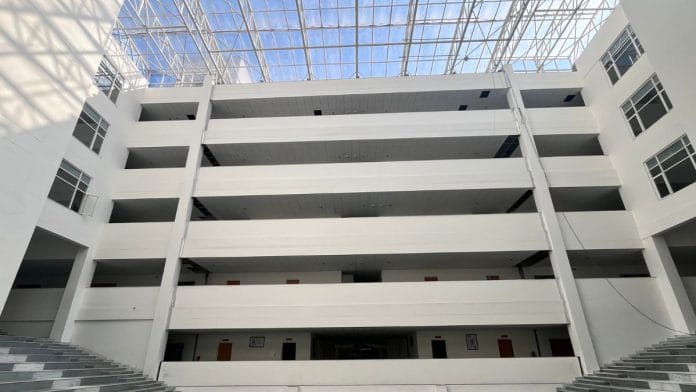
In the few weeks he spent on campus, Nadeef experienced a version of medical education rare in Jammu and Kashmir’s overcrowded government colleges: auditorium-style lecture halls, small batches of 50 students, one-on-one mentoring by faculty, and newly built laboratories stocked with advanced equipment — facilities he says are rare even in older government medical colleges.
Then, almost overnight, the college shut down.
The closure of the Shri Mata Vaishno Devi Institute of Medical Excellence (SMVDIME) has left 50 MBBS students in limbo, disrupted the lives of hundreds of faculty and staff, and frozen a multi-crore public investment in healthcare infrastructure. Beyond individual loss, the episode exposes how a fully functional medical college, cleared by the country’s top regulator and admitting students through a national merit process, became collateral damage in a battle over religion, identity and political pressure in Jammu and Kashmir.
Built and funded by the Mata Vaishno Devi Shrine Board as part of a larger healthcare expansion, the medical college had received its mandatory Letter of Permission from the National Medical Commission (NMC) in September. Admissions were conducted through the Jammu and Kashmir Board of Professional Entrance Examinations, strictly on NEET rankings. Classes had begun, faculty had joined, infrastructure was operational.
The problem began when the final student list was made public. Of the 50 students admitted, 44 were Muslims.
What should have been an unremarkable reflection of regional demographics and merit quickly turned into a flashpoint in Jammu, triggering weeks of protests questioning whether an institution funded by shrine donations should admit Muslim students at all. Within months, the regulator withdrew the college’s permission — a move protestors celebrated, even as students were sent home and a doctor-starved region lost a medical institution it had waited years for.
“There was no illegality in the admission process. So the faith angle was played. That is why there was a surprise visit,” Sheikh Shakeel Ahmed, a lawyer at the Jammu and Kashmir High Court, said.
‘Why should they study here?’
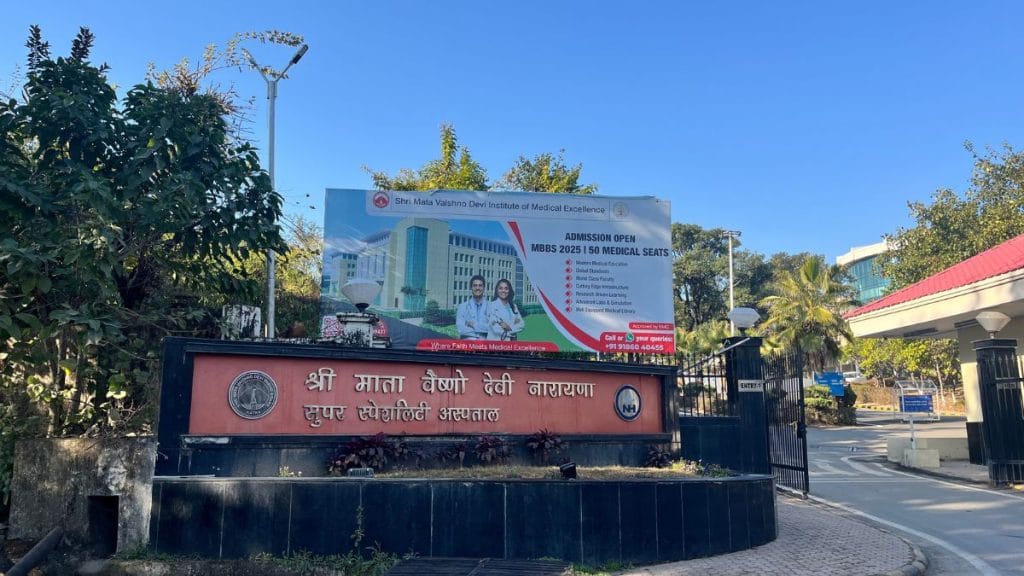
Demonstrations began soon after admissions were finalised, led by Hindu groups under the banner of the Shri Mata Vaishno Devi Sangharsh Samiti. The core demand was blunt: a college built using donations to a Hindu shrine should not have a Muslim-majority intake.
Senior members of the college management say the outrage ignored both law and precedent.
“In Jammu’s medical colleges, the majority of the students are Muslim because their population is higher,” said a senior official, speaking on condition of anonymity. “In every college, the ratio is 60-40 or 70-30. Here, it was a bit higher but it was all done through the process.”
But unlike older institutions, this one was new and symbolically charged. The protests intensified, spilling onto streets and social media, framing the issue not as one of admissions procedure but religious ownership.
Leaders of the protests have conceded there was no legal violation. They just don’t want a shrine-funded institution to be majority-Muslim.
“Why should we allow them to study here? There are many colleges in Jammu and Kashmir, what is the need of this medical college? We should open Gurukul or Sanskrit University here,” said Kartik Sudan, spokesperson of the Vishwa Hindu Parishad in Jammu, who spearheaded the protest.
He also alleged irregularities in counselling, claiming the college opened after two rounds and that students from Jammu had already left for other institutions — accusations officials deny and for which no evidence has been presented.
‘We were told not to step out’
For students, the fallout was immediate and personal.
Saqib Farooq, 19, was the first in his family to pursue an MBBS degree. Everything seemed to fall into place — the college, the infrastructure and the faculty. His family was happy. But within a week, warnings and advice began to trickle in.
“For the first few days, nothing felt wrong,” he said. “Then we started seeing the protests online.”
Faculty members started advising students not to step out of the campus, as protesters had begun opposing their admission to the college.
“I used to see the protests on social media. They were brutal and hurtful. My family was worried. My mother told me not to go out much. Our faculty also advised us the same,” said Farooq, who is now back in Kulgam, waiting for directions from the National Medical Commission.
According to him, there were no visible tensions when students first arrived on campus.
“For the first five or six days, nothing happened. People didn’t even know about the Hindu-Muslim issue. It started after about a week,” he said, adding that he had reached Jammu around November 2 or 3.
The order suspending classes and asking students to leave came as a shock. For Farooq, none of this seemed legal.
“We never expected this. The college had permission, and suddenly, after two or two-and-a-half months, everything stopped,” he said. “It happened after the religion issue came up. It was completely unexpected.”
After being asked to leave, students were told to wait for further instructions. “We’re just sitting at home. We got clearance through the NOC, and now we’re waiting,” Farooq said.
But the episode has not shaken Farooq’s resolve to become a doctor.
“Whatever happened is very sad. I come from a farmer’s family, and I am the first doctor in my family. But I won’t let this hate affect me. I will complete my MBBS, then pursue my post graduation from a good college and serve my nation,” he said.
‘Felt intentional’
From the moment the admission list became public, protestors had one central demand: that the Shri Mata Vaishno Devi Institute of Medical Excellence should admit only Hindu students. Constitutionally, there is no way to enforce such a demand.
When that argument collapsed, some groups began pressing for minority status for the college — a move that would allow religion-based seat reservations during NEET counselling. But under existing law, the medical college does not qualify.
“What happened here felt intentional,” J&K High Court lawyer Ahmed said.
Under the Jammu and Kashmir Shri Mata Vaishno Devi University Act, 1999, the university is explicitly open to students of all religions, castes and communities. The medical college does not have minority status, nor can it claim it under existing law.
“It is a Hindu minority institution, but minority status cannot be granted by a president or authority arbitrarily. The college can’t get it because Hindus are not a minority in Jammu,” he said.
The comparison protestors repeatedly invoked is Acharya Shri Chander College of Medical Sciences (ASCOMS) — the only medical college in Jammu where Hindus are, by law, a minority. ASCOMS was granted minority status because it is established and run by a Hindu religious trust, the Shri Chander Chinar Bada Akhara Udasin Society, and meets the statutory requirement that a majority of its managing committee belongs to a minority community.
Once that status was recognised, the Jammu and Kashmir Board of Professional Entrance Examinations (JKBOPEE) was authorised to reserve MBBS seats under a Hindu minority quota during NEET counselling — a process followed for several years and backed by clear regulatory guidelines.
SMVDIME, by contrast, is run by the Mata Vaishno Devi Shrine Board, a statutory body created by law. While the college is funded through shrine donations, it is not operated by a religious trust and does not fall under minority institution norms recognised by the National Commission for Minority Educational Institutions or the National Medical Commission. Its admissions, therefore, could only be conducted on NEET merit among J&K domiciles.
With the legal route closed, protestors turned to a broader ideological argument: that the Shrine Board had no business running a medical college at all.
“The Mata Vaishno Devi Shrine Board has a defined charter of duties. Running a medical college is not part of that. If the Board wants to engage in education, it should focus on research related to the Vedas and Sanatan Dharma, not professional medical education,” said retired Colonel Sukhvir Mangotia, who led the protests in Jammu.
Jammu and Kashmir has 13 medical colleges, government and private. All have Muslim-majority student populations. The Shrine Board’s nursing college follows the same demographic pattern without ever having faced similar protests.
“There are around 5,000 students in Jammu and Kashmir who cleared NEET, and only about 2,000 get admissions in government and private colleges. You can see the list — it speaks for itself. Muslim students are in the majority. So whoever clears NEET and chooses this college as their preference will come here,” a senior official from the college management.
A surprise visit, then a shutdown
On 2 January, as protests continued, an inspection team from the National Medical Commission arrived at the college. According to college officials, the visit was unannounced. Nearly half the faculty was away on winter leave. The administration, they said, was informed just 15 minutes before the team reached campus instead of the usual 15 day notice.
Soon after, the NMC withdrew the college’s permission.
In its order, the regulator cited serious deficiencies: a 39 per cent shortfall in teaching faculty, a 65 percent shortage of tutors, demonstrators and senior residents, and inadequate hospital infrastructure, including the claim that the attached hospital had only two operation theatres.
A visit by ThePrint to the hospital found eight operation theatres on the premises.
The withdrawal raised immediate questions because the same regulator had granted permission barely four months earlier.
Also Read: J&K medical college was shut over ‘unacceptable’ demography. Hindus can be a minority too
Not just Muslim students
Like his peers, Maani Srivastava also had to leave the college. Srivastava, a Hindu from Udhampur, says he is equally heartbroken. According to him, the protests have harmed Jammu itself.
“This medical college would have helped the people of Jammu in many ways. What they did was wrong. We were given a great opportunity, and it was taken away from us,” said Srivastava, who lives in Udhampur.
For him, this was his dream college — one he says no other government medical college in Jammu could match.
“The kind of infrastructure we had here is something you don’t get in government colleges. I have no direction from the NMC yet. Even if I am allotted a government college now, the dream I had is broken. They did wrong to us,” he added.
A college built to function and staff left in limbo
For a region starved of doctors, the irony was cruel: this was among the best-equipped medical colleges Jammu had ever built.
The medical college was the third phase of the Shrine Board’s healthcare expansion: first a super-speciality hospital, then a nursing college, and finally the MBBS programme. By the time students arrived, the campus was operational.
Around 300 people are now affected by the shutdown. Nearly 100 are faculty members. Many had resigned from permanent posts at government medical colleges, AIIMS and PGI Chandigarh to join the college. None of them have received any direction from the Shrine Board so far.
“Everyone is scared. We never thought a college could shut down. Protests had been happening, but nobody imagined classes would stop. We have no idea what we will do now, or who will hire so many people,” said Ankit, who works in one of the college laboratories.
In its first year, the faculty published 30 research papers. The college also acquired a polygraph machine — equipment otherwise found only at premier national institutes.
“People who love teaching want good infrastructure and advanced equipment. This college offered everything a faculty member needs. Unlike many government colleges, funding was not an issue here,” said a teacher who shifted to Jammu from a neighbouring state, requesting anonymity.
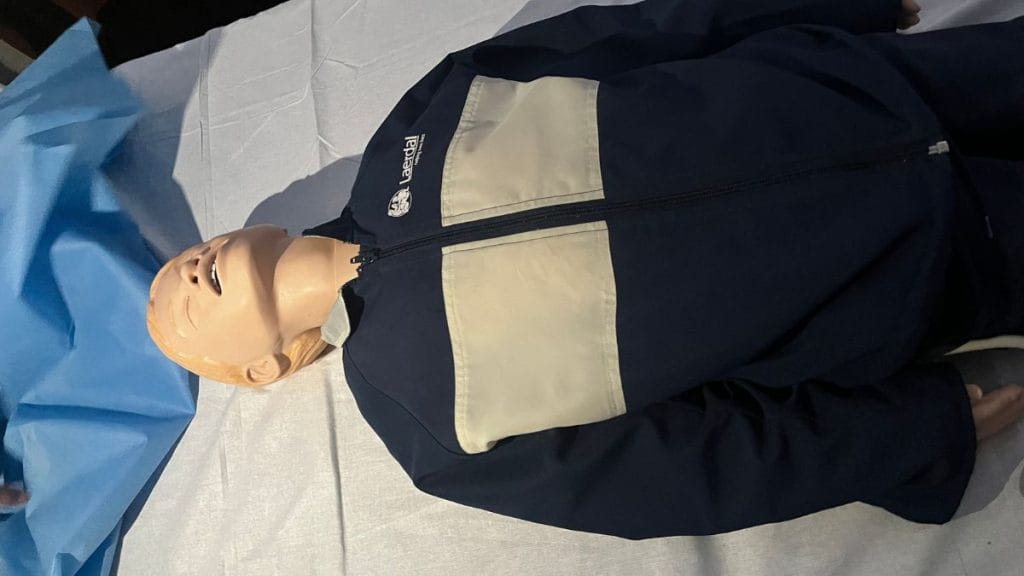
The college’s skill lab, equipped with high-end simulation dummies, was used not just for students but for training Shrine Board staff in CPR — a critical service given the frequency of cardiac emergencies during the Vaishno Devi pilgrimage.
“So many people suffer cardiac arrests during the pilgrimage to Mata Vaishno Devi. We train shrine staff in CPR here. Elsewhere, such training costs around Rs 10,000. We do it free of cost, with trainers certified by the American Heart Association,” he added.
The laboratory alone cost Rs 6 crore and had conducted just 17 training sessions so far.
Leaving the dream
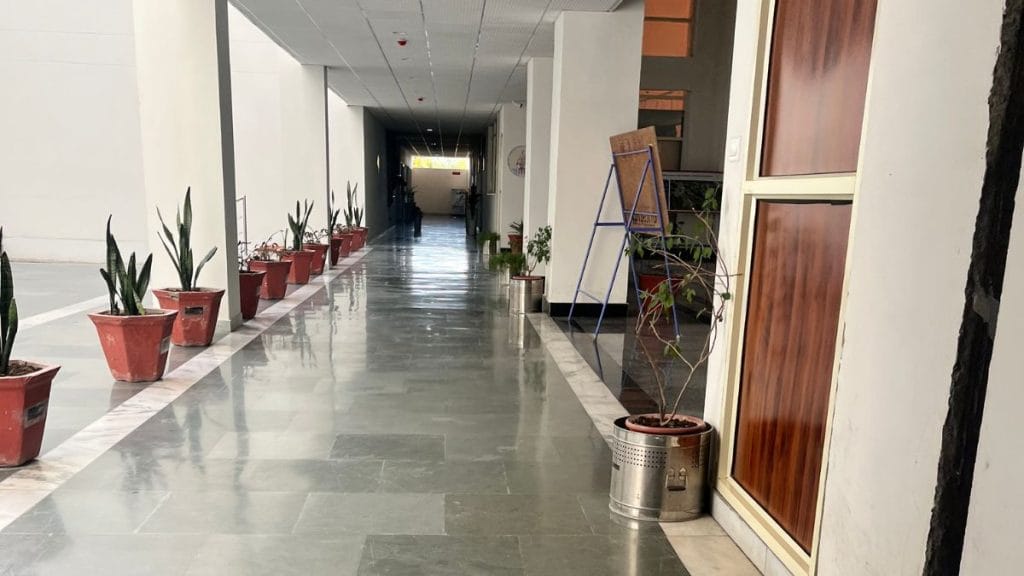
The four-storey medical college building stands deserted today. The only sounds are from construction work on the second floor, where second-year classes were scheduled to begin in September. Corridors once filled with chatter are quiet. Questions that echoed in classrooms, practical training in laboratories, and hands-on learning with advanced equipment have all come to a halt.
Students have received no formal communication beyond being told to return home and wait. Omar Abdullah has said they will be accommodated elsewhere, but no timeline or mechanism has been announced.
Nadeef’s first session in the skill lab was scheduled for the week after the shutdown. He had been counting the days, telling friends about the advanced facility and the training he was finally going to receive.
“I really wanted to learn there,” Nadeef said. “Now I’ll be going to a government college where classrooms have more than 125 students. Here, we were just 50.”
He still doesn’t understand what went wrong.
“I feel like I’m leaving my dream behind. Everything there was first-hand. I don’t understand how they can cancel the permission they themselves gave,” Nadeef said.
He stopped, then continued: “After becoming doctors, we will treat everyone equally, regardless of religion — that’s how it should be.”
Behind him, the college that was meant to train the next generation of doctors in Jammu remains shut — fully built, fully equipped, and completely empty.
(Edited by Stela Dey)
If whatever written is true.this kind of arbitrary actions defies logic. If admissions were based on all india entrance and all rules were followed, religion should not come in the way of Right to Education.