





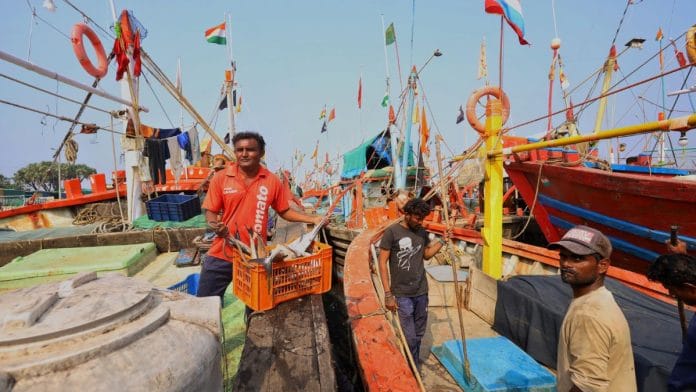



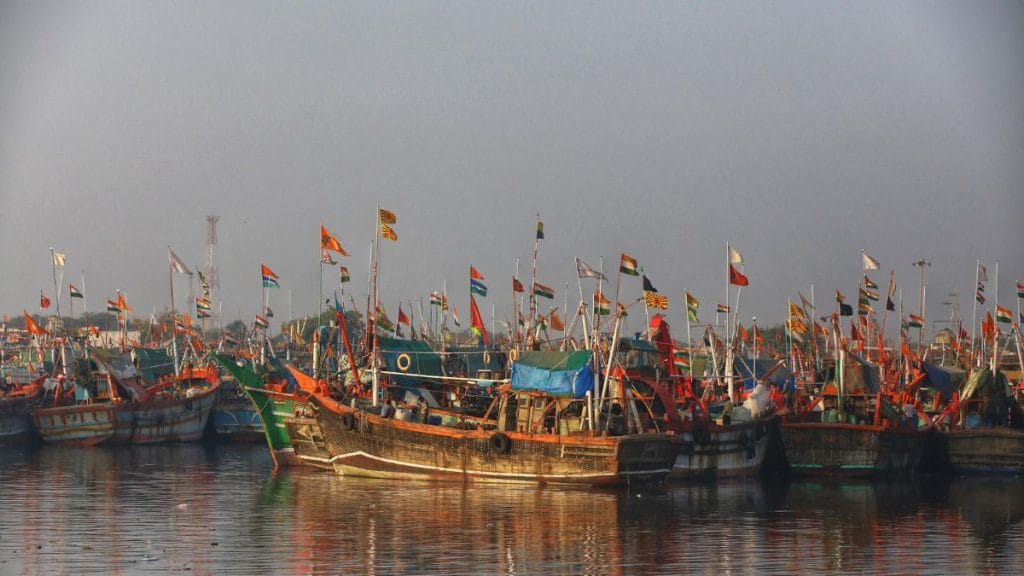
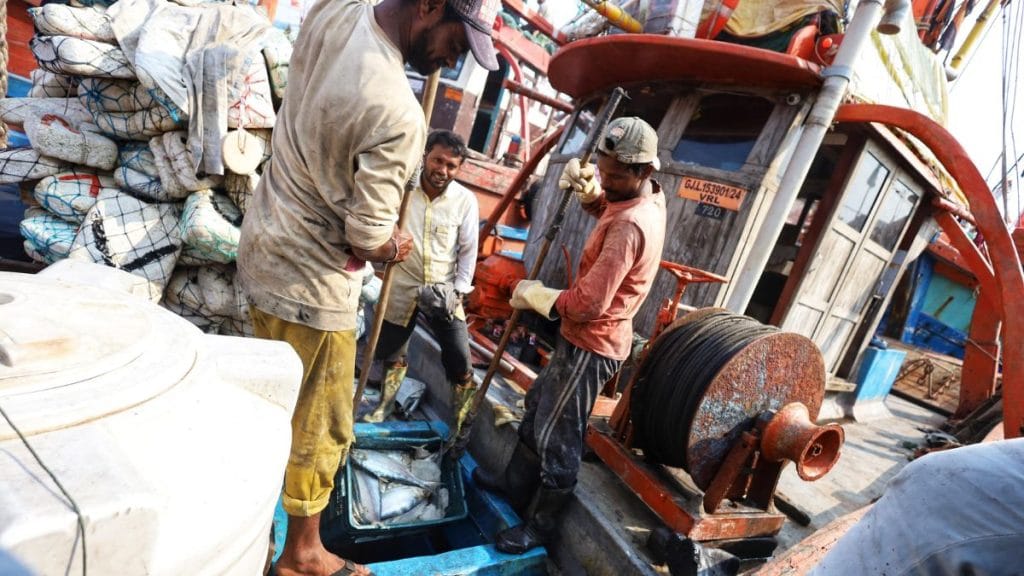
Veraval, Gujarat: Rati Lal Bamiyan’s trawler eases into Veraval port after 15 days at sea, its hull is heavy with the catch — tuna, pomfret and surmai. The work begins immediately; baskets hauled up, ice cracked, fish sorted. Then comes the pause. A basket opens and the mood lifts — Hilsa. For a few moments, the workers’ exhaustion dissolves. There are only smiles all around. On Bamiyan’s boat, the queen of fish has arrived.
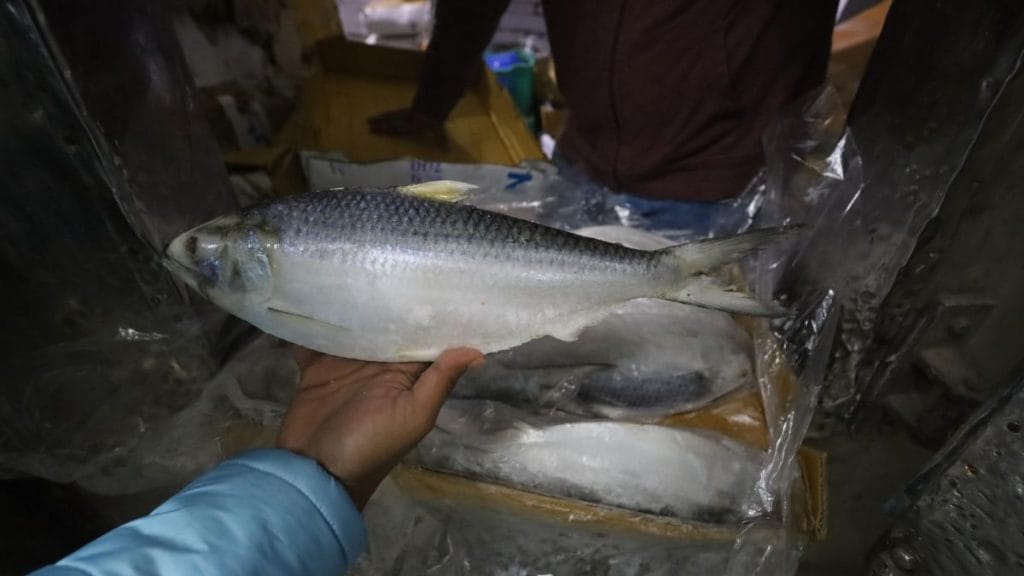
“This is white hilsa,” Bamiyan said of Bengal’s most loved fish. “It is such a beautiful and tasty fish. It will sell for at least Rs 1,200 a kilo. Hardly any fish sells for this much.”
On the deck, the fishermen know exactly what that means: a good season, better margins, and a fish that carries cultural weight far beyond the Gujarat coast.
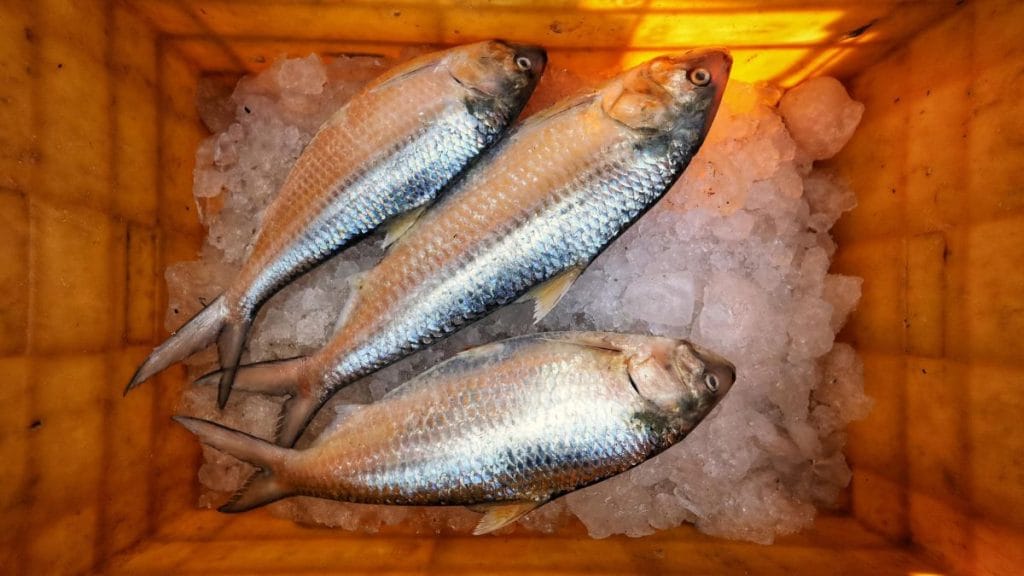
White hilsa or Chaksi is the soft pink-glowing variety of hilsa that Bengalis revere above all others. Rare in sea water, prized when it migrates into rivers during the monsoon, Chaksi carries a premium price and deep cultural weight. For fishermen in Gujarat, catching it is both economic fortune and astonishment.
For decades, Bengal’s beloved hilsa came from two places — the Padma in Bangladesh and rivers closer home. Over the last two years, both have faltered. In their place, an unlikely supplier has surged ahead: Gujarat. A largely vegetarian state has quietly become one of the biggest sources of hilsa for Bengal, reshaping trade routes and market hierarchies. Today, most hilsa in Kolkata’s markets travels east from the western coast and Gujarat’s catch has a near monopoly in markets across Bengal.
The shift became visible in 2024 when hilsa catches spiked sharply in Bharuch, along the Narmada. For local fishermen, it felt like history repeating itself. The river had not seen such numbers since the 1980s, when industrial activity along its banks was far lower. In 2025, the scale stunned even seasoned traders: more than 4,000 tonnes of hilsa moved from Gujarat to eastern India, with fishermen estimates crossing 6,000 tonnes if sea catch is included.
“Almost all of the hilsa goes to Bengalis,” said Nadim Panja, who runs a seafood export firm in Veraval. “Gujarat rarely exports hilsa.”
Traders say daily consignments of five to seven tonnes are now being frozen and shipped east, filling a gap created by declining catches elsewhere. Cold storages in Veraval are filled with hilsa meant not for local kitchens, but for markets in Howrah, Sealdah and beyond.
For fish merchants in Bengal, the change has been stark. “This season, it was only Gujarat hilsa in the market,” said Mehendi Hasan, a trader with two decades in the business. “If not for Gujarat, prices would have crossed Rs 3,000 a kilo.”
Why Narmada, why now
In Bharuch, fishermen still struggle to describe what unfolded along the Narmada over the past year.
It all started last summer. Heavy rainfall has increased freshwater flow into the Narmada, lowering salinity near the estuary — the precise conditions hilsa need to migrate upriver. Pollution levels, locals say, have not fallen. The river simply carried more fresh water than usual.
At first, it didn’t seem unusual. The catch was okay, better than some previous years. Then came the revelation.
“I pulled up my net and it was far heavier than normal,” recalled Imran Memon, a fisherman for 25 years. It was hilsa, net after net. Trucks lined the riverbank for weeks. For three months, the shore became a parking lot of vehicles waiting to be loaded.
For two months, quiet Bharuch turned frenetic, its riverbanks lined with trucks and workers racing against spoilage. All hands were on deck.
The fishermen and traders had last witnessed such a phenomenon in almost fifty years ago.
“I have always heard stories from my father of Narmada being flooded with hilsa. When my father went fishing in the 1980s, hilsa would flow like liquid silver in Narmada,” said Memon. “This was the first time I was seeing it.”
Nadim’s Zenith Exports has been packing and storing hilsa for later as well.
“We were stationed there for weeks, noting down details and packing Hilsa,” said Nadim.
Some fish had to be discarded because storage could not keep up. “We were not able to manage,” Memon said.
Also Read: Hilsa on the table, diplomacy in the air at Bangladesh High Commission’s festive feast
Officials admit they were caught off guard by the sheer volume. The fisheries department has sought scientific inputs from the Central Inland Fisheries Research Institute (CIFRI), a Vadodara-based body that studies inland and reservoir fisheries.
Kirit Patni, Deputy Director of fisheries department, pointed to climate variability and unusually high rainfall as reasons behind the spike.
“This sudden change can be attributed to climate change, rain in the area,” Patni said.
In 2025, Saurashtra recorded well-above-average precipitation — a trend for nearly a decade that may be reshaping fish migration patterns.
“The rain increased the flow of fresh water in Narmada. This may be causing more hilsa to migrate,” added Patni.
Scientists caution against assuming permanence.
“It’s completely unexpected,” Dr Ketan V Tank, Professor (CAS), College of Fisheries Science, said. “There is no guarantee this will repeat next year. It could collapse just as suddenly.”
A hierarchy of taste
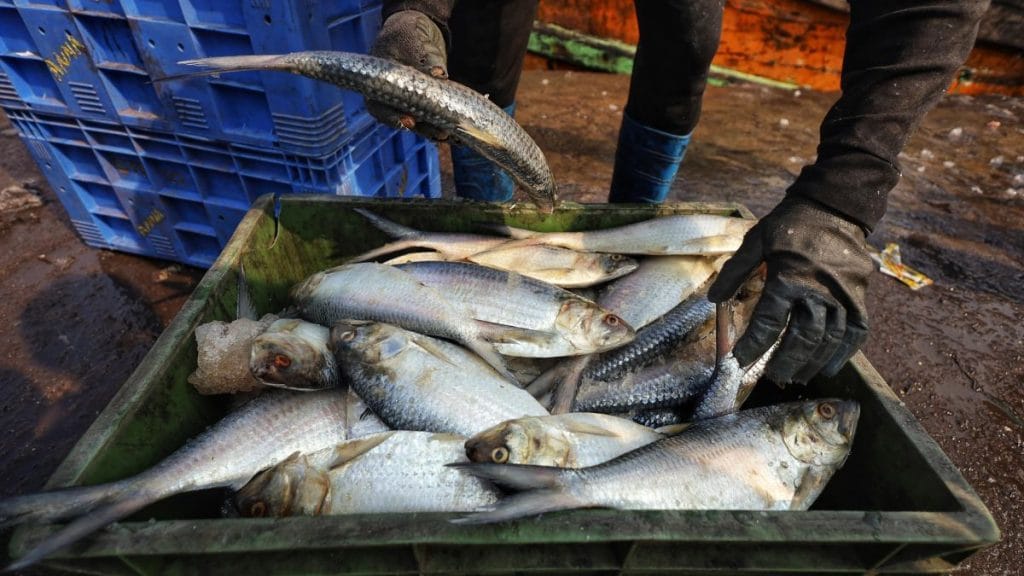
Not all hilsa is equal in the Bengali imagination. On the neighbouring boat to Bamiyan’s, the catch includes hilsa too — but Palwa, the darker sea variety. It sells cheaper, around Rs 350–500 a kilo, and is favoured locally by fishing communities along the Gujarat coast.
Chaksi, with its pale pink sheen, commands seasonal premiums that can touch Rs 2,000 a kilo during the monsoon.
“Bangladesh hilsa still rules,” Hasan says bluntly.
Traders rank them meticulously: Bangladesh at the top, followed by riverine Bengal, then Gujarat. A 1.5-kg fish from the Padma can fetch nearly double the price of its Gujarat counterpart. Despite Gujarat’s dominance in volume, its hilsa sits at the bottom of the prestige ladder.
For many Bengalis, the difference is emotional as much as culinary. Hilsa from Bangladesh would get special attention at markets. They are stored in different boxes, at a different location. The shopkeeper lures the customers with his cry: “Padma’s hilsa! Padma’s hilsa”.
He knows Bangladesh’s ‘ilish’ will be the superstar, and sell quicker at a higher price.
When Kolkata resident Madhurima Samanta went looking for Bangladesh hilsa in the market earlier this season, she was disappointed to get a different variety. The shopkeeper had assured her it was Padma ilish.
“This hilsa was not good. Bangladesh hilsa is beautiful and tasty — it is a treat to have that fish,” said Samanta.
Shoppers still ask for Padma’s hilsa, even when supplies are thin and prices steep.
“Bangladesh hilsa shines brighter than a diamond,” Hasan said. “Gujarat’s Hilsa is not as good.”
For Bengalis, hilsa is memory as much as flavour. The aroma of mustard curry announces the monsoon. The fish itself marks seasons, festivals and family tables.
Black hilsa, white hilsa
Not all hilsa carries the same reverence.
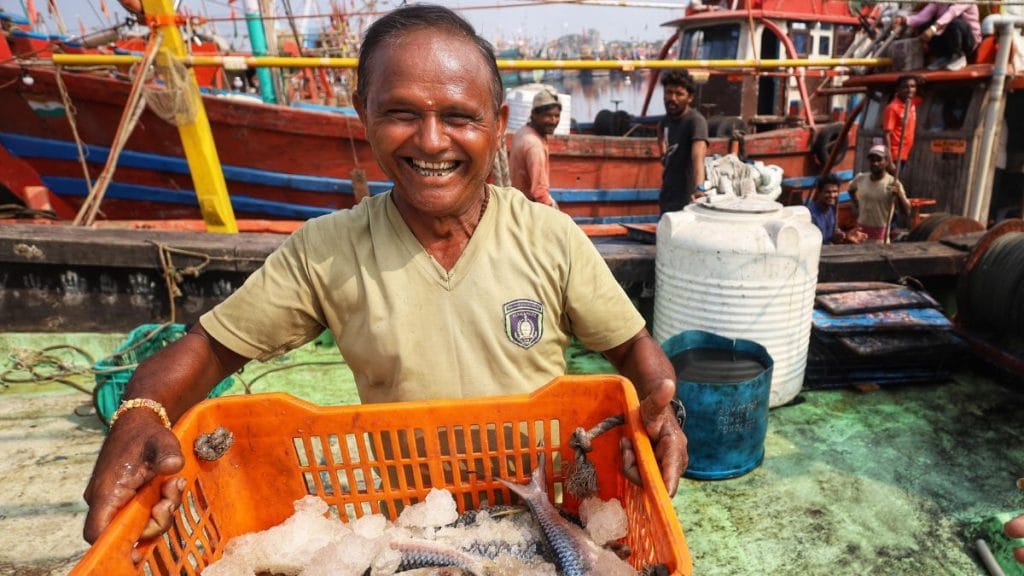
A few boats away from Bamiyan’s, his brother’s vessel, Jalganga Prasad, also carries Hilsa — but Palwa, the black sea variety. It sells for less and is less cherished by Bengalis, though it is popular among Gujarat’s Koli, Kharwa and Bhadala fishing communities.
Jayesh Bhai, directing the unloading of the catch, lifts a black Hilsa from the basket.
“Chaksi is rare in the sea,” he said, after his return to the shore a fortnight later. “Palwa is more common here,” he added, adjusting his cap to protect his head from the scorching sun.
Chaksi is a migratory fish, travelling hundreds of kilometres between sea and river to spawn. With the monsoon, freshwater flows into estuaries, reducing salinity and drawing hilsa inland.
Historically, the fish thrived in the Ganga, the Hooghly, the Brahmaputra, and the Padma. After spawning, adults return to the sea while juveniles follow later.
Bangladesh’s retreat and Hilsa diplomacy
The romance of hilsa endures in Bengal, but the numbers do not. Across the region, freshwater hilsa has declined sharply due to overfishing, pollution and habitat disruption. In Bangladesh — where hilsa is the national fish — catches have fallen significantly over the past decade, with experts pointing to unchecked juvenile fishing and the interception of breeding fish as key reasons.
“Overfishing is the main reason,” says Dr Tank. “Fishermen catch juvenile fish and breeding adults, causing serious depletion.”
The collapse is visible in data. According to ICAR, hilsa catch in India fell from around 80,000 tonnes in the early 2000s to roughly 20,000 tonnes a decade later. Between 2022 and 2024 alone, Bangladesh witnessed a decline of about 42,000 tonnes, ThePrint reported. As production shrank, exports to India became increasingly sporadic and politically calibrated.
Between 2012 and 2022, Bangladesh largely halted hilsa exports to India amid disputes over River Teesta’s water sharing. Exports resumed selectively after former prime minister Sheikh Hasina lifted restrictions, often timed with festivals such as Durga Puja. Following Hasina’s ouster in 2024, bilateral relations cooled again. Bangladesh briefly banned hilsa exports, lifting the restriction only ahead of Durga Puja — Bengal’s biggest festival — when around 3,000 tonnes were sent to India, a fraction of earlier levels. Despite low domestic production in 2025, exports dropped further, with roughly 1,200 tonnes sent ahead of the festival.
Traders describe this controlled flow as “hilsa diplomacy” — where climate stress and political relations together determine supply.
At the same time, Bengal’s own rivers have been yielding less fish. Over the past decade, hilsa landings in West Bengal have dropped by an estimated 40-60 per cent. Two decades ago, annual catch stood at around 16,500 metric tonnes. That figure fell by nearly 10,000 tonnes in subsequent years. In the last three years alone, Bengal recorded about 6,170 MT in 2021, 5,600 MT in 2022 and roughly 6,800 MT in 2023.
To arrest the decline, the state tightened restrictions on catching juvenile hilsa and breeding adults. Seasonal fishing bans, imposed every year between April and June — including a ban from 15 April to 14 June in 2025 — have reduced local landings, even as conservationists argue they are necessary.
“This year too, we were not allowed to fish for many months,” said Bengal trader Hasan. “By then, tonnes of fish had arrived from Gujarat.”
Ecological stress has compounded regulation. Industrial pollution and untreated sewage have degraded the Bhagirathi-Hooghly system, while the Farakka barrage has disrupted hilsa migration routes, affecting spawning cycles. As a migratory species that requires free movement between sea and freshwater, hilsa has been particularly vulnerable to these barriers.
The result is a paradox: Even as Bengal tightens rules to save its iconic fish, shrinking local supply has pushed the state into dependence on hilsa from Gujarat, Myanmar and — in limited, politically negotiated quantities — Bangladesh. Myanmar currently dominates the trade, supplying nearly 80 per cent of hilsa imported into India. With weaker regulations and a focus on sea-caught hilsa, the country exported over 100,000 tonnes in the first quarter of the 2025-26 financial year alone.
An uncertain crown
For now, Gujarat’s climate-driven surge has filled the gap. Back at Veraval port, Bamiyan’s hilsa is packed into ice and loaded for the long journey east and northeast.
Nadim’s phone rings relentlessly. “Wedding season is here. Orders (from Howrah markets) are in lakhs and crores.”
At -16 degrees, hilsa waits in insulated boxes, ready for dispatch. Within two days, hilsa from Veraval will land in Howrah.
Whether Gujarat can hold on to its newfound dominance remains unclear. Fishermen know abundance can vanish as quickly as it appears.
For now, Bengal’s kitchens are simmering, whether with Chaksi or Palwa. The queen has arrived, but she no longer swims. She has taken a longer, unfamiliar route home.
(Edited by Stela Dey)