





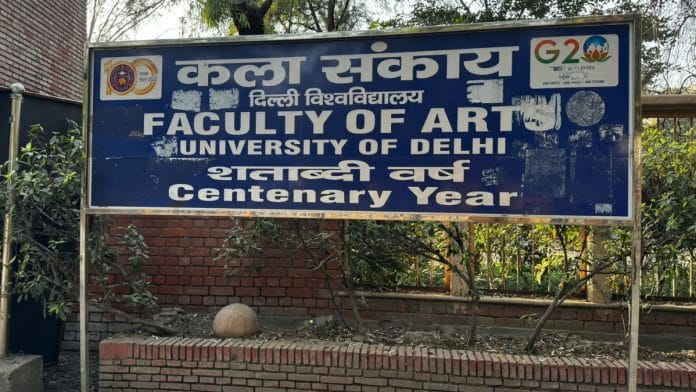



New Delhi: The Faculty of Arts, once the throbbing heart of Delhi University protests, now stands eerily quiet. Activist and PhD student Prithviraj no longer lingers in open corridors. He waits for students to step out of class, then quietly pulls two aside. Never more than three at a time. Never where guards can see them.
“The scrutiny has increased,” he said. The presence of security guards has suddenly become ubiquitous.
It all changed on 17 February, when the university issued a notice prohibiting “public gatherings, processions, demonstrations, protests of any kind, and assembly of five or more persons” within the campus for a month. When students gathered two days later at the arts faculty back gate for a press conference, calling the notice a “crackdown on democratic dissent”, they were swiftly dispersed by security guards and warned of stricter action.
Ripple effects followed. What began as a restriction on protests soon cast its shadow over celebrations and seminars alike. The university’s annual flower show was curtailed. Fests at Jesus and Mary College (JMC), Indraprastha College for Women, and Kamla Nehru College were cancelled or postponed following the order. However, Holi was celebrated at the Polo Ground of Delhi University (DU) on 26 February, with BJP MP Manoj Tiwari in attendance.
“JMC cancelled the fest because the notice said there cannot be a gathering of more than four people. The college interpreted it to mean that a fest—where large numbers of students would show up—would violate the order,” said Maya John, assistant professor in the Department of History at JMC.
Professors told ThePrint that Heads of Departments (HODs) have been asked to sign an undertaking stating that university auditoriums, stadiums, and seminar halls will be used “purely for institutional and administrative purposes”. The document also forbids university spaces from hosting “anti-national, anti-religious, anti-institutional or anti-social activities.”
DU has undergone a radical shift in recent years—from admission delays and reported enrollment dips to rapid infrastructure expansion amid the rollout of the National Education Policy (NEP). The protest ban is the latest flashpoint on the campus. It comes at a time when the Jawaharlal Nehru University is witnessing demonstrations over the rustication of five students on charges of vandalism. For many, the new restrictions reflect a broader pattern of curbing dissent around policies that directly affect students. This has revived conversations about earlier measures, including the NEP, which some students claim was designed to dilute critical engagement and discourage questioning the administration.
Gatherings for protest are banned, but bhajan clubbing is allowed. That tells you what kind of expression is welcome.
—A student at Delhi University
The ban has unexpectedly united rival student groups on campus.
“ABVP, NSUI, and Left organisations—we are all together on this. We are going to meet the administration again. This ban is uncalled for. It is an attack on our rights,” said Rahul Jhansla, vice-president of the Delhi University Students’ Union (DUSU).
‘Unprecedented curb on students’ rights’
It all began on 14 February, when a protest at DU against the University Grants Commission’s (UGC) new rules on caste discrimination drew national attention after YouTuber Ruchi Tiwari alleged harassment by members of the Left-wing All India Students’ Association (AISA). Hashtags demanding justice trended on X, counter-narratives emerged from AISA activists, and FIRs followed.
Three days later, the administration came out with a notice.
“In the past, organizers have often failed to control such protests which have escalated and spread widely, resulting in deterioration of law and order within the University campus,” the document read.
Left student groups and the DUSU describe the ban as an “unprecedented” curb on students’ rights. But some students and faculty members say the clampdown was long in the making. Over the past year, they argue, protests and even cultural events have increasingly been curtailed or cancelled if they fail to align with the administration’s viewpoint.
“This circular is the first of its kind,” said senior professor Abha Dev of Miranda House. “Just like JNU, DU is also known for student politics. We must ask, why has the notice come now? The crackdown on JNUSU and DU is in the context of the UGC equity regulations 2026. And these are two prominent central universities in Delhi. They know that if they allow, huge protests can happen in these universities.”
She added that the cancellation of student events across the university reveals the administration’s anxiety.
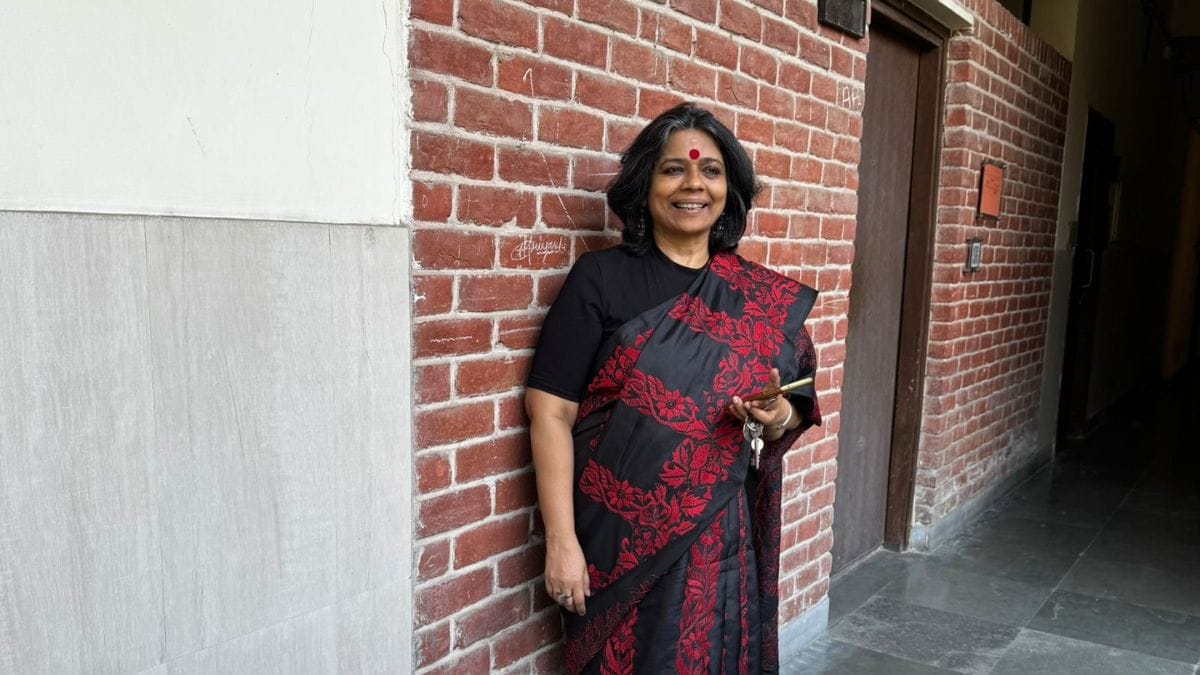
“We issued the notice after the Delhi Police imposed Section 144 on the campus for a month,” said DU Registrar Vikas Gupta. However, a DUSU office-bearer told ThePrint that during a meeting on the notice, proctor Manoj Kumar Singh and vice-chancellor Yogesh Singh told students that it was being implemented as a trial for a few days to “test the waters”.
Also read: Sex, spa and two Muslim women. The Bhopal crime drama that’s in every WhatsApp chat
‘Fear among students’
Sitting at a tea stall outside the Faculty of Arts, 25-year-old Mudita addressed two students.
“It is an outright infringement of our right to protest and dissent,” she said, adding that the ban on protests and gatherings cannot be viewed in isolation.
“DU has always had a politically active culture, but repeated diktats are pushing students to stop speaking their minds. This new circular came after the UGC guidelines—and you can’t talk about this without talking about those guidelines,” she said.
For Mudita and others, the order is part of a broader attempt to depoliticise the campus. But the ban has not silenced conversations. Students say they are navigating around it. Small group discussions have replaced larger gatherings.
The prohibition marks a serious violation of Article 19 of the Indian Constitution, which guarantees the fundamental right to freedom of speech and expression, as well as the right to peaceful assembly.
—Maya John, assistant professor, Jesus and Mary College
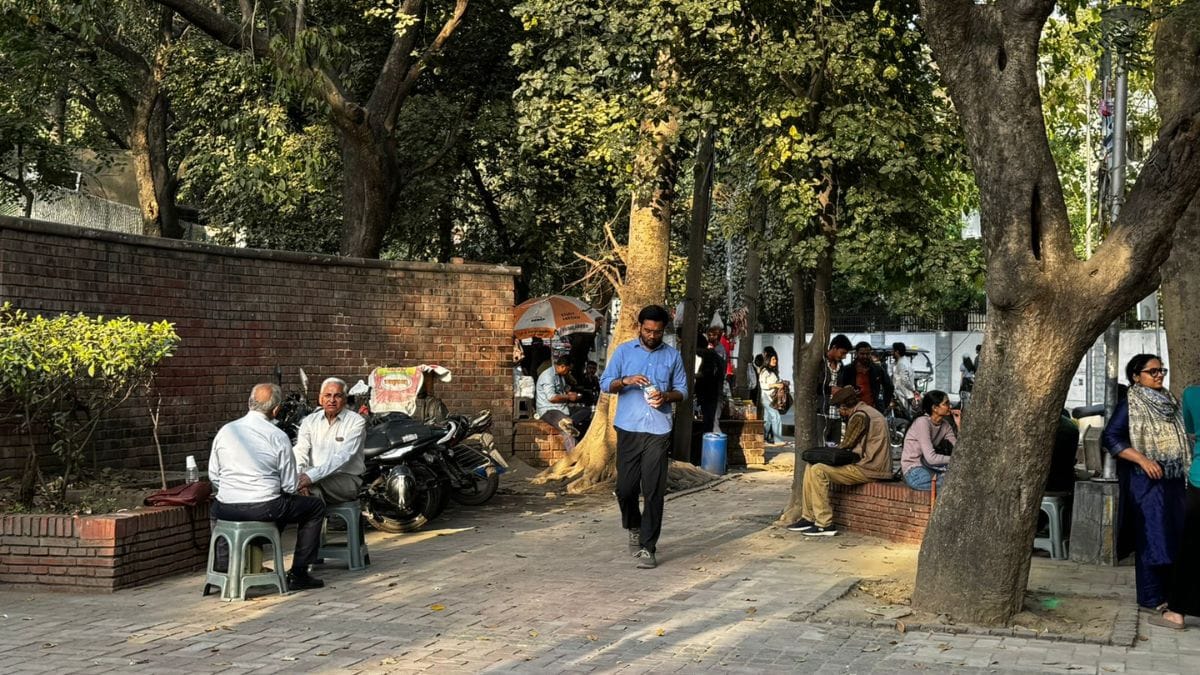
Tea stalls are brimming with students divided in small groups, discussing the future of the university. Pamphlets continue to circulate—handed discreetly across corridors and roadside. One reads: “Strengthen the struggle against caste system! Cast out caste!!”
Soon after the circular was issued, office bearers of the DUSU met the administration. They were assured that the restrictions would be lifted within three to four days. Weeks later, the order remains in place.
For some students, the restrictions are nothing short of “absurd”. “Carrying of any hazardous materials, including marshals, beacons, torches, etc. Engaging in any activity that affects the general tranquility of the public or the smooth flow of traffic,” Mudita read aloud from the notice, laughing sarcastically.
She paused as the conversation turned to university elections. The annual DUSU election is known for its loud campaigning, posters plastered across campus walls, and show-of-strength bike and car rallies that often bring traffic to a halt.
“That phrase of the notice in itself explains everything,” Mudita said. “This is the same campus where every year there are elections. Look at how much garbage is thrown around then, how much ruckus there is.”
A student who didn’t wish to be named said that the gatherings matter because they give students the space to question why the government introduced the UGC guidelines in a manner many view as problematic.
While a section of students claim that the provisions discriminate against general category students, Left-wing student groups such as AISA say the guidelines don’t go far enough. A common concern is that the provisions are vague.
“Now there is fear among us that false complaints can be filed and our entire future can be ruined,” the student said.
Also read: Assam went to war on Kaziranga poachers. Rhinos are winning
‘Protest banned, bhajan clubbing allowed’
Even as protests and political gatherings face restrictions, other forms of assembly continue unabated. One of these is “bhajan clubbing”, featuring devotional music with a modern twist. After Prime Minister Narendra Modi spoke about this new trend in his radio programme Mann Ki Baat, Delhi’s culture minister Kapil Mishra announced a ‘Vasantotsav 2026’ campus tour across DU. It features a bhajan clubbing series and a classical dance festival.
The tour was formally launched by chief minister Rekha Gupta at Ramjas College. Despite the restrictions on protests, a bhajan clubbing event was held at Shivaji College on 23 February.
“Gatherings for protest are banned, but bhajan clubbing is allowed,” said one student. “That tells you what kind of expression is welcome.”
Professors are now speaking among themselves, questioning where the university is headed. They are drawing comparisons between the campus atmosphere under NDA and UPA governments.
According to Dev, when the Congress was in power, the administration’s response in a situation such as this would not have been as strict. “When the four-year undergraduate programme was being implemented in 2013, and the DUSU president was from NSUI, the office bearers of the Student Union and administration simply chose not to participate. They put the entire movement in cold storage. But there was nothing like this kind of hooliganism,” she said.
For John, the proctorial order issued by the university is “unfortunate and an authoritative directive that should be immediately withdrawn”.
“The prohibition marks a serious violation of Article 19 of the Indian Constitution, which guarantees the fundamental right to freedom of speech and expression, as well as the right to peaceful assembly,” she added.
Professors say the undertaking HODs were asked to sign is just the formal acknowledgement of what has been happening on campus for a while now. “During seminars, we think twice while preparing the guest list to avoid any trouble,” Dev said.
In October 2025, a long-running academic seminar scheduled at the Delhi School of Economics (DSE) on land and democracy was cancelled to promote a summit on “cow welfare”.
A professor who didn’t wish to be named said that the undertaking has also asked HODs to take full responsibility for ensuring that “no hate speech will be delivered in seminars and that participants will be associated with any anti-national organisation banned in India.”
On 19 February, several Left–wing groups had gathered at the back gate of the Faculty of Arts to give a press conference on the protest ban. The students say they were holding placards against the ban. Five or six security guards had been posted at the gate.
“Suddenly, the number of guards started to increase, and we started getting threats to stop the press conference. And our placards were torn. It was not even a protest but a press conference,” said Rakesh, a student at DU.
The students say that it was a trailer of what would happen if they flout the “arbitrary, unilateral” laws.
An air of apprehension has prevailed since. “Even if we just went near the Faculty of Arts and recorded (videos) in front of the gate, two or three guards would come and stop us, asking what was going on. It feels like you are constantly under surveillance, whether by the guards or the CCTV cameras,” Rakesh added.
(Edited by Prasanna Bachchhav)