







New Delhi: Pakistan’s television industry is finally asking the question that has long lingered at its margins—why are the country’s religious minorities largely absent from its dramas?
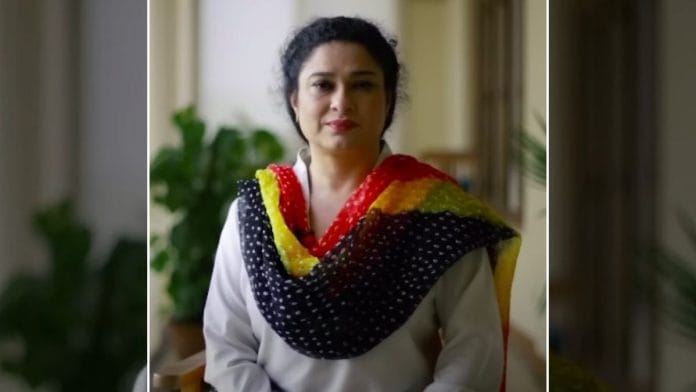
Popular actor Sania Saeed raised the issue at journalist Amna Haider Isani’s talk show last week, while recalling the reaction to Meherposh, a 2020 drama that portrayed a Hindu character.
“On our television, when do we show other religions in dramas? We don’t see other communities as if they don’t exist,” Saeed said.
Saeed criticised the industry’s reluctance to portray religious diversity, arguing that the omission reflects broader social prejudice.
TV dramas are the mainstay of Pakistan’s entertainment industry, with around 30-50 prime-time shows produced annually. The characters are, by and large, Muslim, even though the country is home to millions of Hindus, Christians, Sikhs and members of other religious groups. Religious minorities make up about 3.65 per cent of Pakistan’s 26 crore population. Hindus are the largest minority group (about 1.61 per cent), followed by Christians (about 1.37 per cent).
When minority characters do appear, they are often treated as exceptional rather than ordinary participants in everyday Pakistani life. That debate has gained fresh attention now after Saeed’s remark.
She recalled that the production team of Meherposh, in which she played a supporting role, was taken aback by audience reactions.
“We were reading the comments on Meherposh and were shocked to see our audience’s mindset, and how you are so hell-bent on catering to them. They were objecting to the Hindu portrayal, saying, ‘Who are they? Why was a Hindu shown in the drama? Is Star Plus being aired here?’ They behave as if no Hindus live in Pakistan. Pakistani ideology is prejudiced,” she added.
Meherposh, directed by Mazhar Moin, aired for one season and introduced a Hindu character who had not even been named. He was portrayed as the childhood friend of actor Ayeza Khan’s character. Yet Saeed mentioned how her mere mention riled people up.
‘Such characters needed in Pakistan’
Saeed’s remarks have revived a wider conversation about representation in Pakistan’s entertainment industry.
Acclaimed Pakistan director Saifee Hasan, known for shows on social issues like Tann Mann Neelo-0-Neel and Zard Patton Ka Bunn, told ThePrint that the lack of minority representation in the industry reflects both demographics and creative habits.
“The drama industry is confined to major cities in Pakistan where the minorities are in such a small number that neither are they discriminated against nor is any special thought given to include them as a part of Pakistani dramas, which are a reflection of everyday life,” Hasan said.
He noted that his own production company is headed by Mahesh Wasvani, a Hindu executive. Still, Hasan argued that television has the power to influence public attitudes beyond urban centres.
“However, if we created stories with strong characters belonging to minorities, we could influence the thinking of the uneducated masses that live beyond the big cities and towns. People who are actually biased might have a change of heart if they see the non-Muslim characters as ordinary human beings in Pakistani dramas,” he said, adding that such characters should be a part of Pakistani dramas if the country wants to bring about inter-faith harmony in society.
Also read: Pakistan bans Geo News over ‘blasphemous’ content. People say it’s politically motivated
A slow evolution
One of the first high-profile attempts to centre a Hindu family came in 2016 with Seeta Bagri, a television serial directed by actor and filmmaker Adnan Siddiqui. The drama explored the challenges faced by Hindu citizens in Pakistan and was produced, Siddiqui said at the time, “solely to spread religious harmony and also to highlight the minority of Hindus in Pakistan.”
Its title track was sung by Indian playback singer Sukhwinder Singh, with music composed by Sajid-Wajid.
Then in 2025, Kuch Ankahi featured a Hindu family as part of its ensemble cast, while Case No. 9 included a subplot involving Rohit, a Hindu man accused of raping a woman named Seher.
Actor Navin Waqar, who portrayed Rohit’s wife, later argued that such representation should become commonplace rather than exceptional.
“I think inclusivity matters,” Waqar was quoted in a Dawn article. “It’s so important to show ke ye bhi hamari society ka hissa hain aur ye bhi waise hi rehte hain jaise hum rehte hain (that they’re also part of our society and live just like we do).”
Also read: Pakistan Army’s Jackson Carter attacks India, praises US. He is AI-generated
‘Minorities as strong characters’
Screenwriter Bee Gul, known for creating shows like Darr Si Jati hai Sila, argues that the challenge extends far beyond television. Religious prejudice, she says, is rooted in political conflict, historical narratives and economic inequality.
“So if I talk about the society I’m living in and the culture that I’m familiar with, which is prevalent in our society, of course, there is a lot of discrimination when it comes to minorities,” she said. “And the discrimination is not only cultural, but I would say the discrimination is also political.”
She said decades of political hostility between India and Pakistan have shaped perceptions of Hindus, while Christians have faced a different form of marginalisation tied to colonial history and economic exclusion.
“So this specific, this minority has a political agenda behind it,” she said. “India and Pakistan are both in the same boat. I don’t see a difference anywhere.”
Gul argues that television often approaches minority representation with good intentions but flawed execution. “When its representation comes on television… it comes in a very fake, in a very made-up, in a very ideal state,” she said. “It becomes very preachy and a sermon-like situation.”
Rather than allowing minority characters to emerge naturally from a story, she said, writers often create them primarily to deliver a social message.
“The motivation behind it is already very forced… it is an agenda to promote harmony… which is a good agenda. But at the end of the day, it is not an organic process of writing a story.”
She points to broader patterns of representation in Pakistani television, including colourism.
“Even if we want to write about a person who is not fair-skinned… we paint an actor dark,” she said, referring to the popular drama Parizaad. “Again, a very colonised impression.”
For Gul, the solution is not simply increasing the number of minority characters but changing the way writers think about identity itself.
“As a society, we need to do away with the labels of majority and minority. As long as borders, countries and nations are defined by religious or faith-based identities, minorities will continue to be created,” she said. “We start the discrimination when we continuously say minority.”
“The moment we start thinking that a person deserves respect simply because they are a human being—not because they belong to a minority—then representation will become natural,” she added.
(Edit by Saptak Datta)