





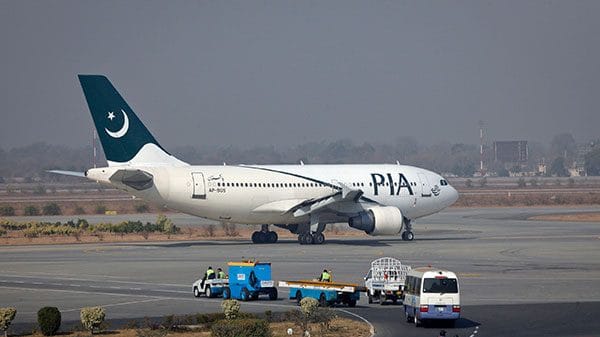



New Delhi: After more than three decades, Pakistan has finally pulled off the privatisation bid for its national airline, Pakistan International Airlines.
On Tuesday, the country auctioned 75 per cent of its stake in Pakistan International Airlines (PIA), once seen as the pride of not just Pakistan but South Asian aviation. It marks the country’s first major privatisation in nearly two decades and a symbolic victory under an IMF-backed reform programme.
“The jinx is broken. PIA is privatized. It’s a success for the country. Regardless of PIA’s history, it was a decaying asset in the government’s hands that has now got a new lease of life. The airline may survive; it won’t face a demise like Pakistan Steel Mills,” a Business Recorder editorial read.
The winning bid of PKR 135 billion came from a consortium led by Arif Habib Corporation, one of Pakistan’s most powerful financial groups. The auction, conducted in two rounds and broadcast live on state television, was meant to signal transparency after last year’s failure, when the sale attracted only one bid.
This time, the government will receive PKR 10 billion in cash, with the remaining amount to be phased into the company as investment. PIA has been valued at PKR 180 billion, and the state stands to receive an additional PKR 45 billion if the buyer chooses to acquire the remaining 25 per cent stake.
The transaction covers only PIA’s operating assets, with all real estate holdings, including vacant land, excluded from the sale.
Pakistan Prime Minister Shehbaz Sharif called it ‘a historic moment’, but many are questioning the math.
Many economists say that since the new owners will control the company, most of the payments offered as investment effectively circle back to the buyer. Meanwhile, the government, which has absorbed the debt, will pay it back through taxpayer money.
Who bought PIA and why
The auction drew three bidders. Lucky Cement, part of Pakistan’s largest industrial conglomerate, opened with a bid of PKR 101.5 billion. Airblue, a private airline, offered PKR 26.5 billion, but exited early after failing to meet the government’s reference price. The Arif Habib–led consortium initially bid Rs 115 billion before emerging as the winner in the second round.
Arif Habib Corporation is best known as Pakistan’s largest brokerage and investment house, with interests spanning across sectors such as banking, asset management, energy, fertilisers, and real estate. The consortium includes affiliated firms and investors with deep ties across Pakistan’s corporate and policy establishment.
Ahead of the sale, the government transferred more than PKR 650 billion in legacy debt—along with pension liabilities—out of PIA and into a state-owned holding company.
What remains is a leaner airline with a valuable route network, landing rights in over 170 countries, bilateral air service agreements with 97 states, and a recognisable brand.
The buyers had originally sought 100 per cent ownership. That did not happen. But with a 75 per cent stake, they gain full management control, while the government’s remaining stake carries no operational authority. The State has exited day-to-day decision-making altogether.
Also read: Pakistanis can’t get enough of U19 coach Sarfaraz Ahmed. ‘He’ll transform new generation’
PIA sale was decades in the making
PIA’s privatisation has been attempted repeatedly since the early 1990s. Despite having established a National Privatisation Commission as early as 1990 under Nawaz Sharif, the country has struggled for over three decades to offload the airline.
PIA was removed from the privatisation list in 2009. In 2013, the government renewed its efforts by proposing to sell 26 per cent of its shares along with management control to private investors. This saw massive protests by staff unions, which led to the death of three employees during a confrontation with security forces near the main entrance to Jinnah International Airport.
In 2018, the Imran Khan-led PTI government shifted its focus away from privatisation, aiming instead to achieve profitability through changes in top management.
In December 2023, the interim government once again announced plans to privatise the airline.
Last year’s attempt ended in embarrassment. A single bidder, real estate developer Blue World City—that had ties to the military—offered around PKR 10 billion for a 60 per cent stake, far below the government’s floor price of PKR 85 billion.
This time, the government rewrote the rules. It offered to sell up to 100 per cent of PIA, offloaded most of its debt, and secured cabinet approval for revised terms. The airline also posted its first pre-tax profit in over two decades, and aviation authorities in Britain and the European Union lifted a five-year ban that had cut PIA off from profitable routes.
From legacy to losses
Muhammad Ali Jinnah wanted to set up a national airline in India before Partition. He put industrialist MAH Ispahani to task in June 1946, and Ispahani launched Orient Airways in October 1946 with Kolkata as a pilot project.
Ispahani was the chairman and Air Vice Marshal OK Carter the general manager of Orient Airways. Operations began in June 1947 with the Calcutta-Akyab-Rangoon route, marking the first post-war international service operated by an Indian-registered airline.
During Partition, Orient Airways undertook one of the largest population transfers in history. It also supplied medical aid.
In 1955, the airline was merged into a newly created state-owned airline, PIA. In 1959, Air Commodore Nur Khan took over and started what is often labelled the “golden years” of PIA.
In 1961, PIA launched its first Boeing 707 jet service on the London-Karachi-Dacca route, which resulted in PIA becoming the first Asian Airline to operate a jet aircraft. In 1964, it became the first non-communist airline to fly to China. By the mid-1960s, PIA was a household name.
The airline modernised operations through the 1960s, installing Pakistan’s first computers to automate tickets and management in 1967.
Then came the decline. The airline entered a period of decline in the 1990s-2000s, incurring billions in losses. Its asset value dropped, disciplinary problems increased, and union influence over management grew. Many operational aircraft were grounded, and repairable equipment was left unattended.
The crisis took its worst shape in 2020, when a PIA flight crashed in Karachi, killing at least 97 people. In a later investigation, Pakistan’s aviation minister revealed that 262 out of 860 licensed pilots had suspicious or fake credentials.
Also read: Pakistan offloaded 66,000 travellers this year. They were going to Riyadh to be beggars
Why privatisation was the last hope
By June 2023, PIA’s liabilities had swollen to PKR 825 billion, with negative equity of PKR 649 billion. Operating cash flows were negative year after year between 2017 and 2022, forcing the airline to rely on borrowing. Finance costs went up from PKR 15 billion in 2017 to PKR 50 billion in 2022, with no chance of recovery, according to reports.
To make privatisation possible, Islamabad created a PIA Holding Company to absorb the debt. Banks agreed to restructure PKR 268 billion in commercial loans, extending maturities and cutting interest rates on the condition that privatisation goals are met by 2027.
Pakistani professor Nasir Iqbal called the deal “a national icon sold off like scrap”.
“This isn’t just a story of one airline’s downfall. It’s a case study in how Pakistan kills competition, rewards incompetence, and buries merit under political patronage. From the world’s top airline to a symbol of institutional rot. This is not privatization. This is liquidation caused by failure of governance,” he wrote.
(Edited by Prasanna Bachchhav)