





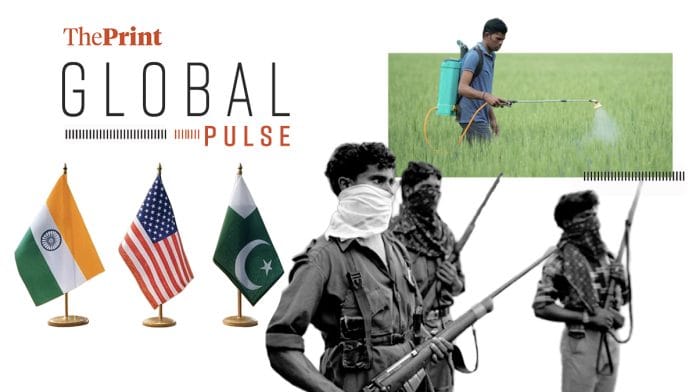



New Delhi: Pakistan is trying to play peacemaker between the US and Iran, while India appears sidelined, writes Alex Travelli in The New York Times, dwelling on India’s diplomatic worries, given Pakistan’s role as a mediator between Tehran and Washington.
Pakistan is playing referee in the West Asia war by proposing US’s 15-point peace plan to Iran; it even offered to host peace talks. On the same day, the US envoy to India announced a phone call between US President Donald Trump and Prime Minister Narendra Modi. Modi confirmed the call via a post on social media, stating that both leaders “agreed to stay in touch regarding efforts towards peace and stability” in West Asia.
Travelli notes that Pakistan is a “natural fit” for the role of an intermediary as it shares a large border with Iran, has experience working with the US military, and defence pacts with Saudi Arabia and China. “Since last summer, after an intense but short conflict between Pakistan and India that Mr Trump claimed to have settled, Pakistani leaders have enjoyed a warm welcome in Washington,” says the report.
India’s stance on the West Asia war was also made “awkward”, as Travelli points out, by Modi’s visit to Israel just two days before the US and Israel attacked Iran.
While India-US ties have improved over the last year, with US officials hailing India as “a republic of continental scale,” the NYT report mentions Congress leader Jairam Ramesh as saying that India was “outmanoeuvred by Pakistan’s superior diplomatic engagement and narrative management”.
The West Asia war is not only putting the spotlight on India’s diplomatic reach but also disrupting supply chains. In the BBC, Abhishek Dey reports on how India’s fertiliser supplies could take a hit if the war continues.
India, the world’s largest fertiliser user after China, relies heavily on imported raw materials and finished products, and much of it comes from the Gulf via the Strait of Hormuz.
While PM Modi has said that the government is taking the required steps to ensure that the supplies are not disrupted, experts say “current stocks are enough for the upcoming sowing season, but this may change if the war stretches on”.
Indian farmers are not feeling the stress, at least for the current sowing season, which will take place in June and July. India had urea stocks of about 6.2 million tonnes as of 19 March, the report notes.
While the current stock of urea would be able to support the upcoming monsoon crop season, much will depend on “how long the conflict continues, with analysts saying supply chains could stabilise within weeks if shipping resumes at the normal pace”.
The Economist writes about “the end of the world’s longest-running Maoist insurgency” in India, talking to a rehabilitated Maoist rebel who said he ordered the execution of hundreds of people and led attacks that left thousands of families displaced.
“For six decades, Indian security forces have battled Maoist insurgents, especially in areas across India’s central and eastern states. For years, Indian governments considered the rebels the biggest threat to domestic security,” the report notes.
Union Home Minister Amit Shah said earlier this month that India will be Maoist-rebel-free by 31 March. And the numbers seem to attest to the progress. “In recent years, security forces have been stepping up their anti-Maoist operations, to great effect. Indian forces say they have killed 748 guerrillas since 2024, a record tally,” it notes.
By February 2026, the number of districts with Maoist activities have fallen from 800 to seven, it adds. “Until last year, the village of Kutul in Chhattisgarh was sometimes described as the Maoists’ unofficial capital. But now they have been pushed out. Many of the village’s tribal residents seem relieved.”
A local resident told The Economist that while their ideology was good, they would kill anyone who disobeyed them. “They (locals) say the Maoists forced locals to run errands, donate food, and, most tedious of all, attend classes in Marxist theory,” according to the report.
“The government’s counter-insurgency efforts have involved both carrots and sticks,” it adds. Some rebels have been persuaded to surrender with incentives such as Rs 50,000 cheques and housing. When security forces reached Kutul, officials also promised to enroll residents in India’s digital ID system for access to public services and to build concrete homes, says the report.
It also notes that the battle against Maoists have been “extremely brutal”.
Civil society groups have accused Indian security forces of killing insurgents who could have been captured. In Chhattisgarh, a 5,000-strong “District Reserve Guard” made up largely of tribal recruits, many of them former Maoists, carries out infiltration attacks on rebels and interrogations of those who surrender, says The Economist.
Locals also fear that the government is getting rid of Maoists to clear forest land “so that companies can grab the treasure” in an area rich with iron ore and other minerals.
(Edited by Nida Fatima Siddiqui)
Also Read: Affordable housing crisis affecting Asia’s growth. ‘Political rewards from fixing it may be massive’