





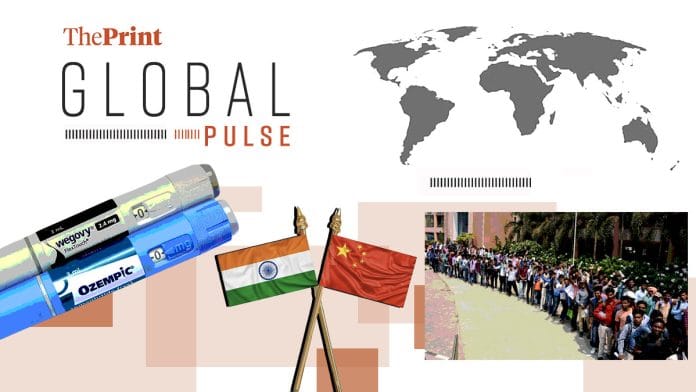



New Delhi: ‘India’s young are more educated than ever. So why are so many jobless?’ asks Soutik Biswas in the BBC, reporting on India’s graduate unemployment.
Citing a report by Azim Premji University, ‘State of Working India’, Biswas examines how a country with the largest youth population is struggling to provide secure, paid employment.
Biswas notes that of the 367 million young people, 263 million constitute the potential workforce in India. “It is an enviable demographic bulge.”
While the country’s educational landscape has “rapidly transformed”, a lot remains. “Enrolment in high school and colleges has surged, broadly keeping pace with India’s development levels. Gender gaps have narrowed. Caste barriers, though far from erased, have reduced.”
Between 2007 and 2017, the share of students from the poorest households enrolled in higher education rose from 8% to 17%, the report notes. But, “the transition from education to employment remains stubbornly broken.”
“Nearly 40% of graduates aged 15-25—and 20% of those aged 25-29—are jobless, far higher than among the less educated,” the report finds. “Only a small share secure stable, salaried jobs within a year.”
India is now producing about five million graduates a year. However, since 2004-05, barely 2.8 million annually have found jobs, with even fewer securing salaried jobs, it says.
After the Covid pandemic, India added 83 million jobs, lifting total employment from 490 million to 572 million, with gains for both men and women. Yet most were in agriculture, dominated by women and typically marked by low productivity and disguised unemployment.
“In other words, the economy has been creating work, but not the kind that transforms livelihoods,” Biswas writes.
In Bloomberg, Menaka Doshi also writes about the challenge of unemployment in the India newsletter, citing the ‘State of Working India’ report.
“The problem of graduate unemployment is widening in India as salaried-job creation significantly lags rising education levels and an expanding youth population,” she writes.
For Doshi, what stood out in the report was India’s educational enrollment rate. “India’s tertiary education enrolment rate of 28% is on par with countries that have a similar level of per capita income.”
The problem area remains the school-to-job transition. Doshi also notes the urgency of the challenge: “There isn’t much time. India’s demographic dividend is nearing its peak, the report said, as the working-age population share will begin declining after 2030.”
India has to overcome the unemployment problem with the AI boom threatening its massive IT sector.
The New York Times reports that with Novo Nordisk’s semaglutide patent expiring Friday, cheaper anti-obesity generics are expected to flood the pharmaceutical markets, giving tough competition to Novo Nordisk’s Ozempic for diabetes and Wegovy for obesity.
“The new markets for generics are enormous. Together, India and China are home to more than 800 million adults who are obese or overweight and more than 360 million adults with diabetes,” says the report.
In India, Novo Nordisk sells higher doses of Wegovy for about 180 dollars a month, a price that is out of reach for most patients, it adds.
Mumbai-based Alkem Laboratories, among the drugmakers cleared to sell a generic version in India, has been ramping up production and getting ready for distribution. “We will try and make sure as quickly as possible that we can make our product accessible to doctors and patients,” the company’s chief executive told the NYT.
Like many countries, India prohibits direct-to-consumer prescription drug advertising that is widespread in the US. But with generic competition looming large, Novo Nordisk this month sponsored a front-page ad in The Times of India focused on raising awareness about obesity, the report points out.
India’s estimated trade deficit with China from April 2025 to February 2026 topped the $100 billion mark, with a month left in the current fiscal. A Global Times report looks at the fine print of this trade deficit.
India estimated that exports to China surged nearly 38% year-on-year to $17.5 billion between April 2025 and February 2026. During the same period, imports climbed over 15% to nearly $120 billion, widening the trade deficit to about $102 billion, it says, citing a report in The Times of India.
“While these numbers naturally draw attention from Indian media amid claims of a ‘trade imbalance’, an excessive focus on the deficit obscures the real opportunities embedded in them,” it adds.
India’s exports to China increased by 38%, more than doubling the growth rate of imports from China, which the report says is “the true game-changer”.
“This figure holds the key to understanding the real potential of India-China economic ties.”
According to the report, the increase in exports shows that the vast Chinese market is providing “tangible growth momentum for Indian exports”.
“Moreover, the support that India-China trade provides to the Indian economy should not be overlooked. Cost-effective goods from China not only enrich India’s domestic consumer market but also play an irreplaceable role in reducing production costs and improving efficiency for Indian businesses,” says the report.
For The Guardian, Chris Johnston reports from a corner of Kolkata, where a man makes life-size replicas in clay, fibreglass and silicone. Not just extraordinary replicas of deities, cultural figures, cricketers and celebrities, but “custom-made 30kg replicas of the dead, commissioned by family and loved ones”.
The factory-warehouse is run by Subimal Das and his staff of 80. “Widows or widowers are the most common customers at Subi Creative House. They order their dead wife or husband by handing over a photograph to Das and his team. Several months later, they take the replica home,” says the report, adding that each figure costs about Rs 2.5 lakh.
“Das says his customers want to keep their loved ones with them in some way. For many, he says, ‘it’s about managing death and loss’.”
These replicas are often dressed in a favourite outfit or sari, and stand or sit in the home they once lived, in a familiar spot or chair, according to the report.
(Edited by Nida Fatima Siddiqui)
Also Read: Global media spotlights ‘magic-pill moment’ for India & why piped gas could be next crude shock