








New Delhi: India has released data on the country’s economic growth, and it has been the fastest-growing economy for the last four years.
In ‘How India became one of the world’s biggest economies’, Alex Travelli and Aaron Krolik of The New York Times explain that India’s economy—which was growing at a 7.5 percent rate in 2025—was expected to surpass Japan’s economy. But with the rupee weakening against the dollar, its prospects did not improve.
The report, however, also says, “But in terms of growth, India far outperformed Japan, which grew only 1.1 percent in 2025. The three largest economies—the United States, China and Germany—all grew more slowly than India last year.”
The country’s growth has been steady. The NYT says India is charting its own path, “breaking every rule about how countries are supposed to modernise”. Others at the same level have struggled to maintain an uptick.
“Its rise up the league table of economies has given it geopolitical clout and drawn interest from investors,” the NYT says.
“The country’s thousands of small businesses hire most of its workers, but an increasing share of growth has come from its biggest companies. Dynastic family firms play an outsize role at every scale, from conglomerates like Mukesh Ambani’s Reliance Group to industry-specific companies.”
The report credits India’s policies to “modernise technology”. “In the past decade, the government has pushed biometric IDs and digital payments, pulling a majority of India’s adults into the banking system.”
However, it highlights the contrasts in the Indian economy. “India is still poor.”
The average income in Japan is roughly 12 times higher than in India, while the average German earns about 21 times more than the typical Indian.
By comparison, India’s per capita income stands at $2,900 annually. “The country’s top-heavy economy means most of its citizens make far less,” notes the authors.
They add that three cities in the world with the largest number of skyscrapers under construction in 2025 were in India. “The tallest of those buildings, however, the 56-story Palais Royale in Mumbai, is stalled, under construction since 2008. India is in a mode of making tall promises and delivering on them sporadically.”
In ‘India, the world’s most colourful country, is changing its hues’, The Economist dwells on the colours that characterise India. The opening lines of its piece, paraphrasing Mark Twain, says, “It is all colour, bewitching colour, enchanting colour—everywhere all around.”
In the run-up to Holi, “it is also a good moment to reflect on the way that India’s palette has changed.”
The Economist says that today, three colours are prominent on the canvas of the country: yellow, green, and saffron.
An “inviting yellow that shines from shop signs and wedding venues, hangs from roadside stalls and marks the outlines of flashy high-rises.” It is produced by LED lights, which have replaced the white tube lights.
Today, this luminosity is a measure of India’s power-generating capacity. “Many cities and towns suffered brownouts, and swathes of villages were not connected to the grid. India has since then nearly doubled its power-generation capacity—half of which is renewable—and now produces a surplus”.
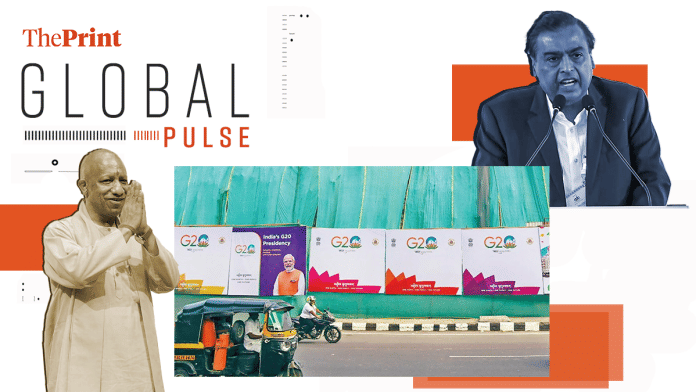
Another colour abundant in the country’s cityscapes is dark green netting draped around under-construction sites to prevent the dust from adding to the already worsening air pollution.
“Developers in its eight biggest cities launched 362,000 housing units last year, up from just under 225,000 in 2019. And railways stations, airports and other infrastructure are getting facelifts or being built brand new”. The colour symbolises not just India’s construction boom, “but the problems that come with growth and the struggles to minimise its repercussions”.
In 2024, when Prime Minister Narendra Modi inaugurated the Ram Temple in Ayodhya following the Supreme Court verdict on the disputed site, where a mosque stood earlier, saffron flags “became ubiquitous outside homes and shops across the country”.
“It is increasingly painted on cars and autorickshaws. A colour once rarely seen outside religious contexts is now unavoidable,” The Economist says.
Mansi Choksi of The Economist brings to readers ‘The Uttar Pradesh association of dead people’.
The interactive report traces the land disputes in India, along with how they have unfolded. Choksi writes about how land is stolen by declaring a living person dead, and how this has led to people organising to fight the theft.
Rambachan, who wanted to open a licensed liquor store to generate a steady second stream of income, soon discovered that the land that he owned, along with his cousins, already belonged to someone else.
“Rambachan learned that all three of his family’s plots now stood registered in the name of a stranger, meaning that his inheritance—as well as the possibility of starting his liquor shop and thereby ascending into the lower middle class—had vanished.”
And after doing back and forth between the court and his part of the town, Rambachan finally found the association, run by Lal Bihari Mritak. Upon reaching the association building, Rambachan and his cousins saw Lal Bihari sitting.
“Welcome,” he said to the cousins in a lucid moment, as a plate of biscuits and a steel tumbler of water were brought into the room. “Which one of you is dead?” Choksi reports.
For Lal Bihari, the mission is personal. Choksi highlights the gravity of land disputes that lead to strange activities in rural India. “An estimated 7.7m people are caught in some sort of legal dispute over India’s 2.5m hectares of farmland. Often these arguments degenerate into violence. Between 2017 and 2021, more than 3,000 land-related murders were committed in Uttar Pradesh alone.”
In ‘Why is WhatsApp’s privacy policy facing a legal challenge in India?’, Cherylann Mollan of the BBC reports on the Indian Supreme Court scrutinising WhatsApp’s 2021 privacy policy in a major case centred on data control and Big Tech’s business model.
“A few days ago, WhatsApp told the Supreme Court it would comply by 16 March with an order requiring it to give Indian users greater control over how their data is shared with its parent company, Meta.”
The users would be able to continue using the platform even if they opted out of sharing data with Meta. The updated policy drew flak from users who felt uncomfortable sharing the data with the parent company, the BBC reports. “The policy has also been criticised by digital rights activists as invasive and a violation of user autonomy, while others argue that leveraging a platform’s popularity for advertising is common practice in the internet age.”
Petitioners have moved the Supreme Court, contending that the law infringes on the rights to information and free expression and risks enabling surveillance. A five-judge bench will take up the matter in March, the report says.
(Edited by Madhurita Goswami)
Also Report: Govt refuses to dilute AI content rules; meeting attended by Google, Meta ends in 30 mins with a firm no