





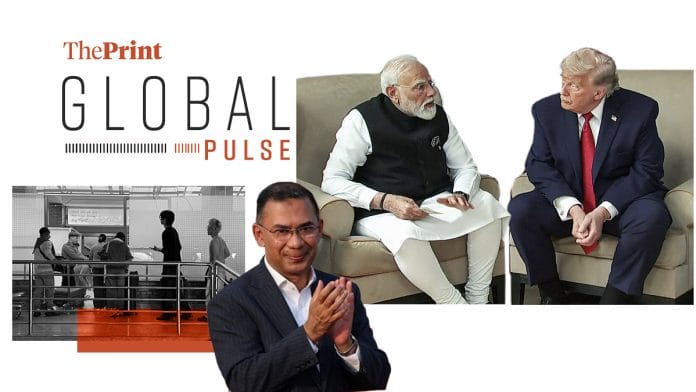

New Delhi: Over the last year, the India-US relationship has been through some trying times. US President Donald Trump’s claim that he brokered the India-Pakistan ceasefire in May 2025 did not go down well with the Indian government.
Trump also threatened India with punitive tariffs for buying Russian oil. In February, the two countries finalised a consequential trade agreement, which Trump is yet to sign off on.
Despite many trials and tribulations, India still seems to be sticking with America, writes C Raja Mohan, professor at Jindal Global University, in Foreign Affairs magazine.
Rather than distancing with the US, Raja Mohan says India may have adopted what could essentially be called an “America Plus” strategy, “in which it seeks to sustain partnership with the United States while widening its engagement with other powers, namely U.S. allies.”
But the US recent move to empower President Trump to impose heavy tariff on countries buying Russian oil can test that balance.
The US Senate recently passed the Lindsey O. Graham Sanctioning Russia Act of 2026 that would grant Trump power to impose a 100 percent tariffs on countries buying Russian oil. If the law comes into force, India would also fall under the radar of those tariffs.
However, Raja Mohan notes Prime Minister Narendra Modi has responded with “unusual restraint” to Trump’s many provocations, and has also resisted demands to pull away from Washington.
There is also a marked difference between Trump’s Asia policy in his first and his second, Raja Mohan says. “Through 2024, Modi and his ruling Bharatiya Janata Party (BJP) were excited at the prospect of Trump’s return to power. Modi had established an unusually warm personal relationship with the president during the latter’s first term,” he writes.
The two leaders headlined two major events in Houston and Ahmedabad as a show of strengthening bilateral ties.
However, the gusto had somewhat fizzled till Trump entered his second term. The US President has also become “friendlier” with China while skipping the Quad meeting in 2025. Quad consists of Australia, India, Japan, and the US, and was created to keep China’s power in check in South Asia.
Raja Mohan writes that in his second term, President Trump has spent a significant amount of time engaging with Chinese leader Xi Jinping— “even talking loosely of establishing a ‘G-2,’ under which China and the United States would meet regularly to hash out global problems,” he writes.
Raja Mohan argues that due to Trump’s latest activities, the tide of public opinion started turning against him. And while the Opposition has strongly criticised the Modi government for maintaining proximity with the US, “Modi has largely avoided confrontations with Trump”.
Modi’s “America-plus” strategy can be attributed to a combination of factors, as Raja Mohan explains.
“India is trying to reduce its exposure to American volatility, but it still recognizes that Washington is its most important partner. After all, when it comes to cultivating a great-power patron, India doesn’t have better options. China and Russia will never buy Indian goods and services on the scale that the United States does, nor can Russia help India balance China,” he writes.
However, the professor also cautions that if Trump continues to “bully India”, public opinion could force Modi to abandon his restrained approach.
Diplomatic ties between the US and India are a work in progress, and so are the relations between Bangladesh and India. Anbarasan Ethirajan of the BBC reports on the diplomatic relations between India and its eastern neighbour—that deteriorated sharply under the interim government led by Muhammad Yunus that took over after the ouster of prime minister Sheikh Hasina. The article looks at how the new government in Bangladesh, led by Prime Minister Tarique Rahman, views India.
Ethirajan starts with a recent event that quietly set off chatter within diplomatic and journalistic circles about India’s attempts to repair ties with Bangladesh. An official email from the Indian president’s office earlier this month said a weekend Change of Guard ceremony at the presidential palace had been cancelled because rehearsals were being held for the ceremonial welcome of the Bangladesh PM.
“There was just one problem: no visit had been officially announced,” writes Ethirajan.
The mail was later withdrawn, but it added to weeks of speculation over a possible visit by Rahman. “India is keen to host the leader of its eastern neighbour for talks – and the timing matters,” Ethirajan writes.
The relations between India and Bangladesh have significantly deteriorated since New Delhi gave asylum to ousted Bangladesh leader Sheikh Hasina, The newly elected government in Bangladesh has asked India to extradite Sheikh Hasina. India has said the “request is being considered”.
“Despite the issue, Delhi has made repeated overtures to the new government. A formal invitation was extended to Rahman soon after he took office, and India’s High Commissioner to Bangladesh Dinesh Trivedi has held discussions with Bangladeshi officials, including the prime minister, in recent weeks,” the report says.
Shyam Saran, a former Indian foreign secretary, told the BBC, there is a degree of frustration in Delhi, because, other than extraditing Hasina, “they have gone pretty far in terms of reaching out to Dhaka”.
Another issue landed India in hot waters with Bangladesh. On 5 August, Hasina addressed journalists virtually at an event organised by the Foreign Correspondents’ Club of South Asia in Delhi.
The Bangladesh government reacted, saying it was “outraged” by the event.
“The timing was particularly sensitive. Lailufar Yasmin, a professor at Dhaka University, says there had been reports that Rahman was seriously considering a visit to India before Hasina’s appearance,” the report says.
Meanwhile, Global Times brings an update from the ground on the devastation caused by flash floods in Tibet, or what China calls the Xizang Autonomous Region.
The report, originally by news agency Xinhua, says residents affected by a mudslide in Gyirong County, southwest China’s Xizang Autonomous Region, have been resettled, and all stranded tourists have been transferred.
A total of 499 villagers and construction workers have been properly accommodated, while 555 affected tourists were evacuated and relocated with the coordination of cultural and tourism authorities. No tourists remain stranded, the report adds. However, the report did not mention the countries of the tourists rescued.
Civil aviation authorities have also joined the rescue efforts. As of 3 pm Thursday, civil aviation services had transported 324 rescue personnel and delivered 24 tonnes of rescue equipment, daily necessities and medical supplies to the disaster-hit area, supporting emergency response efforts and the relocation of affected residents, says the report.
Michael Stott, Joe Leahy, and Andres Schipani of the Financial Times report on the fragile ecology of the Himalayas.
“The giant flash flood that tore through settlements near Nepal’s border with China on Wednesday came as a brutal reminder of the growing risks to people in the Himalayas, a mountain range scientists say is deeply vulnerable to climate change,” the report says.
The report adds that although it is too early to determine definitively what caused Wednesday’s flood, but scientists said satellite images taken before and after the disaster suggest that a large section of a cliff north of Langtang Lirung, near Tibet, collapsed, breaking off a massive chunk of the glacier above it.
The calamity, the FT reports, highlighted dangers of melting glaciers and mountain slopes in face of rapid climate change. The report also adds that according to scientists, cast Chinese hydroelectric projects are accelerating climate change in the region.
(Edited by Ajeet Tiwari)
Also read: Global media reports on China’s warning about ‘secondary mudslides’ in aftermath of Nepal floods