





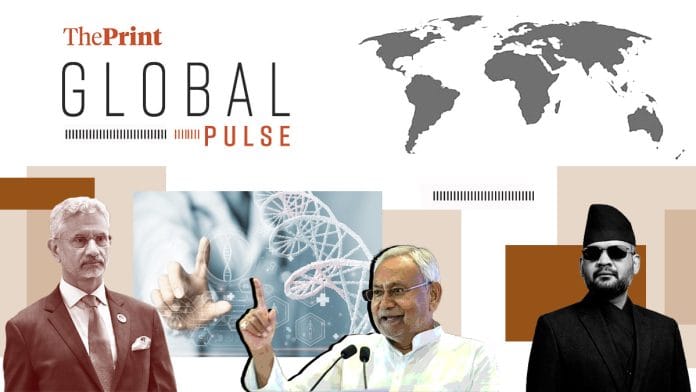



New Delhi: With two India-flagged vessels making their way through the Strait of Hormuz Saturday, External Affairs Minister S. Jaishankar has hailed “direct talks with Iran as the most effective way to restart shipping” through the strait, after US President Donald Trump called on countries to send warships to help the US force open the narrow pathway, Henry Foy reports for Financial Times.
Jaishankar told the FT that negotiations between Tehran and New Delhi are an example of “what diplomacy could bring”.
“I am at the moment engaged in talking to them and my talking has yielded some results,” he told the correspondent.
“Certainly, from India’s perspective, it is better that we reason and we co-ordinate and we get a solution than we don’t,” he added.
As oil prices clocked above $100 last week, Iran’s new Supreme Leader, Mojtaba Khamenei, said last week that the country’s military would continue blocking the narrow waterway, which previously carried about one-fifth of the world’s oil and gas.
Jaishankar told FT that he would be happy to share what India is doing with EU leaders to contemplate the best course of action between negotiations and military involvement. He also clarified that India does not have a blanket agreement with Iran, and each individual case is being negotiated.
However, the negotiations do not involve Iran receiving anything in exchange for allowing Indian vessels to pass through. “It’s not an exchange issue,” he said. “India and Iran have a relationship. And this is a conflict that we regard as something very unfortunate.”
Parag Saxena, CEO of Vedanta Capital, writes in the Wall Street Journal about “India’s Boundless Biotech Potential”.
“Indian manufacturers account for roughly 20% of the global supply of generic medications by volume. But artificial intelligence could shift India’s role from producing drugs to discovering them.”
Saxena writes that India holds a distinct advantage in researching genetic mutations for drugs. India’s many communities have long practiced endogamy, or marrying within the same group. This makes certain rare genetic variations far more common, helping researchers find them faster and at lower cost. Studying these mutations can reveal genes linked to diseases and point to potential drug targets, with insights that can benefit people worldwide, he explains.
However, “translating genetic insight into a drug candidate requires capabilities in chemistry and biologics engineering long concentrated in the US and Europe. India’s opportunity is partnership—combining Western translational depth with Indian-scale discovery.”
It is the last stage, clinical trials, where India struggles, and AI could help. Programmes run into millions of dollars, but “AI could improve patient matching, optimise trial design and automate documentation. With 1.4 billion people, India could support clinical research at unmatched scale”, he says.
Saxena also highlighted India’s massive IT labour force that would develop the tech needed to conduct trials more effectively.
The Economist comments on Nitish Kumar’s resignation as Bihar’s chief minister and his ascent to the Upper House of Parliament. “The Bihar of today is a showcase of his achievements—and of his shortcomings,” it says.
Contrasting the state of affairs in Bihar, “India’s poorest state and home to some 130m people”, under previous chief minister Lalu Prasad Yadav, The Economist makes a case for Kumar’s administrative choices and political pragmatism.
The report says that under Lalu, “kidnappings, extortion and murder were the norm”. Economic growth was negligible.
“Average annual growth in Mr Yadav’s last term was 3.2%, half the national rate. Incomes were 60% of those in the next poorest state and a mere fifth of those in India’s richest big one.”
After an alliance with the BJP, Kumar won in 2005 “and set to work tackling crime, which dropped by 68% in his first term”.
“He built roads and bridges. He launched a bevy of welfare schemes directed at minorities, oppressed castes, and women and girls. School enrolment soared. Health clinics received supplies.”
However, by 2013, Kumar’s public image of “Mr Good Governance” was starting to diminish, says The Economist. And it was not long before he joined Lalu to retain power in the state. “Mr Kumar has spent the past decade switching between parties to retain power, his attention distracted from governance,” it adds.
And while Bihar remains the poorest state, Nitish has left behind “a state that has learnt to expect more from its leaders. Bihar’s people are no longer embarrassed to say where they are from.”
Nepal, the state that shares part of its border with Bihar, saw a national election this month post the Gen Z uprising. A four-year-old party led by a 35-year-old former rapper took charge in the country, signifying a change of the old guard. The Economist reports on Nepal’s new prime minister-designate, Balendra Shah.
“For much of the past two decades Nepal has been run by three parties: Mr (K.P.) Oli’s communists, the centre-left Nepali Congress and a Maoist outfit. They alternated gleefully between propping each other up and toppling each other,” it says. And economic opportunities grew scarce with youth unemployment remaining steady at 20 percent.
Balen was Kathmandu’s mayor and joined the Rastriya Swatantra Party (RSP), promising “to wipe out corruption and focus on governance”.
“Squashed between two giants, India and China, Nepal is used to being a buffer state where the two vie for influence. Balen’s vision is to make it a ‘bridge’. That, along with promises to create 1.2m jobs and double GDP per person to $3,000 in five years, may not be realistic, but it was a breath of fresh air for voters,” says the report.
But Balen’s victory is not without risks. “The first is that he fails to meet the outsize expectations a desperate country has heaped on his shoulders. Cleaning up a corrupt system is harder than tidying Kathmandu’s streets. The second is Balen’s governing style. He can be aggressive.”
His eviction of encroachments from central Kathmandu was sometimes “violent and offered them no rehabilitation”.
“Yet, for now, Nepalis can breathe air filled with a rare sense of optimism,” it adds.
(Edited by Nida Fatima Siddiqui)
Also Read: Blue flame of Indian gas stoves ‘flickering’—global media spotlights ‘anxiety’ over LPG