





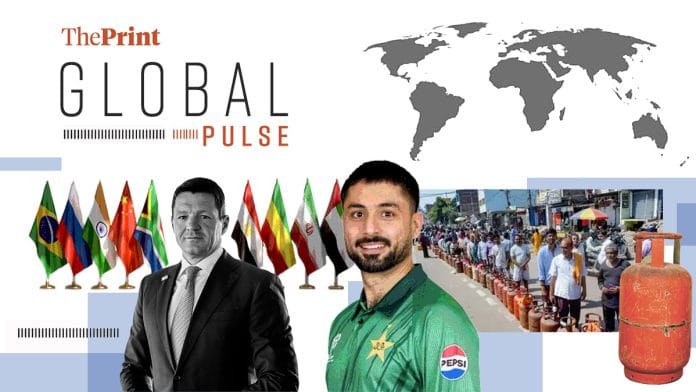



New Delhi: In India, crematoriums have stopped using gas to burn their dead, and restaurants have stopped deep-frying food, Andres Schipani, Michael Stott, Krishn Kaushik, and Chris Kay report from India for the Financial Times.
The US-Israel war with Iran has disrupted energy supplies across the globe, but the effects are being felt most acutely in South Asia.
India, the world’s second-largest LPG importer, which sources approximately 60 percent of its supplies from the United Arab Emirates, Kuwait, Qatar, and Saudi Arabia, is facing a crunch as the Strait of Hormuz is now effectively shut. “Supplies are dwindling, and New Delhi does not have big stockpiles.”
The shortages have prompted the government to even allow the use of polluting fuels, including coal, wood, and kerosene, for cooking.
“The National Restaurant Association of India has already advised its 5,00,000 members to consider shorter operating hours, stop offering items requiring long simmering and deep frying, and use lids while cooking to save energy,” Financial Times reports.
Last week, Pieter Elbers, IndiGo’s chief executive since 2022, announced his decision to step down with immediate effect. His sudden resignation follows several embarrassing instances for the airline in the last few months, Veena Venugopal writes in the Financial Times newsletter.
After Elbers’ exit, Managing Director (and founder) Rahul Bhatia has taken charge until a new leader is named.
“On 9 March, the day before Elbers’s sudden resignation, an IndiGo flight from Delhi to Manchester spent 14 hours in the air due to confusion over altered pathways because of the Middle East war.”
Last December, IndiGo experienced an “operational meltdown” that led to delays or cancellations of thousands of flights. “IndiGo, which had long been proud of its quick and efficient handling of aircraft, had failed to make appropriate arrangements to comply with regulations on staff rostering,” Venugopal writes.
What lies ahead for IndiGo? Elbers was focused on expanding IndiGo from a domestic low-cost carrier into a hybrid model, targeting 50 international destinations by the end of the current fiscal year. However, the company has been posting poor quarterly results.
The airline also recently added a fuel surcharge to its fares in the backdrop of the war in West Asia.
“What follows could decide whether problems at IndiGo will continue, or mark the start of a reset.”
The silence of BRICS on the war has not gone unnoticed. C. Raja Mohan writes in Foreign Policy how the BRICS action (or lack thereof) is the “latest case study in the persistent failure of transnational solidarity”.
“Two weeks into the war in the Persian Gulf, BRICS has issued no joint statement on the conflict. This has disappointed many BRICS enthusiasts in both the East and the West who imagined the grouping as a credible counterweight to US power and a harbinger of a multipolar order,” Raja Mohan writes.
The column highlights there’s a flaw in the grouping’s fundamental structure: the long-standing rivalry between Iran and the Gulf monarchies, such as the United Arab Emirates, despite both being part of BRICS.
“The strategic divide between them is too deep. Iran has defined itself in opposition to the United States since the Islamic Revolution of 1979, while the UAE and its fellow monarchies have long been partners of Washington.”
Even if India, which currently chairs the group, were able to draft a statement that was acceptable to both Tehran and Abu Dhabi, “the result may not be worth the paper it is written on”.
BRICS, along with other organisations, Raja Mohan writes, is “built on common aspirations defined in the broadest possible terms. That is not good enough to produce unified action in a major conflict”.
Nikhil Inamdar of the BBC writes about the fate of India’s “300 billion dollar” IT industry in the face of the AI boom.
“Over the past three-and-a-half decades, India’s software industry has created millions of white-collar jobs, spawning a new middle class driven by high ambition and strong purchasing power.”
The Nifty IT Index of the country’s 10 biggest software companies is down some 20 percent this year, wiping out tens of billions of dollars in investor money, Inamder reports.
While many founders have already noted that the IT sector will not exist by 2030, other CEOs have warned that AI could eliminate around 50 percent of entry-level IT jobs.
“Amid the unease, Indian IT giants have sought to calm frayed nerves, saying the fears are overblown. Artificial intelligence will create new opportunities, they say, though there’s little doubt it will structurally change how things were done in the past,” the BBC report says.
Fees that Indian IT firms earn for routine work, such as maintaining software, fixing bugs and handling updates, are set to decline as demand shifts toward higher-value but less consistent services, such as consulting, the report notes.
A cricket team at Hundred’s auction has signed a Pakistani player, and Indian cricketers have something to say, Stephan Shemilt reports for the BBC.
Former India captain Sunil Gavaskar has said Sunrisers Leeds’ signing of Pakistan spinner Abrar Ahmed “indirectly contributes to the deaths of Indian soldiers and civilians”.
“Gavaskar’s comments are the most high-profile criticism of Sunrisers’ deal for Abrar at last week’s Hundred auction.”
The company owns the Sunrisers Hyderabad team in the Indian Premier League.
“Although belated, the realisation that the fees that they pay to a Pakistani player, who then pays income tax to his government, which buys arms and weapons, indirectly contributes to the deaths of Indian soldiers and civilians, is making Indian entities refrain from even considering having Pakistani artistes and sportspersons,” Gavaskar wrote in a column for a newspaper.
However, as Shemilt points out, Sunrisers’ signing of Abrar has allayed the fears that four IPL-associated teams would boycott Pakistani players for the Hundred tournament.
(Edited by Madhurita Goswami)
Also Read: India seeks safe passage for 6 LPG tankers through Strait of Hormuz amid conflict