





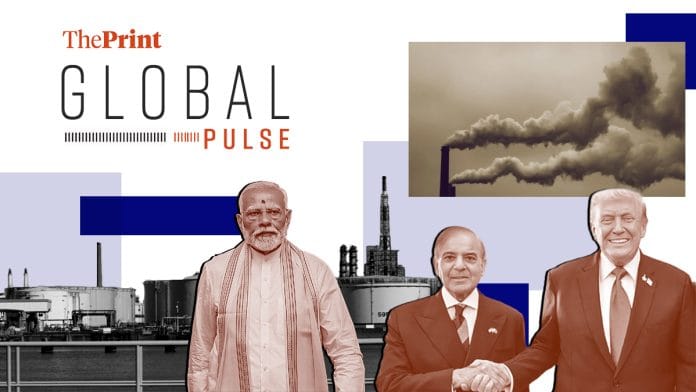



New Delhi: While Pakistan may or may not be succeeding in playing peacemaker, it is definitely making India’s position “awkward” in the West Asia war, reports Soutik Biswas for BBC.
“The chatter in Delhi is unmistakable: as Pakistan positions itself as an intermediary in the US-Iran crisis, is India being sidelined?” he writes.
Moving with “unusual agility”, Pakistan had reportedly relayed a 15-point US peace plan to Iran and offered to host talks in the country—an offer that Tehran rejected. “This week, Pakistan took the lead again, with its foreign minister flying to Beijing to seek Chinese backing for a five-point peace plan to end the conflict.”
The unease for India is “sharpened by a more uneven phase in India’s ties with the US, even as Pakistan appears to be rebuilding channels with President Donald Trump”.
While some in the Opposition and experts have pushed for India to at least try playing an intermediary, others “see little value in such visibility for its own sake, cautioning that mediation without leverage or invitation can backfire”, the report says.
It further notes that in the all-party meeting last week, EAM S. Jaishankar is said to have dismissed Pakistan’s role as “dalali (brokerage)”, asserting that India has played such a role since 1981, including in US-Taliban talks.
“Between these positions lies a more pragmatic middle ground: India need not insert itself into high-risk mediation, but it cannot afford to be passive either,” Biswas writes.
For instance, former Indian foreign secretary Nirupama Rao believes that rather than chasing a mediatory role, India should engage in less visible acts of peacemaking, “from hostage swaps and back-channel military contacts to negotiating safe passage through chokepoints like the Strait of Hormuz—in the long run”, as she wrote in a post on X.
The report also quotes Ajay Bisaria, former Indian high commissioner to Pakistan, as saying that India needs to think beyond headline diplomacy.
Meanwhile, The Economist writes that India’s oil refiners are “feeling the squeeze” from the war.
The article notes how Indian refiners have always benefited from “geopolitical flexibility”, dabbling between the Gulf and Russia. Even when many countries shunned Russia after the war with Ukraine, Indian conglomerates like Reliance Industries, Nayara Energy, and state-owned companies, kept buying Russian crude.
“Now, with the Strait of Hormuz, a bottleneck between the Persian Gulf and the Gulf of Oman, all but closed, geopolitics has bitten back. The force that propelled profit for four years has turned into a drag,” the article reads.
India got around 2.5 million barrels a day, roughly half its imports came from the Middle East, chiefly Iraq, Saudi Arabia and the United Arab Emirates. “That amount has fallen by half.”
Russia’s share of India’s oil imports came down from around 44 percent at its peak to 25 percent by February, which is now on the rise again. A waiver from Trump on sanctions for Russian barrels already at sea eased things along. “Since the conflict began India has bought an additional 30 million barrels or so from Russia, equivalent to about two and a half weeks of the missing Gulf supply,” the article notes.
India also faces increased competition for Russian oil, which it no longer procures at a discount, but at a premium of 10-15 dollars over Brent, the global benchmark, the column notes. China is buying more, and other Asian countries, including Japan and South Korea, are also considering buying from Russia.
The article further says, “India’s state-owned oil-sellers are squeezed on the retail side too. The Indian government froze local fuel prices in 2022, which gave refiners (and the state) a windfall when crude costs fell. It has kept prices fixed even as oil gets dearer to source.”
Much of the competition for products, like diesel and jet fuel, lies beyond the blocked strait. But with supplies tight, the Indian government is unlikely to let refiners export fuel. “India’s refiners, like the tankers on which they rely, are simply stuck.”
A Bloomberg report looks at India’s new emissions-reduction plans, which offer “significant investment opportunities” in sectors pertaining to grid upgrades and storage batteries, according to Eversource Capital, one of India’s largest climate-focused funds.
“By 2035, the world’s third-largest polluting nation aims to increase the share of electricity generation from cleaner sources to 60%, and plans to cut emissions intensity—the amount per unit of economic output—by 47 percent from a baseline year of 2005,” writes Ishika Mookerjee.
Energy transition investment in India jumped about 15 percent in 2025 to a record 67.9 billion dollars, but to hit net zero by 2070, India will have to deploy as much as 21 trillion dollars on decarbonisation.
However, India’s new climate plan, as required under the Paris Agreement, has been criticised by advocates of faster action as “lacking in ambition”, the report adds. “The strategy didn’t set a goal for reductions in absolute greenhouse gas emissions, while a clean energy target is regarded as offering only an incremental advance.”
(Edited by Mannat Chugh)