



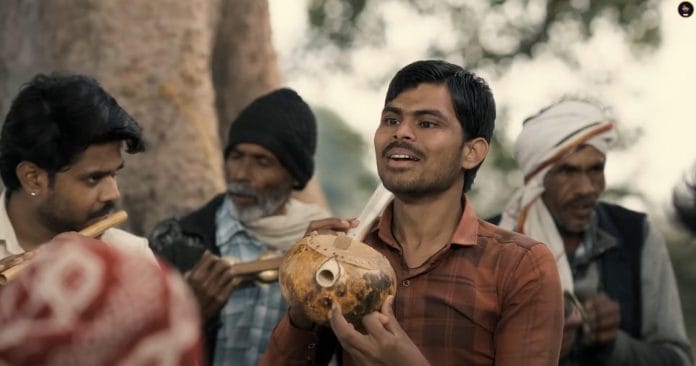
New Delhi: Suneel Lodhi, who sang “Main Tere Hi Bharose Hanuman” for the film Hanuman Ansh, was considered a bad omen in his village in Bundelkhand for years — so much so that if his fellow villagers saw him in the morning, they would change their route.
In an interview to ThePrint, Suneel said that being blind wasn’t a crime but people looked at him as if he practised black magic.
“When I stepped out in the morning, people wouldn’t look at me. Many times, I heard them wince, ‘Whose face did we just see early in the morning?’” the 25-year-old said.
Little did he know that an Instagram page, started by his uncle Rohit Sahu in the year 2019, would change the course of his life. Bundeli Duniya had opened with the motive of showcasing the folk art of the Bundelkhand region, which covers parts of Uttar Pradesh and Madhya Pradesh. One day, Rohit got a call from his sister, who informed him about Suneel’s talent as a singer.
He instantly packed his phone and tripod, went to Suneel’s village. When Rohit first heard Suneel sing, he felt that his voice had been blessed by the almighty. He shot Suneel’s first video on the roof of his house.
“For months, nothing moved. The view counters sat at single digits. The entire village began mocking at me – ‘Why are you wasting your time, fuel, and hard-earned money chasing an unemployed blind boy?” said Rohit.
From an outcast to a favourite
As time passed, however, Suneel started getting invited to nearby villages to sing during festivals. In 2023, he recorded “Dulha Bankar Aa Gav Thela, Hai Motar Ko Byav,” which received nearly 900,000 views. This set off a domino effect, and Suneel started getting invitations to perform at local events. Roughly nine months back, he released another music video, called “O Mere Sankat Ke Kataiya Hanuman,” which ended up getting more than 33 million views.
In February this year, Rohit and Suneel were in Mumbai to record a song for Sai Baba Studio run by producer Gajendra Saxena. During this visit, Rohit recorded a video of Suneel at the Versova beach and posted it on Instagram. Vishal Chaturvedi, the director of Hanuman Ansh, saw the reel and Suneel got his first big break.
Suneel recalled singing the song “Maine tere hi bharose Hanuman, sagar mein naiya daar dai,” with his tambura. “I sang four lines and the entire room went silent,” he said. He remembered Vishal saying, “This is the voice of the film.” Suneel was, however, skeptical on whether the song would actually make the final cut.
“Bhaiya, ye film industry hai. Inke paas bade-bade playback singers hain. Hamari dehati Bundelkhandi aawaz ko aakhirkar film mein kaun rakhega? (Look, this is the film industry. They have big playback singers here. Who would keep our rustic Bundelkhandi voice in a film?) We expected them to replace it,” he said.
Now his voice has reached hundreds of thousands of people across the country. “The very people who earlier questioned his future, stand outside our door today with garlands, waiting to touch his feet,” Rohit said.
His uncle is his sight
Suneel is blind by birth. He did not have the means to complete his formal education. His family still survives on small-scale animal husbandry, and owns a small piece of land in Agra village of Bundelkhand.
From an early age, he started taking interest in folk bhajans like “More Sankat Ke Kataiya Hanuman” at the chaupal, where villagers gather for meetings and celebrations. He would look forward to bhajan mandalis — a troop of artists travelling from village to village, singing Bundeli folk bhajans — visiting his village.
One of the artists from these bhajan mandalis was so impressed that he gave him a tambura, a long-necked string instrument.
“Seeing a blind kid maintain rhythm without missing a beat, an elderly mandali singer took his own tambura, placed it into Suneel’s hands, and said, ‘This belongs to you now.’ That wasn’t just an instrument; it became his lifeline to survive the world,” Rohit said.
Since then, Suneel has been singing folk bhajans. But, when he is tasked with learning new lyrics, his uncle helps him out.
“When a formal script is placed in front of me, my uncle becomes my sight. He sits across from me, breaking down each line syllable by syllable, repeating it twenty times until the cadence is locked in my chest,” Suneel said.
Hanuman in his breath
Recently, a video of Suneel singing on a train was shared widely on social media which falsely claimed that he used to sing in local trains for alms. Suneel clarified that he was just doing his riyaaz (routine singing practice) but the creator used mournful music in the background, making it more dramatic than it was.
“I wasn’t begging; I was doing my riyaaz. Singing to my Lord is my worship, my work, and my self-respect. An artist doesn’t become a beggar just because he cannot see,” he said.
Suneel added that Hanuman is “the rhythm of his breath since he picked tambura.”
Hanuman Ansh’s story revolves around the early life of Laxman Das, who left his home at the age of 13 and grew up to become Neem Karoli Baba; his connection with Hanuman and the miracles surrounding his life.
(Edited by Aakriti Handa)