





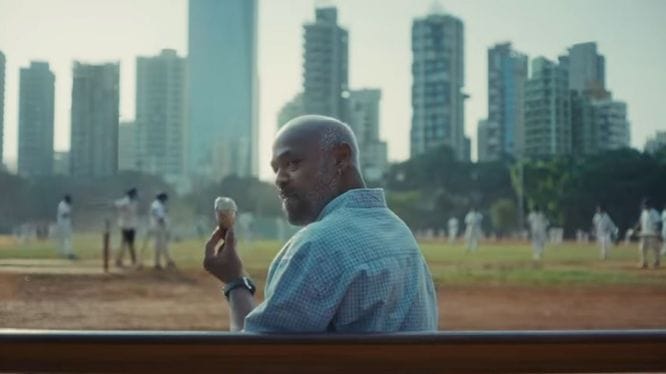


Dinshaw’s latest ice cream commercial had all the familiar elements: a warm summer afternoon, kids playing cricket, and, of course, ice cream. Then came the surprise, Vinod Kambli, making his first appearance since the health scare last year.
The ad builds on a simple idea: some people get a little less in life, so they deserve a little more. But many viewers saw it differently. To them, the message felt more like: a man got less, that is sad, here is something that gives more. And that “little more” was nothing more than the chocolate-filled tip of a cone, now made three times bigger.
What was positioned as a comeback quickly turned into another controversy for the former left-handed batsman. Something about the ad didn’t sit right with audiences online, even as the agency stood by its intent.
“The response we have received to the commercial is overwhelming. Over 95% of the people have loved the campaign. Yes, we live in a democracy, and some people have the right to have an opinion,” said Gunjan Gaba, creative in charge of the commercial at TheWomb.
“All we know is that we approached this with all our heart, as an agency we always see the positive in people,” he added.
Also read: Why Pond’s is facing heat over its new sunscreen campaign
Why the backlash?
In the commercial, the “little less” Kambli refers to isn’t fictional. It’s his real life. His struggles have played out in public—health challenges, financial strain, allegations of fixing in 1996, public rifts with teammates and friends, accusations of domestic violence, and arrests for drunk driving. The list goes on.
The issue on social media isn’t that the ad incorporates the cricketer’s story, but how it uses it. Instead of acknowledging his journey, the brand borrows it and then reduces it to a backdrop for selling ice cream.
The word ‘dildaari’, meaning generosity, runs through the narrative. But here, it’s tied to something trivial, an extra bit of chocolate. That contrast is what many viewers found difficult to swallow. A deeply human story is turned into a passing metaphor or worse—just a symbol.
Some may argue that the ad creates empathy, that people might look him up and understand his journey. Maybe. But what it really leans on is sympathy, and there is a difference.
Gaba, however, believes “sympathy” is too small a word to describe Kambli’s story.
“The entire experience of meeting and working with Kambli has been a life lesson for us on humility and positivity. So, the word that comes to our mind is that Kambli deserved a lot more. And that’s the story we’ve tried to capture,” he said.
For Gaba, the connection between Kambli and the brand was clear from the start. Recalling their first meeting, he described Kambli as someone who still has a strong appetite for life despite everything he’s been through, ‘someone who finds joy in simple things like his wife and family.’ In that sense, the product itself, the chocolate-filled tip of the cone, was positioned as a small moment of joy too.
“That’s where we saw the connection,” he added.
Gaba also pointed out that our idea of a celebrity is often limited to success or a certain image.
“Maybe it’s time we also acknowledge and talk about people who aren’t conventionally successful,” he added.
(Edited by Saptak Datta)