








The Indian cricket team scripted history recently by lifting the T20 World Cup for the third time—twice in a row—when they defeated New Zealand by 96 runs. The win on 8 March was celebrated across the country with great joie de vivre, but the advertisement industry went on the usual rampage of vigorously highlighting Indians’ obsession with cricket.
Earlier this week, Dabur Red released an ad featuring the hilarious character Nawab Chaubey, played by veteran Indian actor Manoj Pahwa. Chaubey is the perfect mix of a proud Team India fan and a caricature of every cricket-crazy Indian ever.
In the 25-second-long ad, Chaubey is sitting in front of the Buckingham Palace and reciting a poem, featuring iconic lines such as “Kyunki cricket mein royalty sirf humari hai (We are the only ones who are considered royalty in cricket)” and “Chabah dalenge tumhe apple ki tarha (We’ll chew you up like an apple)”.
The short film is a masterpiece in understanding modern marketing. It is short, which fits perfectly with the limited attention span of a social media user. It is also quirky and eccentric enough to draw the viewer, featuring a loveable non-A-list Bollywood celebrity and a baffled “King Charles II”. Like many ads nowadays, it does not mention or even show the brand or product till the end; another feature to tug on the curiosity of the viewer.
But the toothpaste commercial is not the only one that hit streaming platforms and social media sites soon after the World Cup win. Historically, any time cricket fever sweeps the country, the Indian marketing sector starts working overtime. From tweets to billboards to speciality campaigns, the week after a cricket victory is when the real work begins for marketers.
Also read: Generali Central Insurance’s new ad slams tokenism on Women’s Day, calls for pay parity
New theme: cricket
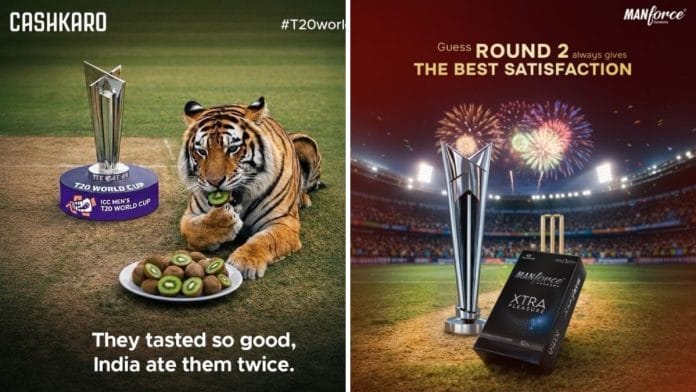
Indian cashback and coupon platform, CashKaro, shared a poster of a Bengal tiger eating kiwis—the nickname for New Zealanders—on a 22-yard cricket pitch. The caption for the ad read: “They Tasted So Good, India Ate Them Twice.”
Although topical, the ad does not really make much sense. There is no real connection between a cashback app and India’s recent cricket win. It feels like a poor, forced attempt by the brand to stay relevant. Much like a recent full-page ad Goibibo took out in the Hindustan Times earlier this week. There is no brand recall between the two backpackers in the middle of a cricket field and the travel company.
The condom manufacturer, Manforce, too, was quick to join the celebration with a tongue-in-cheek advert claiming “Round 2 Always Gives the Best Satisfaction”. The brand, with its #BackToBackChampions ‘slogan’, has often banked on the country’s love of cricket to gain notoriety.
The caption read, “Kiwi went hard. We went harder once again.” Unlike CashKaro, the Manforce ad at least makes sense, even if it does not add any real value to the company.
Even the trustworthy Parle-G advertised India’s victory with a “Pehle dip se aakhri Cup tak (From the first dip, to the last Cup).” The biscuit, commonly eaten by dipping it into a cup of tea across the country, taps into its stature as a household staple and India’s legendary victory in a vintage-style poster that highlights the timelessness of both.
The ad banks on the tried and tested strategy used by many of its peers and competitors by furthering the mood of the moment. But by making its version of the same congratulatory message look “retro,” Parle-G ensures brand recall of both its own and India’s past cricket glory.
From “suffer” to “safar”, the government-funded, Goa Miles, also congratulated the cricket team. The taxi service posted a picture on its Instagram page showing depressed New Zealanders sitting in a corner as Indian brave hearts Hardik Pandya, Sanju Samson, Suryakumar Yadav, and Tilak Varma walk off the field toward cheering Team India fans in a stadium.
The ad read: “Dear New Zealand, sorry you had to suffer, but we had an amazing safar.” Goa Miles’s ad does a far better job than Goibibo. It highlights the country’s journey towards its third World Cup win and also a journey one might take in any Goa Miles cab.
Popular culture ensures that Indians will not forget our cricket victory anytime soon. These ads help reinforce that sense of national achievement and pride.
(Edited by Saptak Datta)