





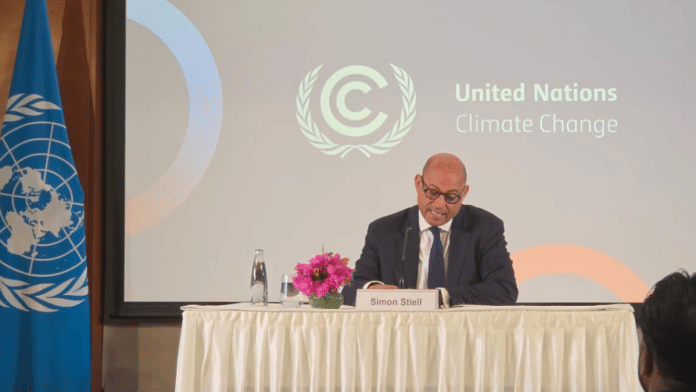


New Delhi: Appreciating India’s commitment to clean energy, executive secretary of United Nations Framework Convention on Climate Change Simon Stiell said that the country’s clean energy growth was “Sachin Tendulkar and Vaibhav Sooryavanshi rolled into one.”
Stiell, who is in Delhi for a series of meetings with Indian government representatives and non-governmental organisations, said that if the country continues its efforts on renewables and clean energy, the coming decade can be “truly extraordinary.”
“Decarbonisation is central to India’s impressive development strategy. This is forging a new path for others to follow,” said Stiell during a press briefing.
“Fossil-fuel-free power now makes up half of India’s installed capacity, a milestone you’ve hit five years early,” he added.
Speaking about India’s work in the field of solar energy, Stiell said that the country is now a “solar superpower.”
“India is now a solar superpower – that has turbocharged your economy, pushed up living standards, and, along with other renewables, saved you $18 billion in fossil fuel purchases last year alone, according to the International Renewable Energy Agency,” he said.
According to IRENA data, India’s solar manufacturing capacity has increased 75-fold since 2014.
Quoting IRENA, Stiell said that India is currently the most competitive solar market in the world on generation cost, producing cheaper power than any other major economy.
India’s stand on the global floor
Earlier on Tuesday, Stiell had a detailed meeting with Minister of Environment, Forests and Climate Change (MoEFCC) Bhupender Yadav to discuss India’s role in achieving global sustainability goals.
“India has assured us of their commitment towards achieving an implementable road map towards sustainability,” Stiell shared.
He added that the implementation will be the focus of the upcoming UN COP-31 in Antalaya, Turkey.
“This will be a COP of implementation. We have seen the most devastating heatwaves in Europe, which have been worsened by El Nino. Countries will have to come together and commit,” he said.
“The US withdrew from the (2015) Paris Agreement, but nearly 194 countries pledged their commitment. It is just one country; everyone else is committed to the goal,” Stiell said.
(Edited by Insha Jalil Waziri)