



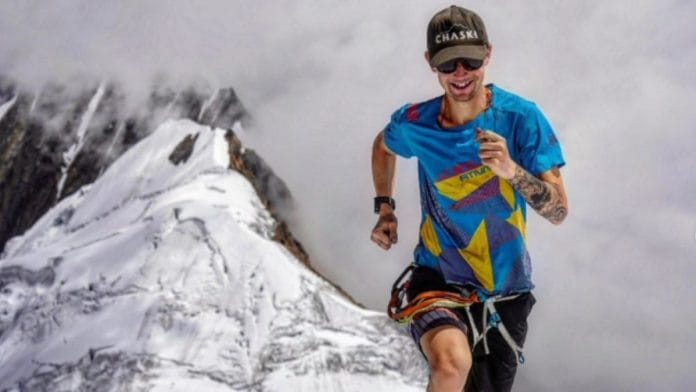
New Delhi: Tyler Andrews, who this week broke the world record for summiting Mt. Everest in less than 10 hours, is a Taylor Swift fan. While scaling 8,848.86 metres, he had Father Figure, the 2025 hit, playing on his earphones.
The 36-year-old American climbed Everest in 9 hours 55 minutes; he broke Lhakpa Gelu Sherpa’s record from 2003, who climbed the highest peak in 10 hours 56 minutes.
Andrews, who is finally back in Kathmandu after finishing his summit– to and fro in 16 hours 32 minutes. He said he felt “happy and relieved”.
“This has been years in the making for me. I have spent the last several years chasing this goal, and after six unsuccessful attempts, there were definitely moments where it felt discouraging,” he told ThePrint on a WhatsApp call. Each attempt helped him rebuild confidence.
“For everything to finally come together on this attempt felt incredibly satisfying,” he said.
Teenager as a music enthusiast
Andrews grew up in Boston; he was not into climbing, mountains, or extreme sports. His interest leaned toward music and art.
For the first time, he discovered his passion for running when he started running cross-country in high school.
“What I loved was pushing my own physical limits,” he said.
At the age of six, Andrews was diagnosed with aplastic anemia, a rare and serious blood disorder. Since then, he has been an advocate of medical research and patient support.
He pushed himself into endurance sports that helped him build strength and travel the world with a different perspective.
“I started as a runner, then moved into ultramarathons, and eventually realised I seemed to perform really well at altitude. Over time, that naturally pulled me toward bigger and bigger mountains.”
Even if he did not pursue a career in music, Andrews drew parallels between his childhood passion for music and the discipline required in running, climbing and expeditions. The devotion he had for music, he put it in climbing and running.
In Massachusetts, the American climber was not exposed to mountains or hilly regions. However, in the last few years, he trained in the Andes, Ecuador, in South America.
“I could train on 4,000- and 5,000-metre peaks regularly, and that experience became the foundation for everything I have done in the Himalayas.”
There were highs and lows while climbing Everest. At one point, Andrews did think it would not be possible this time. But he has perseverance. Sometimes music helped him, and sometimes just looking at the mountains, he said.
At one point, very close to the summit, he said he felt a wave of emotions. Approximately 100 metres below the top, when he could finally see it in front of his eyes, he could not believe it– “I was actually going to do this”, he said.
Everest has two summits; Andrews was at the South Summit from where he could see the highest point on the Earth. For climbers, it takes an hour from there to reach the actual top.
“Up until then (South Summit), so much of the route feels endless. You’re climbing in darkness, exhausted, just focusing on the next step. But suddenly, there it was.”
It was almost like he could throw a rock and hit it.
“For the first time, I stopped thinking about all the things that could go wrong. I knew I still had enough time, I felt strong physically, and suddenly it became real,” he told ThePrint over a call.
Love for Nepal and a supportive team
Nepal played an important role in his initial years of training. Andrews first came to Nepal in 2020; since then he has spent around four months in the country every year. During his visits, he said that he developed a really deep connection with the country.
At first, the culture and the scale of the mountains were overwhelming to him, but now “it is a second home”.
“Honestly, everything has kind of been preparing for Everest,” said Andrews, referring to his time spent trekking, trail running and climbing progressively on higher mountains in Nepal.
He started with 6,000 metres, gradually moved toward expeditions such as Mount Manaslu and Mount Makalu, two of the world’s highest peaks, located in the Nepalese Himalayas.
In May this year, he tried to break the record with more than 22 hours. He has done three expeditions till now.
“The difference between 4,000 and 5,000 and 6,000 and 7,000 to 8,000 metres — each of those is a really big step,” he said. “The only way to really figure that out, I think, is through experience.”
In his long stay in Nepal, Andrews has made close friends there, both in Kathmandu and in the Khumbu region. “Every season I come back, it feels more familiar. For the climber, the journey was far from an individual achievement.
“So grateful to Apu Sagarmatha, Chomolungma, Everest for allowing me safe and speedy passage to the top of the world (and down safely),” he thanked his support team in his Instagram post.
Over the last few years, he has been working with Dawa Steven Sherpa at Asian Trekking (a company organising treks and mountain expeditions) for all his Himalayan expeditions.
For his summit support, three points were arranged across various camps to minimise any sort of delays during the ascent.
“I would stop for just a few minutes, grab some water and energy gels, and then continue moving. Altogether, I probably spent only about 30 or 40 minutes stopping during the entire ascent.”
Talking about his years of hard work, he emphasised the years of learning from the failed attempt.
“I think people sometimes imagine these records are about one magical breakthrough moment, but for me it was really the accumulation of years of preparation and experience,” he said.
Before making the climb, Andrews was doing strength training and felt stronger than ever. “But success on Everest also depends on factors you cannot control. You need good weather, good timing, and safe route conditions. The mountain has to cooperate too,” he said.
Also read: Does climate change worsen antimicrobial resistance? Lancet study says there’s correlation
Proud parents
Happy and exhausted, Andrews wanted his parents to know that he was “alive and successful”.
He connected with the Base Camp team on a walkie-talkie, and the team made a WhatsApp call to his parents in the US. His parents, who were worried about him, spoke to him on speakerphone through the walkie-talkie.
“I think my family was relieved for the most part that I was down safely,” Andrews said.
All his proud parents wanted from him was to come back in one piece.
(Edited by Ratan Priya)