


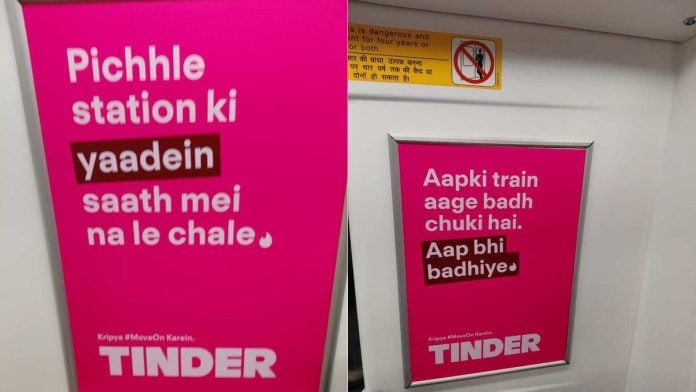
New Delhi: Tinder is right in the faces of Delhi Metro commuters. The red-and-white ads plastered across the compartments are hard to miss, partly because the dating app’s message is so on point and so neatly aligned with the daily commute.
Two of the latest posters seen on the Yellow Line of the Delhi Metro Rail Corporation (DMRC) are asking singles to let go of the baggage. “Jo laut nahi rahe unke seat bacha kar na rakhein.” Don’t save a seat for someone who isn’t coming back. “Pichhle station ki yaadein saath mei na le chale.” Don’t carry the memories of the last station with you. Someone missing their ex and painting their journal with tears can look at these messages and feel very, very seen. Perhaps that is why the dating app’s commute-campaign has struck a chord.
In advertising, this is called a contextual out-of-home (OOH) campaign. OOH advertising refers to ads placed in public spaces outside the home, such as billboards, bus shelters, transit stations and metro compartments. A contextual OOH campaign takes this a step further by tailoring the message and placement to the surroundings, making the advertisement feel relevant to the people who encounter it.
As per reports, Tinder’s DMRC campaign was first seen in August this year. Considering how quickly ads get switched up on the metro lines, one can see that the dating app has been able to hold its place. Young, old and the mid-century moderns on their journeys remain fascinated by the bright advice blocks in every other metro. One can imagine that the target audience also feels called out.
“Yatriyon se nivedan hai situationships se uchit doori banae rakhe,” said one of the hard-hitting posters. The passengers are requested to maintain a safe distance from situationships. It emulates the light and breezy authority of Shammi Narang and Rini Simon Khanna—former Doordarshan news anchors who gave voice to announcements made in DMRC. While the anchor duo warns people to stay away from the metro door, not to play loud music, and to follow other important orders, the dating app is asking singles to stay emotionally safe.
In another poster, the message is this: “Yatriyon se nivedan hai apne standards neeche na rakhein.” Do not bring your standards down in the name of being picked by a stranger on the app.
Also read: Hungary to reveal Communist-era secret police files to the public
Maximising marketing
The lovelorn commuters dangling in the bogies, holding on to the pole or the handles, are being baited to click a picture of the sardonic ads and post it on their Instagram stories. That’s how the dating app’s boss is continuing to bet on these ads even after months.
It is nothing unusual to see Tinder go all out and paint the DMRC with its quirky campaigns. The latest trend in the dating app world is all about maximising marketing. Even Hinge, which has not made ads in a decade of its run in India, has now started making ad films. The decline in users is one reason, and the meme-worthy renewal of the dating discourse is another. Either way, the idea is to hold on to the singles and bring them back to the swipe-left-right routine. By doing it right, the apps are at least successful in staying part of the conversation.