



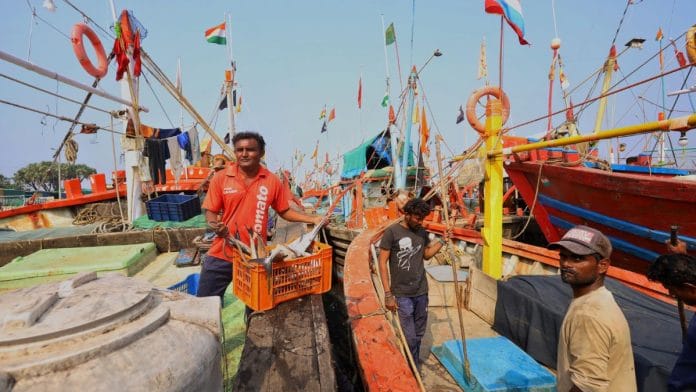
New Delhi: For six years now, Bangladesh has exported Hilsa, or the Queen of Fish, to India for Durga Puja celebrations. Across Bengal, Bangladeshi ilish has been a constant on plates. This year, however, the Hilsa might disappear, replaced by Gujarat’s Narmada Hilsa.
“For the last five years, we have been sending ilish from Bangladesh to Kolkata. But this year, there is very little ilish in Bangladesh, so there will be very little available for export,” said Kamal Das, owner of MDV Fish in Kolkata.
After the Sheikh Hasina government lifted the ban in 2019, tonnes of Hilsa were exported to India during Durga Puja.
In September 2024, 3,000 tonnes of Hilsa were exported. Exports came down to 150 tonnes last year, although the government had approved 1,200 tonnes for export.
This year, Hindustan Times reported that, following a request from traders, 1,200 metric tonnes of Hilsa are again to be exported.
But exporters are worried. “There is little to no hilsa catch in Bangladesh this year,” they told ThePrint.
Also read: Gujarat’s surprise hilsa boom feeds Bengal’s most prized appetite
Gujarat emerges as an alternative
With Bangladesh’s Hilsa catch dwindling, exporters have turned to alternatives over the past two months to meet demand.
Gujarat’s Bharuch has emerged as a hotspot for Hilsa over the past three years.
ThePrint has earlier reported that more than 4,000 tonnes of Hilsa were sent from Gujarat to eastern India. Exporters estimated that, if the sea catch is included, the total could rise to 6,000 tonnes.
“We first sent 400 tonnes of Hilsa from Howrah to Bangladesh, and then another 200 from Gujarat,” Das told ThePrint.
Das travelled to Bharuch with fish exporter Nadim Panja in July this year. So far, he has exported more than 200 tonnes of Hilsa to Bangladesh.
Panja, owner of Zenith Exports, was shocked to find that Gujarat’s Hilsa was being exported to Bangladesh.
By early September, India had exported around 500 tonnes of Hilsa to Bangladesh.
“In Gujarat, not many people consume this fish; I have packed around two truckloads of Hilsa to be exported to Bangladesh,” Panja told ThePrint.
Traders were expecting to move more than 150 tonnes in the coming week. However, the Bangladesh government on Tuesday evening said it was stopping Hilsa imports from India and Myanmar.
Bangladesh will halt fishing for 22 days from 8 October. The ban coincides with Durga Puja, casting a shadow over the prospect of the beloved Padma Hilsa making it to Bengali plates in India.
Even after 103 fish traders were permitted to import the fish, the Hilsa exported to Bangladesh was being sold for around Rs 1,500 per kg.
However, fish traders in Bangladesh told ThePrint that the catch is extremely low and not sufficient even for domestic consumption.
“Only a quarter of the usual catch happened this year,” said Khokon, owner of Satata Fish in Dhaka.
Gujarat vs Bangladesh Hilsa
Meanwhile, eastern India is seeing a growing debate over which Hilsa tastes better. Exporters, while welcoming an alternative source, rank Gujarat Hilsa lower.
“Padma Hilsa tastes so much better than Gujarat; there is no match,” said Das.
Much of the Hilsa in Kolkata’s markets now comes from the western coast. Gujarat’s catch is largely directed towards the Bengal market.
A shift began in 2024, with a sudden increase in the Hilsa catch in the Narmada River in Bharuch. It was a revival after decades of little or no Hilsa in the river in Gujarat.
Hilsa holds emotional and cultural importance for Bengalis and has a special place in Bangladesh. The sudden rush of Gujarat Hilsa, however, has turned out to be a disappointment for some consumers.
“The taste of Hilsa has deteriorated over the years,” Deboshree Mondal, a resident of Howrah, told ThePrint.
Mondal used to look for Bangladeshi Hilsa in the market, but in recent times, her family has struggled to find it.
“The essence of the fish is gone,” emphasised Mondal.
(Edited by Maryam Hassan)