


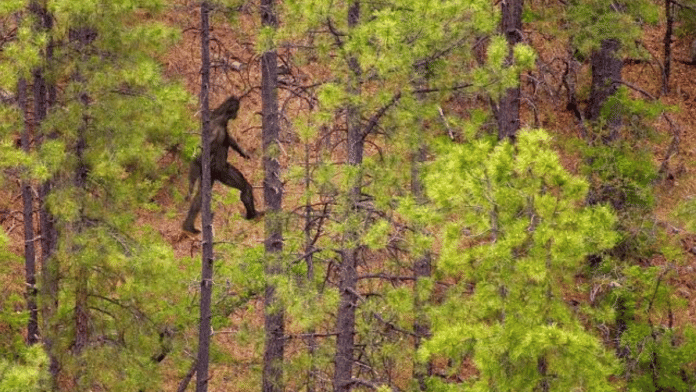
New Delhi: After decades, the United States Forest Service has finally released secret files on Bigfoot—a legendary, large and ape-like creature, which resides deep in the forests of North America. The public files also include recent sightings of the mythical beast, also known as Sasquatch, prompting widespread speculation, superstition and controversy.
It all began when the agency quietly uploaded three historical documents under the heading “Bigfoot/c Records” to its Freedom of Information Act Reading Room website on 15 October. The documents include an investigation from 1982 that dug into both mysterious footprints found in Oregon and accounts from 1980 of alleged encounters in Montana.
The agency had also hosted an event called Bigfoot in Your Backyard at California’s Stanislaus National Forest on 8 October, The Washington Post reported. At the event, agents discussed alleged sightings and the creature’s significance in local folklore, but also emphasised that the agency “cannot confirm or deny the existence of Bigfoot”.
What do the government records reveal?
The most detailed document covers an investigation conducted after forest patrolman Paul Freeman reported encountering a large, hairy creature in Oregon in 1982.
Freeman pointed to unusual footprints he discovered shortly after the sighting as proof, which prompted wildlife biologist Rodney Johnson and a US Border Patrol tracker to photograph the tracks, measure them and produce plaster casts as part of an elaborate investigation.
While Johnson acknowledged the intricate details contained within the prints, he ultimately concluded that they were unlikely to have been produced by a large, two-legged animal, describing them as “a very clever attempt to perpetrate a hoax”.
The other records include a newspaper report of alleged sightings from Montana in 2003, and an account of odd sights and smells at a certain creek dated to 1980, again in Montana.
Despite their scant nature, the developments have nevertheless excited Bigfoot enthusiasts, as they hope the government will become more willing to discuss alleged sightings in the future.
“I’m hoping what this means is that they could be ramping up government entities to start releasing information about Bigfoot,” Jeremiah Byron, host of the Bigfoot Society podcast, told The Washington Post.
What does science say?
Despite decades of reported encounters, there is no scientifically verified evidence that Bigfoot exists.
A study published in 2014 in Proceedings of the Royal Society B analysed DNA from 30 hair samples attributed to Bigfoot and other supposedly undiscovered primates, which were then traced to known animals, including bears, wolves and cows.
The latest Forest Service disclosures, therefore, offer an insight into how authorities historically investigated unusual sightings, rather than any sort of confirmation of the existence of the legendary creature.
(Edited by Insha Jalil Waziri)