





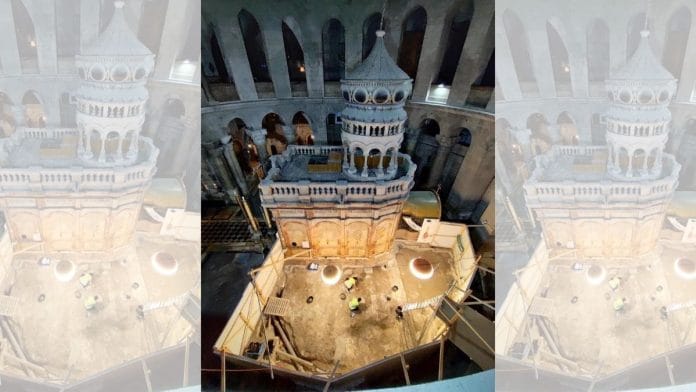

New Delhi: Archaeologists excavating beneath the Church of the Holy Sepulchre in Jerusalem say they have uncovered new evidence that appears consistent with Gospel accounts of where Jesus may have been crucified and buried — although they stop short of making a definitive claim.
“We have found evidence of a funerary landscape,” lead archaeologist Francesca Romana Stasolla, of the Sapienza University of Rome, told the Daily Mail.
The team led by Stasolla excavated an ancient burial area beneath the church. They uncovered rock-cut tombs, cultivated land and evidence of a garden. The excavation began in 2022 during floor restoration work at the church and continued through 2025. The findings were later published in the Jerusalem archaeological journal Liber Annuus.
The Church of the Holy Sepulchre is a fourth-century Roman church built over a site traditionally believed to be the place where Christ was crucified, buried and later resurrected on Easter Sunday.
Researchers also say they have found traces of olive trees and grapevines dating to around 33 AD, the approximate time of Christ’s death.
Stasolla said the findings are parallel with the description in the Gospel of John, which describes a garden near the crucifixion site containing a “new sepulchre, wherein was never man yet laid”.
Stasolla’s team also identified cultivated fields between the site traditionally identified as the place of the crucifixion and the tomb.
What the excavation reveals
Stasolla and her team have, however, been careful not to frame their findings as proof of the Biblical account. The researchers still have geological testing to conduct on the marble tombs and mortar, while a portion of the church’s northern aisle remains to be excavated.
The rock-cut tombs also bear similarities to the burial descriptions in the Gospels of Matthew, Mark and Luke. The site itself was located outside Jerusalem’s city walls during Jesus’s lifetime, another detail that is consistent with the Biblical narrative.
Archaeologists have additionally identified marble tombs on the Church grounds that they believe connect to Joseph of Arimathea, the figure who, according to the Bible, provided the burial plot for Jesus.
Stasolla also pointed out that, regardless of the site’s historical authenticity, it has been treated as sacred and used as a pilgrimage site for centuries. The history of worship surrounding the site, she suggested, is itself significant and worth documenting.
A claim researchers are treating with caution
Researchers and academics have been cautious about presenting the discovery as yet another “Jesus tomb” claim, particularly as further testing of the marble and mortar is still pending.
The Church of the Holy Sepulchre, however, is not the only site associated with the story of Jesus – it has a rival, the Garden Tomb.
The Garden Tomb was identified in the late 19th century outside Jerusalem’s Damascus Gate and has remained the subject of debate between archaeologists.
This is not the first time a “Jesus tomb” claim has made headlines. A 1980 discovery in East Talpiot, later popularised through a 2007 book and documentary, claimed that ossuaries bearing the names “Jesus,” “Mary” and “Joseph” belonged to the Holy Family – a theory that was widely dismissed by biblical scholars and archaeologists alike.
Stasolla’s team appears keen to avoid a similar interpretation, presenting the new findings as corroborative evidence rather than conclusive proof.
(Edited by Maryam Hassan)