





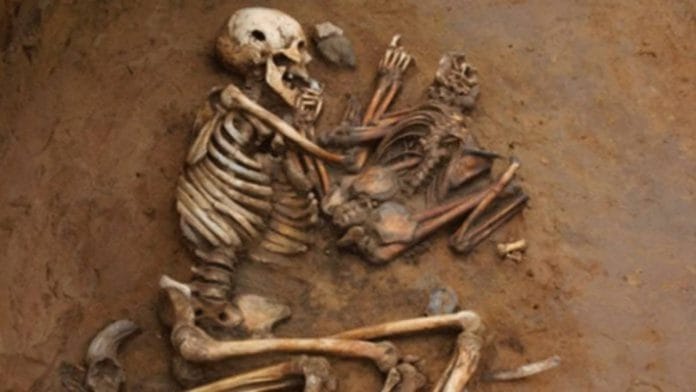

New Delhi: When veteran archaeologist Vasant Shinde’s team excavated 70 burials at the Harappan site in Haryana’s Farmana in 2006, they made a rookie mistake. They had left the remains open to the elements for two months, and whatever DNA had survived for 4,500 years in the soil promptly escaped into the air.
“When no DNA was found, we had realised that we have failed miserably,” he said, to muted laughter from the audience at the India International Centre on Tuesday, where he was speaking at IIC’s classical series lecture, ‘Indian Archaeology: Evolution of Bharatiya Knowledge System: An Archaeological Perspective’. His admission of failure offset a lecture that was otherwise grand in its claims about Harappan ancestry across the subcontinent.
Shinde, former vice-chancellor of Deccan College, Pune, and one of the lead excavators of Rakhigarhi, the largest known Harappan site, argued that most people living between Ladakh and the Andaman Islands, between Bengal and Afghanistan, are, in some measurable genetic sense, descendants of the Harappans.
The event was chaired by IIC Director KN Shrivastava, with former ASI Director (Monuments) Pratap Bhanu Singh Sengar moderating. A mix of scholars, historians, retired civil servants, engineers, and curious regulars of Delhi’s IIC circuit filled the basement hall.
Shinde opened with a familiar civilisational comparison: why did the Harappans not build pyramids? And then promptly provided the answer. The Egyptians and Mesopotamians had monarchies, slave labour, and standing armies, he argued, while the Harappans had something closer to a democratic system.
“Whatever was created in Egypt and Mesopotamia was only for the kings and queens,” he said. “But whatever the Harappans created was for the people.”
In his telling, the lack of huge, monumental architecture was never a matter of capability, since the Harappans were the finest civil engineers of the ancient world, equipped to build well-planned cities.
Shinde described them as a civilisation that chose welfare over spectacle. He pointed to terracotta figurines from Harappan excavations that he said show early evidence of yoga postures, which are practised to this day.
“More than 170 countries follow this particular tradition today,” he said, citing yoga’s global spread as a measure of the Harappan knowledge legacy.
The centrepiece of the evening, though, was the DNA research that challenged the Aryan invasion theory, as well as the debate that followed.
Also Read: Meet Alok Tripathi — Modi government’s go-to archaeologist, Gyanvapi to Dwarka
The Harappan ‘lady luck’
After the Farmana debacle, Shinde’s team regrouped with Korean scientists, who advised them to excavate one burial at a time, pack samples immediately, and have everyone in PPE.
This method was put to work at Rakhigarhi but was almost undone when the team discovered East Asian genetic markers in one sample, leaving them confused. The sample was later traced to a Korean student who had been working in the trench.
“In spite of taking so much care, the DNA escaped and got into the sample. This explains how sensitive it is,” Shinde said.
Of 62 burials excavated, 61 yielded nothing. The one that did was a woman, 30 to 35 years old, buried with enough pottery to suggest that she had a degree of social standing.
Shinde describes her with evident affection.
“She was very beautiful because she had very sharp features,” he said. “We thought that she is our lady luck.”
The sample from her skull was analysed in parallel by three institutions: the Centre for Cellular and Molecular Biology in Hyderabad, a Korean lab, and Harvard Medical School’s ancient DNA facility, the largest of its kind in the world.
The results, published in 2019 in Cell, one of the world’s foremost scientific journals, carried a title that functioned as a rebuke to a long-standing academic argument that a Bronze Age migration of Steppe pastoralists (the so-called Aryans) from Central Asia brought Indo-European languages, culture, and genes into South Asia.
In Shinde’s findings, there was no Steppe ancestry in the Harappan-era genome. “An ancient Harappan genome lacks ancestry from Steppe pastoralists or Iranian farmers,” the title read.
Using genetic chronology, the team traced the roots of the Harappan woman’s DNA back to around 10,000-12,000 BCE, to a population of hunter-gatherers on the Iran-Afghanistan border who had split into two groups. One went to Iran and mixed with other populations. The other came to South Asia, where its genes mutated in isolation over millennia into what researchers now call “Ancient Ancestral South Asian” DNA — a distinct genetic signature that, the research claims, forms the dominant ancestral component in most people across the subcontinent today.
“From Andaman-Nicobar to Ladakh and Kashmir, from Bengal to Afghanistan, 20 to 25 per cent of Harappan genes continue in our population,” Shinde said.
Also Read: Nalanda’s end was more complex than the popular version, says William Dalrymple
A loaded debate
Pushback came, but Shinde said he had anticipated it.
The research was celebrated by some as a blow to the Aryan invasion theory and criticised by others as being stretched beyond what one ancient genome could prove. Some critics argued that it did not rule out later Steppe migration into South Asia. Others accused the researchers of tailoring their findings to a political agenda.
“The data is in the public domain. Anybody wants to check, it is available,” Shinde said.
What Shinde accepted as a more “valid critique” of his research was that sweeping conclusions cannot rest on a single individual’s genome. He chose to address it with a metaphor.
“It is like tasting rice. Whether rice is cooked or not, we pick up only one grain,” he said.
The data was sufficient for a hypothesis, even as he acknowledged more was needed.
Shinde also talked about a facial reconstruction project, the first of its kind for the Harappan period, in which CT scans and bone measurements from Rakhigarhi burials were fed into a modelling programme developed jointly with Korean scientists. The results, he said, showed faces that were not much different from modern people.
The lecture closed with Shinde quoting Lord Macaulay’s disputed “backbone of this nation” speech, in which the British politician is said to have declared that India could only be conquered by breaking its spiritual and cultural heritage. Shinde did not dwell on whether Macaulay actually made the speech, but used it to support his argument that British education policy deliberately disrupted the transmission of indigenous knowledge.
(Edited by Asavari Singh)
When a piece of writing clearly shows a reporter has a thumb on the scale, it completely destroys any claim to neutrality or objectivity.
Real journalism is supposed to give you the facts and lay out different viewpoints without resorting to cheap mockery or subtle derision. When a writer relies so heavily on loaded framing, like dragging up a “botched dig” from twenty years ago or reducing a massive scientific milestone down to a single student’s contamination mistake, it stops being detached reporting. It is just a calculated attempt to steer how the audience thinks.
By front-loading old failures and obsessing over the critics instead of giving fair weight to the groundbreaking work of extracting ancient DNA in a harsh tropical climate, the blogger openly signals a deep religious and ideological bias. Anyone who is trained to look at data integrity, spot anomalies, and see where a narrative is being forced can see through this kind of manipulative framing instantly.
At the end of the day, it does not matter if a journalist claims they are just playing devil’s advocate or asking tough questions. The tone they choose exposes their actual agenda. When that tone leaks heavy cynicism against one specific finding while giving a total pass to the old orthodoxy, the pretense of objective journalism is completely dead.