





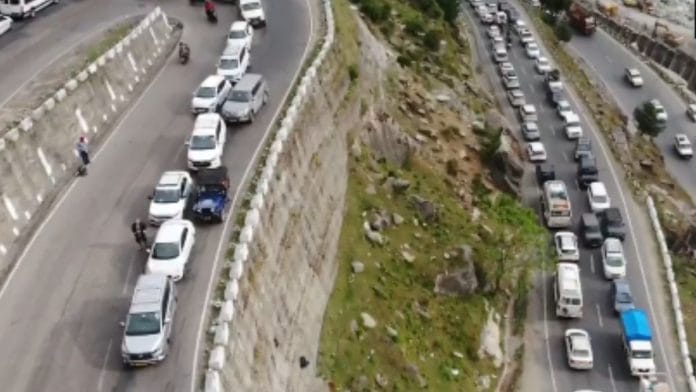


New Delhi: As north India reels under a severe heatwave, hill stations across the country are witnessing a sharp surge of tourists seeking relief from soaring temperatures—bringing with it hours-long traffic snarls, packed hotels and overcrowded roads.
From Shimla and Manali in Himachal Pradesh to Darjeeling in West Bengal, Gangtok in Sikkim and Kodaikanal in Tamil Nadu, social media is flooded with viral reels. Posts on X show bumper-to-bumper traffic, tourists stranded on highways and vehicles crawling slowly through mountain roads.
Tourists are reportedly stuck in kilometre-long jams on roads leading to Shimla and Manali. Some X users joked that they spent more time in traffic than sightseeing. Similar scenes have emerged from hill destinations in Uttarakhand and the Northeast as people flee temperatures crossing 45 degrees Celsius in parts of Delhi, Rajasthan, Punjab, Haryana and Uttar Pradesh.
The rush has translated into packed hotels and rising occupancy rates across several tourist hotspots, even as the strain on narrow roads and limited parking spaces becomes increasingly visible.
“What’s even the point of vacations if you’re stuck in 10 km traffic jams for hours? Right now it feels more like torture than a holiday,” a user on X wrote.
In Shimla, police data showed that about 1.54 lakh vehicles entered the city in a week, while over 70,000 vehicles moved between Solan and Shimla in just three days, underscoring the scale of the summer surge.
A tourist rush has also been reported in Darjeeling, with severe traffic congestion of 15-20 kilometres, while Kodaikanal has seen kilometre-long queues and traffic pile-ups at entry points. In Sikkim, viral footage from the Zero Point route has shown long queues of vehicles inching uphill as tourists flock to cooler high-altitude destinations.
Tourist influx
Rajinder Thakur, assistant manager at Hotel Holiday Home in Shimla, said the hotel has been operating at near-full capacity for the past two weeks as tourists continue pouring into the city.
“The hotel has been at maximum capacity since the last two weeks with more than 80 per cent occupancy,” Thakur said. “This is a yearly trend. Most of the tourists are coming from north India itself, Delhi, Punjab and Haryana, but there are also people coming from far like West Bengal and Odisha.”
According to him, traffic congestion has now become one of the biggest concerns for travellers planning trips to hill stations during the summer months.
“We get calls immediately after people book the hotels asking when and how they should come, also trying to understand how bad the situation is,” he said. “But we have not received any cancellations.”
Even as tourists continue arriving in large numbers, Thakur said the issue of congestion has steadily worsened over the years. “This issue of traffic has been increasing year by year and there seems to be no solution,” he said.
Also read: India and the problem of toxic liquor. 5 worst hooch tragedies in 10 years
Exaggerates chaos
The situation has once again brought attention to the growing strain mass tourism places on hill towns every summer. Narrow mountain roads, limited parking spaces and infrastructure designed for much smaller populations are often unable to handle the seasonal surge in vehicles, especially when the rush coincides with heatwave-driven travel demand.
In several cases this year, authorities have had to step up traffic management measures and regulation orders to handle the pressure.
However, police officials in Shimla said that while there has been a tourist rush, social media videos often exaggerate the scale of the chaos on the ground. Ajay Bhardwaj, DSP (Traffic), Shimla Police, said the perception created online does not fully reflect the actual situation in the city.
“The reels and the outrage on social media do not match the ground reality,” Bhardwaj told ThePrint. “There is no traffic today and the situation has been more or less in control”.
Still, officials acknowledged that managing tourist traffic during peak summer months remains a challenge because infrastructure expansion in hill towns is limited.
“We can’t take any measures to control cars and traffic that come during the summer months, we can’t increase the number of parking spaces or infrastructure, so we just manage,” Bhardwaj said.
He added that authorities are focused on facilitating tourism rather than discouraging visitors. “We are only welcoming tourists; we are not telling tourists not to come,” he said. “We even allowed tempo travellers into main Shimla, and we haven’t faced any issues”.
The annual summer migration to hill stations has intensified in recent years as worsening heatwaves, improved road connectivity and social media-driven travel trends push more people toward mountain destinations. But as tourist numbers continue rising every year, many hill towns are increasingly finding themselves trapped between the economic benefits of tourism and the growing pressure it places on local infrastructure.